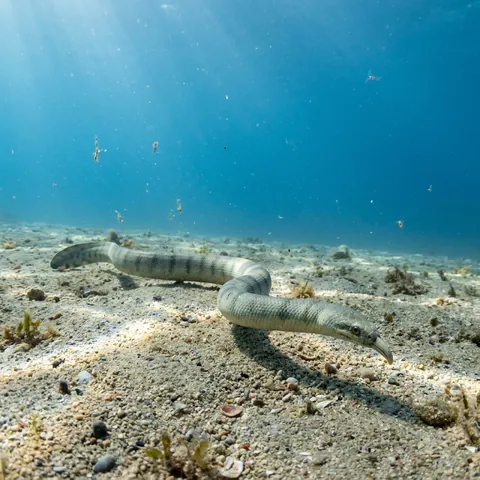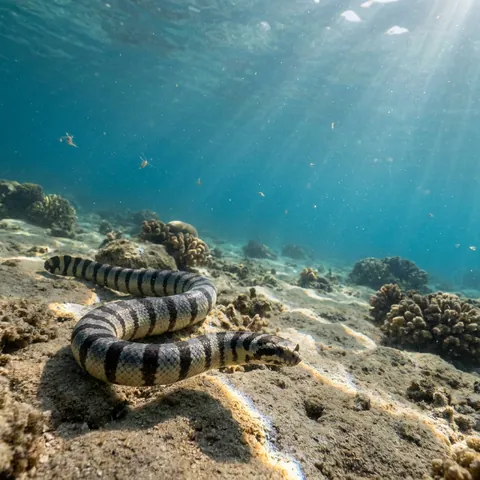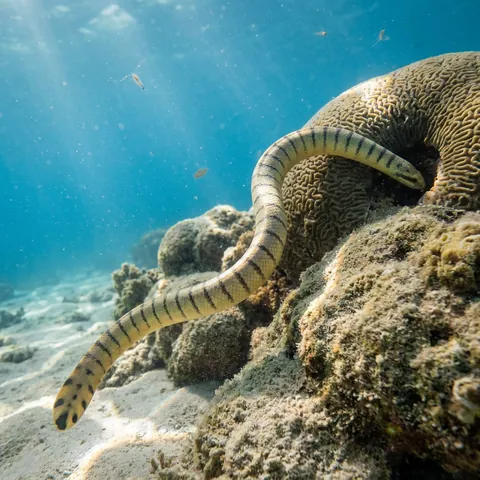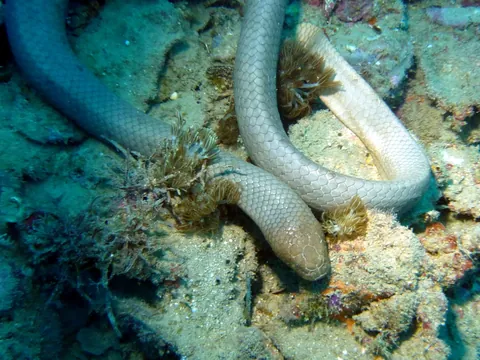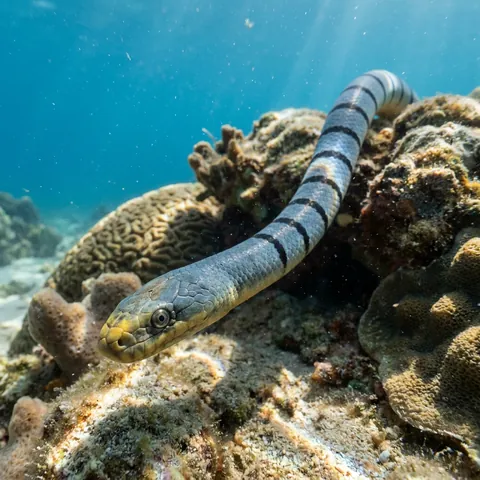
Banded Sea Krait
Laticauda colubrina
Hydrophis platurus
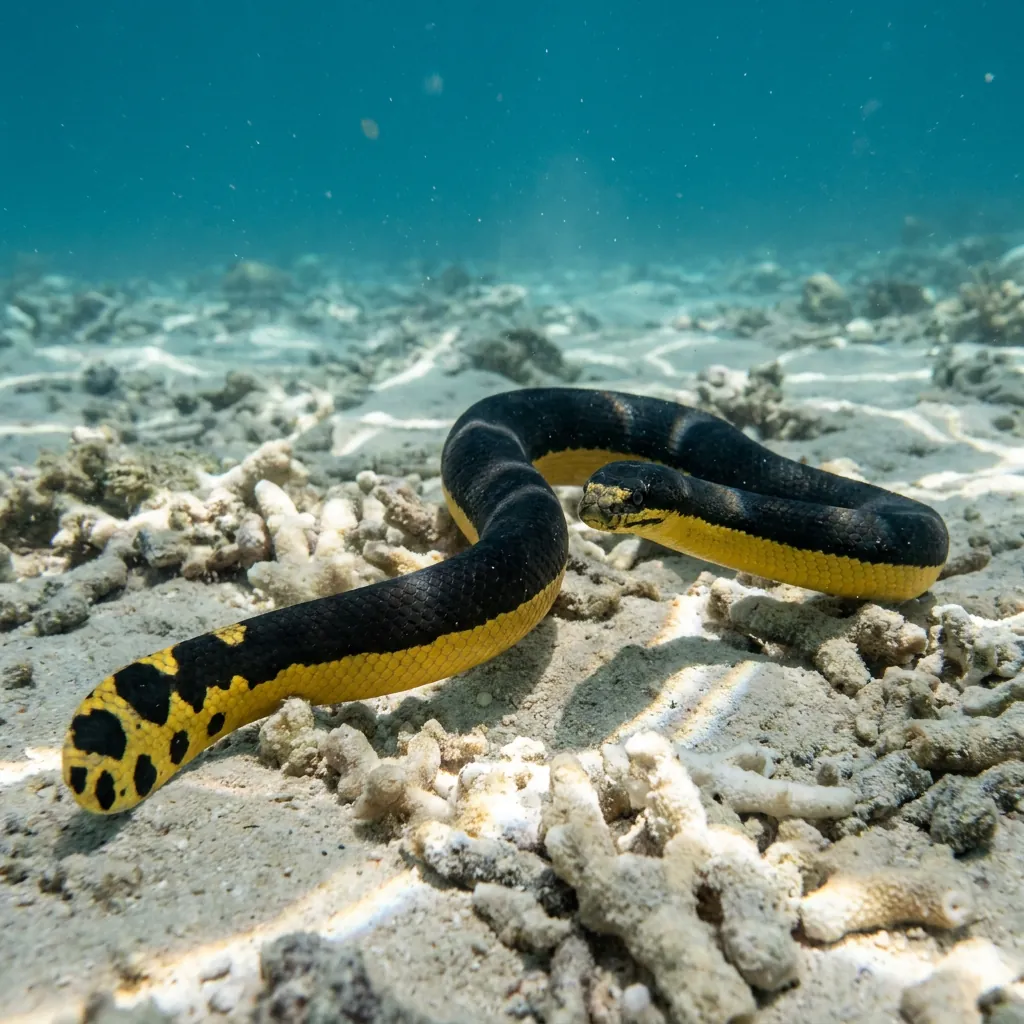
The yellow-bellied sea snake never needs to come ashore. It mates, feeds, and gives birth entirely at sea, drifting on ocean currents far from any coast.
Also known as: pelagic sea snake, yellowbelly sea snake
At the surface it can be mistaken for an eel, but the paddle-shaped tail and sharp black-and-yellow bicolour pattern belong to no eel species; any snake-like animal showing this crisp two-tone pattern far from shore is this species.
This snake has a laterally compressed, ribbon-like body and a flattened, paddle-shaped tail built for swimming rather than crawling. Its pattern is sharply bicoloured: black or brown along the back, with a bright yellow underside, the two colours meeting in a crisp line along the flank.
This is a fully open-ocean species, drifting along surface currents and storm-driven drift lines rather than living on the reef or seabed. It has one of the widest ranges of any snake, spanning the tropical Indo-Pacific, and is sometimes found around floating mats of sea kelp.
It hunts by floating motionless at the surface, using its body to attract small fish looking for shelter, then striking with a sudden backward swimming lunge. It is sometimes seen in huge aggregations of drifting individuals along ocean drift lines. Despite carrying potent venom, it is not aggressive and only defends itself if handled or threatened.
It hunts by striking backwards, lunging its jaws in reverse to snatch prey that gathers in its shadow, a swimming strike unlike that of any other sea snake.
Describe what you saw and we name it, then keep every species you find in your Oceandex.