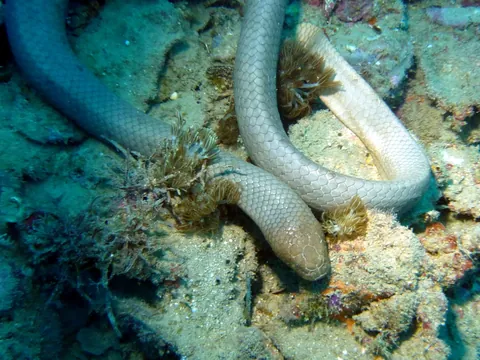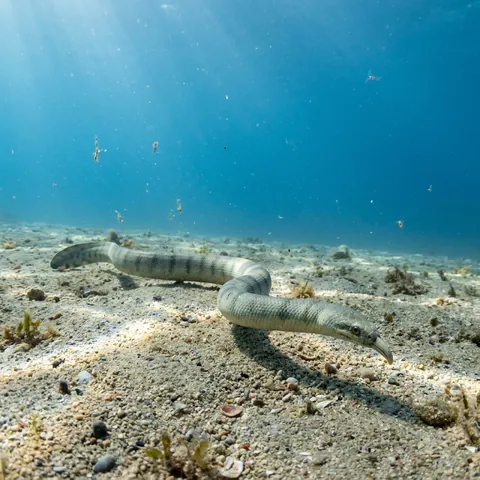
Beaked Sea Snake
Hydrophis schistosus
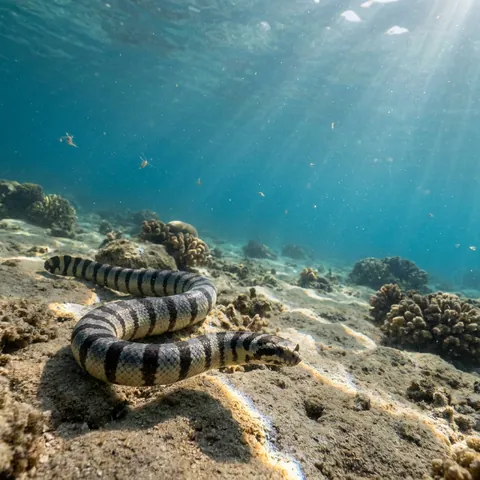
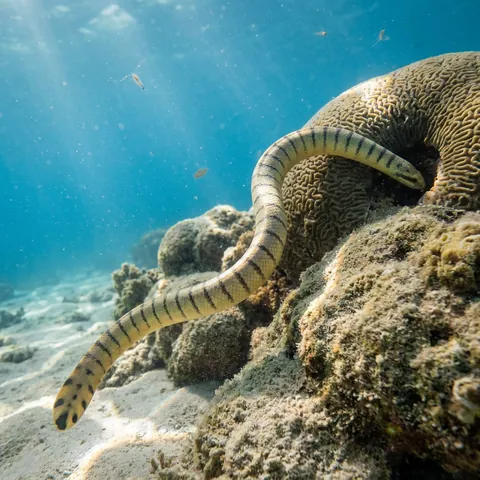
Laticauda colubrina
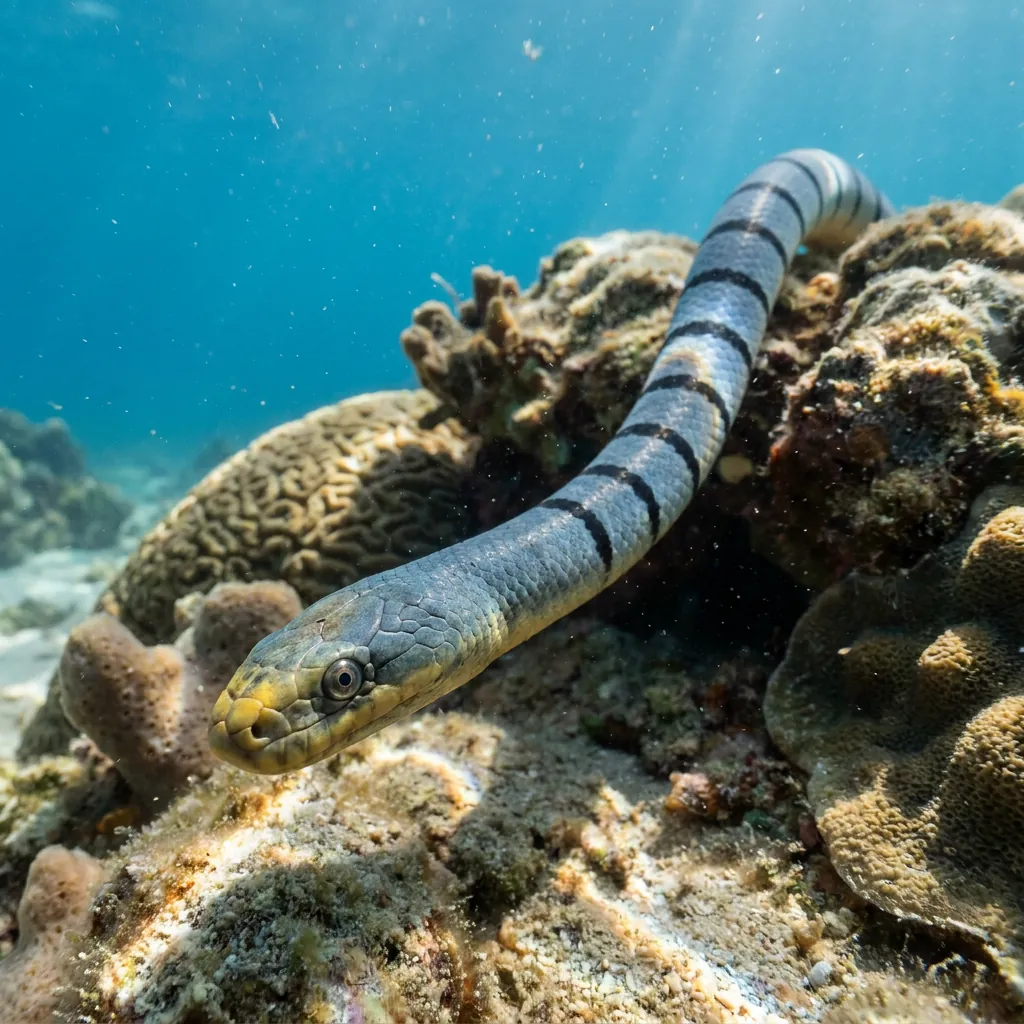
The banded sea krait leads a double life: a venomous sea snake that hunts underwater but comes ashore to rest, digest, and lay its eggs. It is one of the few reptiles a diver is likely to meet on a tropical reef.
Also known as: banded sea krait/yellow-lipped sea krait/amphibious sea snake, banded seakrait, colubrine sea krait, columbrine sea krait, laticauda colubrina, yellow-lipped sea krait
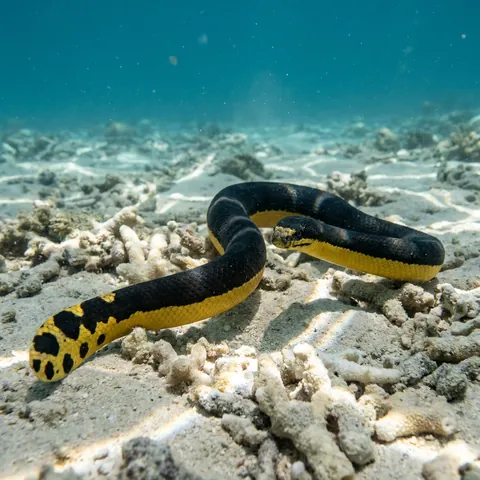
This species is easily confused with its close relative, the blue-lipped sea krait (Laticauda laticaudata). Check the snout and upper lip: on the banded sea krait they are yellow, not blue.
This snake has a black head with a yellow snout and upper lip, and the yellow extends back above the eye. Its body is bluish grey above and yellowish below, ringed by even black bands that narrow or break up on the belly. The tail is flattened like a paddle for swimming.
The banded sea krait is found across the eastern Indian Ocean and western Pacific, from India and Southeast Asia to southern China, Japan, and the Pacific islands. It rests in crevices on fringing reefs near the water's edge, forages in the open ocean, mangroves, and shallow coral-island waters, and shelters on land among rocks, vegetation, and caves.
This sea snake is semiaquatic: juveniles stay in the water and along the coast, while adults split their time between land and sea. Its venom is a powerful neurotoxin, but the snake is not aggressive and only bites when it feels threatened.
The banded sea krait hunts mostly alone, probing crevices and holes with its head to flush out prey, though it sometimes hunts alongside trevally and goatfish, which snap up anything that flees. It feeds mainly on eels, along with some small fish.
Mating takes place each year in the warmer months, when males gather on land and in shallow water at high tide. A male chases and courts a female, and several males may intertwine around one female for days before mating. The female lays up to 10 eggs per clutch, hidden away in crevices.
highly venomous but very docile — never handle
Even though it is common across its range, wild nests of this sea snake are almost never found - only two have ever been confirmed.
Describe what you saw and we name it, then keep every species you find in your Oceandex.