Amazonian manatee
Trichechus inunguis
Trichechus manatus
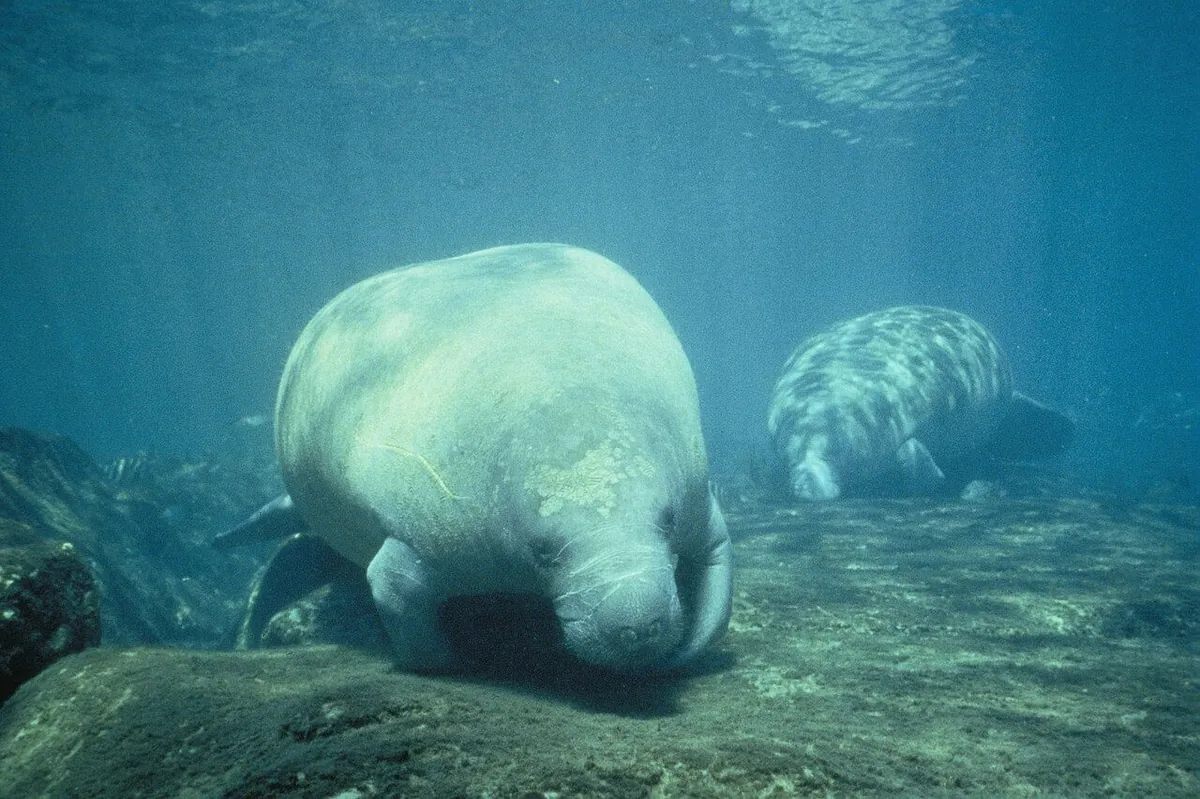
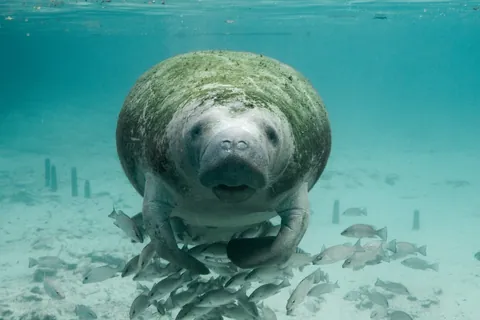
The West Indian manatee is a large, slow-moving mammal that grazes on underwater plants instead of hunting. It can grow to 390 cm long and weigh over 1,500 kg, making it one of the biggest animals a diver can meet in shallow water.
The easiest confirmation is what's missing rather than what's there: this animal has no rear flippers or fluke at all, just the single paddle-shaped tail described above, a shape no seal, dolphin, or shark shares.
The body is grey, thick-skinned, and streamlined, with sparse hair and no visible ear flaps. It has no hind limbs at all; instead, a single rounded, paddle-shaped tail drives it through the water. Skin colour can look patchy where algae or barnacles have grown on it, and old wounds leave lasting white scars.
Manatees live in shallow coastal waters, rivers, and estuaries, moving freely between fresh and salt water. Most stay in the upper 2 to 5 m, though they can dive to about 13 m. They need warm water and stay close to tropical and subtropical coasts.
Manatees are usually solitary, but gather in warm-water spots during winter and in temporary breeding herds. They evolved without natural predators, so they show little fear or escape behaviour. Their large size lets them make long, slow dives rather than fast ones.
Manatees eat only plants, grazing on seagrass and other water plants for five or more hours a day.
Males can breed from around 3 to 4 years old, females from about 3 to 5. When a female is ready to mate, several males gather around her in a breeding herd that can last two to four weeks.
harmless to humans (vulnerable — do not disturb or feed)
The West Indian manatee is listed as Vulnerable. Boat strikes are its biggest threat, causing over half of all recorded adult deaths, along with habitat loss and, in some areas, illegal hunting.
A manatee's molars keep wearing down from a lifetime of eating tough plants, so new teeth grow in from the back of the jaw and slowly push forward to replace them - dubbed 'marching molars'.
Describe what you saw and we name it, then keep every species you find in your Oceandex.