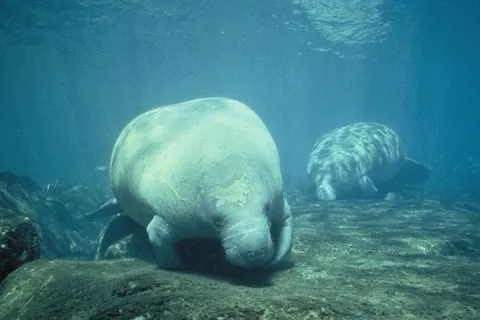
West Indian manatee
Trichechus manatus
Trichechus inunguis
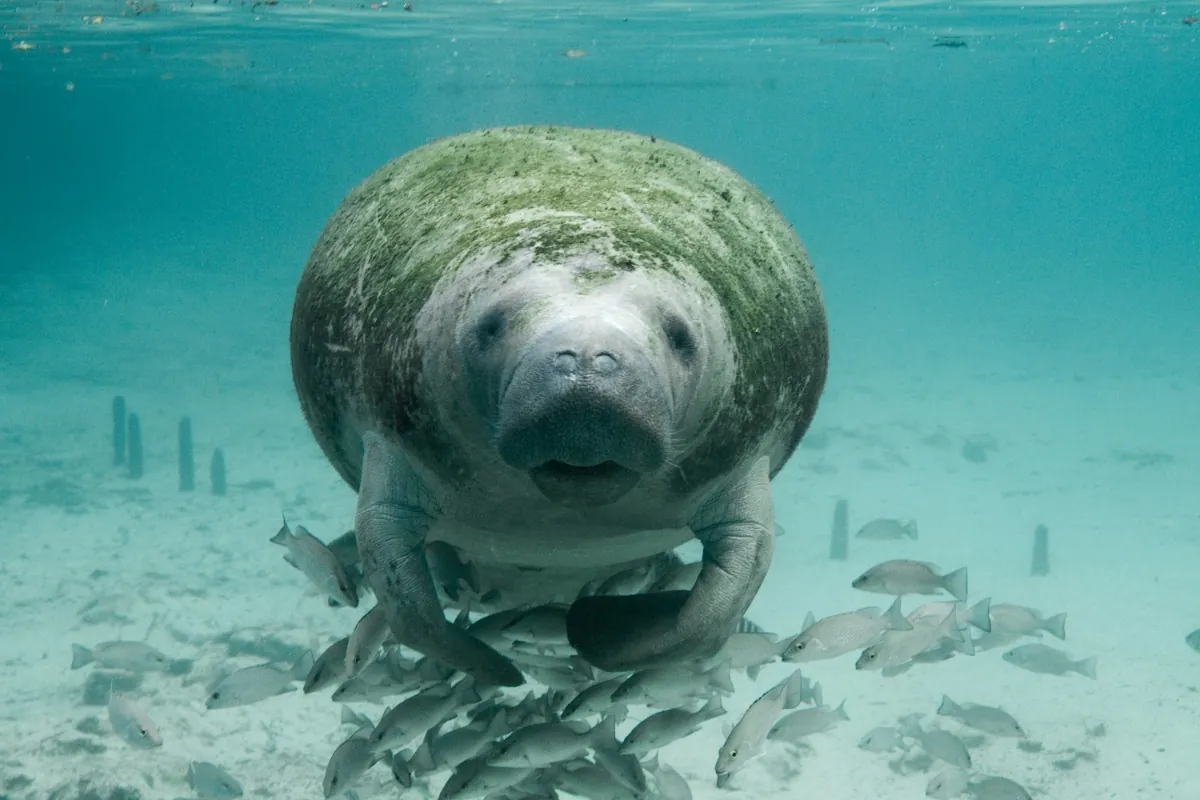
The Amazonian manatee is the smallest manatee species and the only one that lives entirely in fresh water. It can reach 300 cm long and 450 kg, and it spends its whole life gliding slowly through the rivers and flooded forests of the Amazon.
Its range overlaps the West Indian manatee's along the Brazilian coast, but a close look at the flippers settles it: the Amazonian manatee's flippers have no nails at the tips, while the West Indian manatee's do.
It has a large, cylindrical body, with front flippers and a broad, flat, rounded tail instead of back legs. Its skin is smooth and rubbery, coloured grey. Its upper lip is thick, bristly and split down the middle, and each side can move on its own while it feeds.
It lives throughout the Amazon River basin, across Brazil, Colombia, Peru and Ecuador. It favours calm, plant-choked backwater lakes, oxbows and lagoons connected to larger rivers, moving between flooded forest and open water as river levels rise and fall through the year.
The Amazonian manatee is slow-moving and mostly solitary, though small groups sometimes form. It breathes through nostrils that seal shut underwater, showing only its nose above the surface, and it can be active by day or night.
It feeds on floating and submerged water plants such as water hyacinth, water lettuce and grasses, along with fallen palm fruit. In the dry season, when water drops and food gets scarce, thick fat reserves and a slowed-down metabolism let it fast for long stretches with little or no food.
Breeding is seasonal, with most calves born as river levels start to rise. A calf stays close to its mother and continues to nurse for well over a year before becoming independent.
harmless to humans (endangered — sensitive to disturbance)
The Amazonian manatee is listed as vulnerable. Illegal hunting for its meat is the main threat, and it also faces habitat loss and the effects of a changing climate, made worse by how hard it is to survey in its murky home waters.
During the dry season the Amazonian manatee can go a long stretch eating little or nothing, living off stored fat while its metabolism drops well below the usual rate for a mammal its size.
Describe what you saw and we name it, then keep every species you find in your Oceandex.