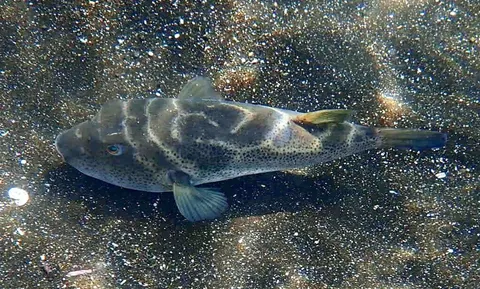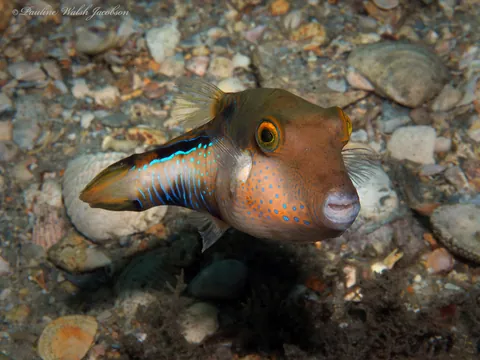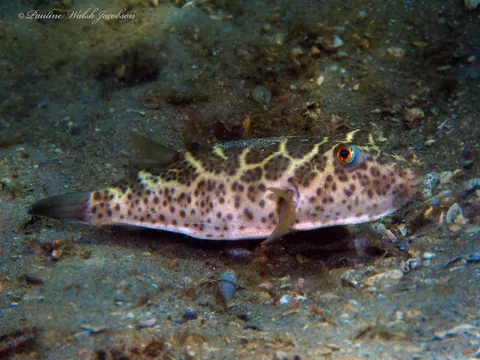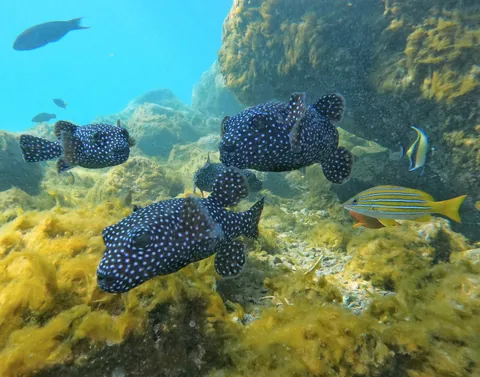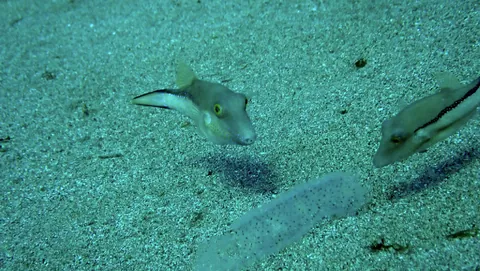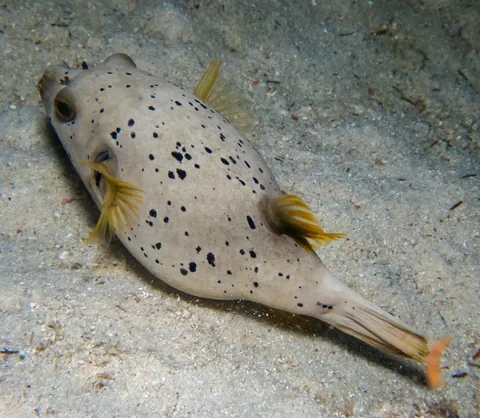
Blackspotted puffer
Arothron nigropunctatus
Canthigaster valentini
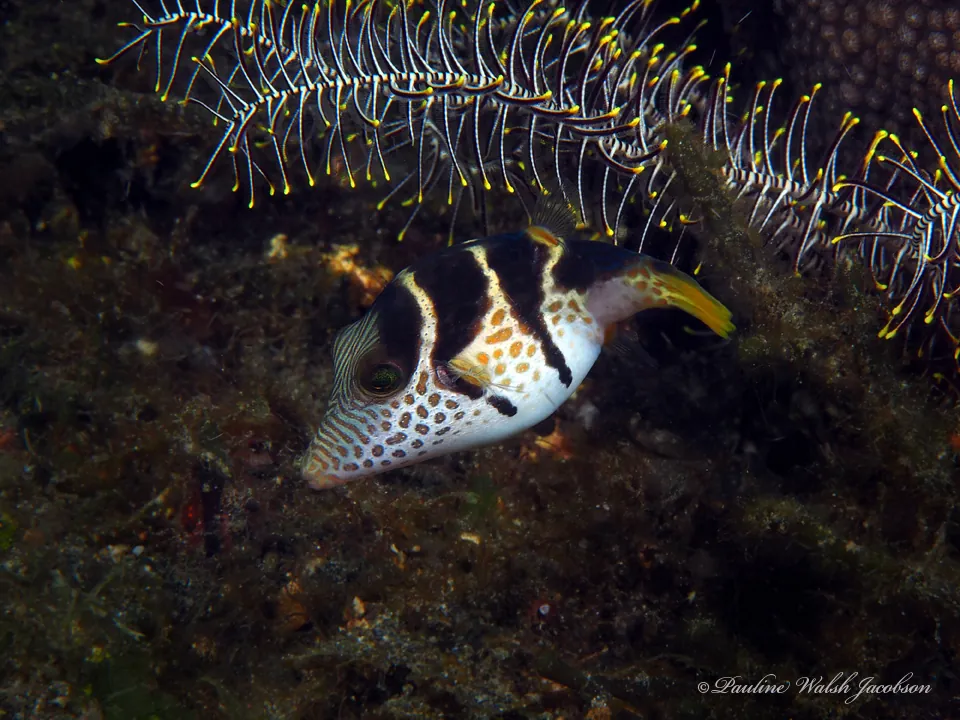
Valentin's sharpnose puffer is a small, brightly marked reef fish found across the Indian Ocean and into the Pacific, growing to about 11 cm. It is active by day and highly poisonous if eaten.
Also known as: black saddled toby, black-saddled toby, black-saddled toby, valentin's sharpnose puffer, model toby, saddleback pufferfish, saddled pufferfish, sharpnose puffer fish, valentini's sharpnose puffer, valentinni's sharpnose puffer, saddled toby, sharpnose puffer fish, black-saddled toby, model toby, valentin's sharpnose puffer, saddleback pufferfish, saddled pufferfish, black saddled toby, striped toby, valentin's sharpnose pufferfish, saddled puffer, blacksaddle toby
Look for a small white fish speckled with blue-grey spots and crossed by four bold black saddle-shaped bars on the back. A similar-looking filefish sometimes swims alongside it, but the filefish has a more slender, compressed body shape.
The head is blue-grey and the body is white, speckled with blue-grey spots. Four distinct black stripes, or "saddles", cross the back. The tail and fins show hints of yellow, with a streak of rainbow colour behind the eyes.
Dominant males hold a territory with several females and breed only with them. Females lay eggs on algae on coral rubble every four to ten days, and no parental care is needed afterwards because the eggs are unpleasant to eat and predators quickly spit them out. This species is sometimes seen shoaling together with a non-toxic filefish that mimics its colour pattern for protection from predators.
A harmless filefish, Paraluteres prionurus, mimics this puffer's colour pattern so closely that it can shelter within groups of the toxic puffer to avoid being eaten.
Describe what you saw and we name it, then keep every species you find in your Oceandex.