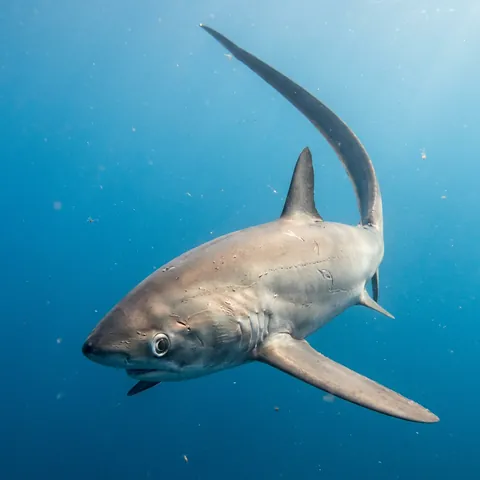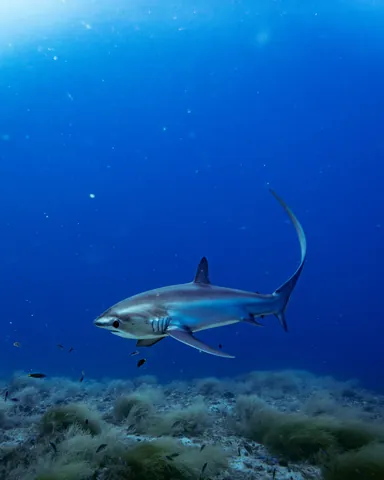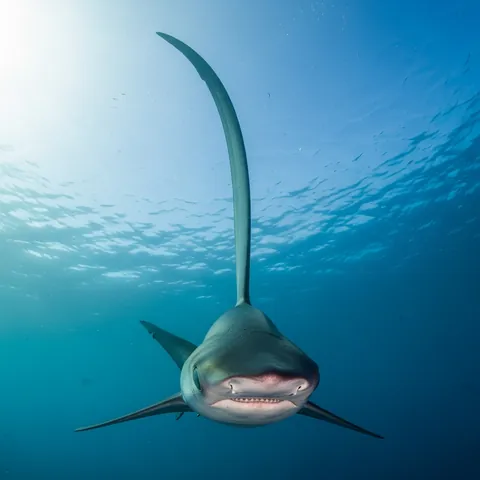
Big-eye shark
Alopias superciliosus
thresher_shark
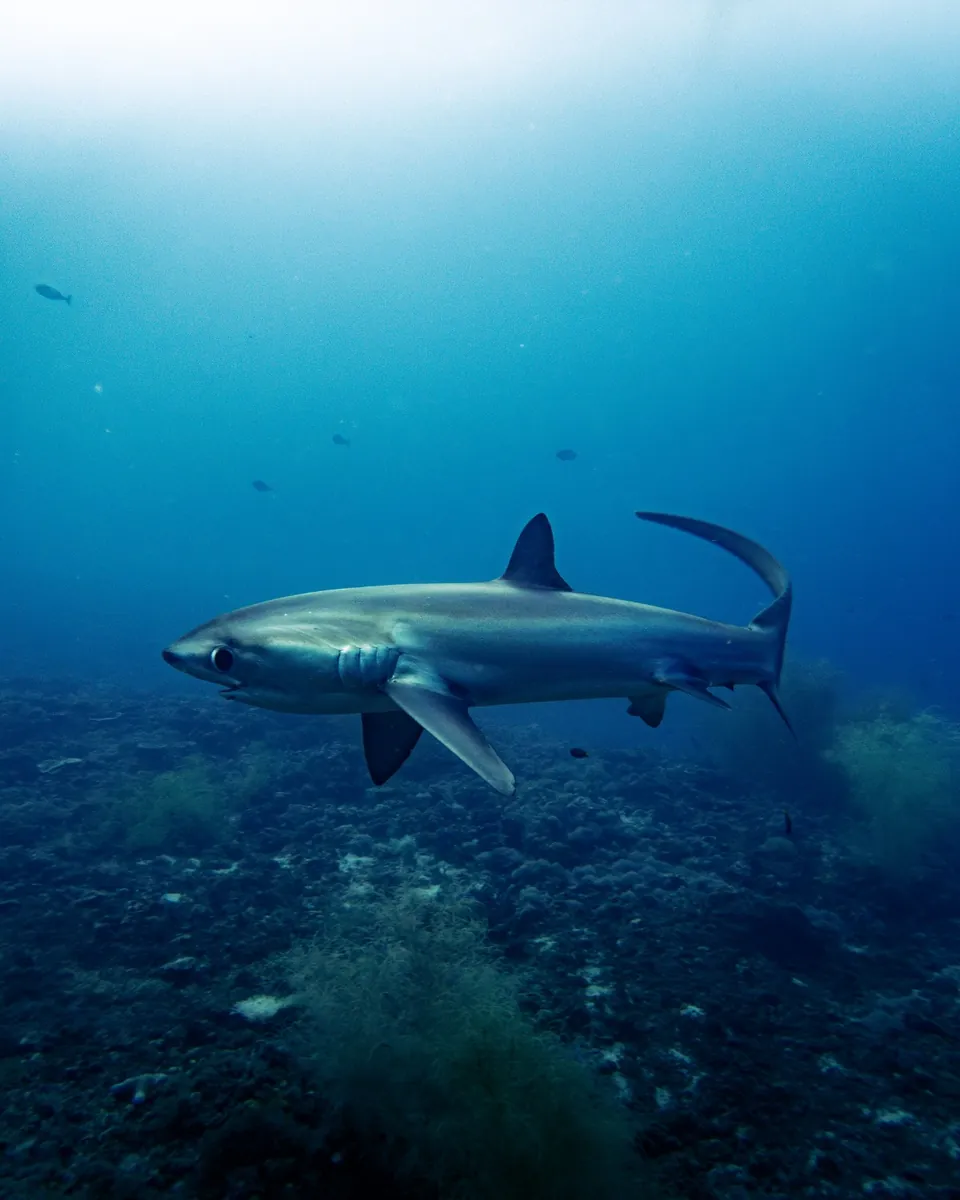
Thresher sharks are easy to spot by their huge, whip-like tail. In this app the group includes the Common Thresher and the Pelagic Thresher Shark.
A tail fin as long as the shark's own body marks a thresher shark; no other shark group shares this shape. The three kinds are best told apart by the colour on top of the body and by size.
The tail fin is the giveaway: it can be as long as the rest of the shark's body. Thresher sharks have a short head, a cone-shaped nose, and a small mouth. Their body is slender, with small fins on the back and large, curved side fins. Colour ranges from brown, blue, or purple-grey on top to a lighter shade underneath. The common thresher is the biggest, reaching up to 6 metres. The pelagic thresher is the smallest, at about 3 metres.
Thresher sharks mostly live in the open ocean, usually no deeper than about 550 metres, though one was seen much deeper in the Gulf of Mexico. Common threshers favour coastal waters over the continental shelf off North America and Asia. Pelagic and bigeye threshers are more common in warmer parts of the Central and Western Pacific.
Thresher sharks usually swim alone, though a few may hunt together in twos or threes. They travel long distances across the ocean. To catch schooling fish, a thresher whips the water with its long tail to stun them. Threshers are also one of the few sharks known to leap fully out of the water.
Thresher sharks feed on schooling fish such as bluefish, young tuna, and mackerel, plus squid and cuttlefish. They stun this prey first with a whip of the tail.
Thresher sharks give birth to live young, usually two to four large pups at a time. Before birth, the pups feed on their mother's unfertilised eggs inside her body. They grow slowly and do not reach breeding age for seven years or more.
harmless to humans (shy and elusive)
A thresher shark hunts by whipping the water with its own tail, which can be as long as its whole body, to stun schooling fish before eating them.
Describe what you saw and we name it, then keep every species you find in your Oceandex.