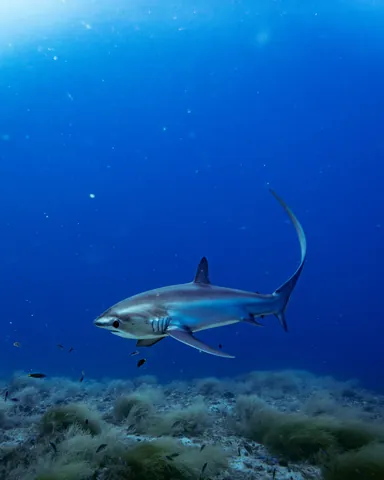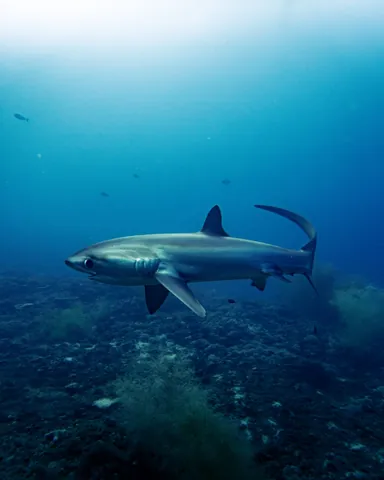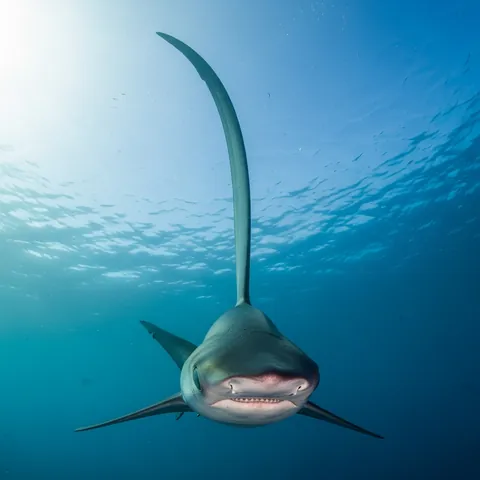
Big-eye shark
Alopias superciliosus
Alopias vulpinus
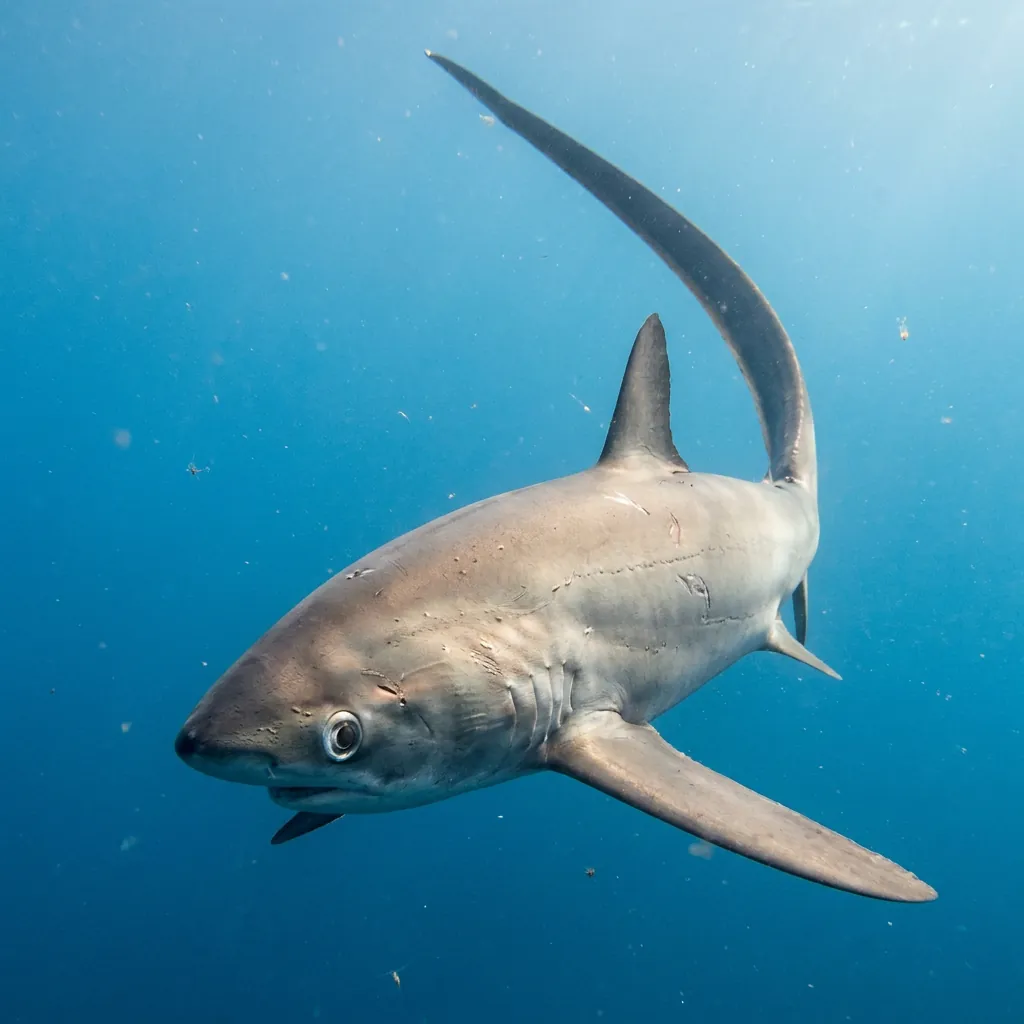
The common thresher is instantly recognisable by its extraordinary tail, whose upper lobe is nearly as long as the rest of its body. It can grow to 573 cm long and weigh up to 348 kg, and it roams open ocean worldwide.
It can be confused with other thresher sharks, which share the same long tail. A close look at the mouth settles it: the common thresher has small grooves at the corners of its mouth that other thresher species lack.
This shark has a solid, torpedo-shaped body, a short broad head and a pointed snout. Its pectoral fins are long and sickle-shaped, and the first dorsal fin stands tall, while the second dorsal and anal fins are tiny. Its most striking feature is the huge, thin upper lobe of its tail fin, held at a steep upward angle and roughly as long as the rest of the shark.
The common thresher is found in tropical and cool temperate seas worldwide, moving toward higher latitudes as warm water spreads with the seasons. It ranges from the surface down to about 650 m, though it usually stays in the upper 200 m.
It is a fast, powerful swimmer, occasionally seen leaping clear of the water. Special blood vessels keep its swimming muscles warmer than the surrounding sea, letting it sustain fast swimming for long stretches. It often hunts in pairs or small groups, herding schools of fish before striking.
Most of its diet is small schooling fish such as sardines, anchovies, mackerel and herring, along with occasional squid and larger solitary fish. It rounds up prey by circling and slapping the water, then uses its long tail to stun fish before eating them.
harmless
The common thresher is listed as vulnerable. Some regional populations have collapsed sharply from overfishing, and it continues to be caught both directly and as bycatch in trawls and fish traps, though catch limits now regulate some fisheries.
The common thresher's scientific name comes from the ancient Greek word for fox, after a legend that it protected its young by swallowing them, a story that was never actually true.
Describe what you saw and we name it, then keep every species you find in your Oceandex.