Emperors
emperors
Gnathodentex aureolineatus
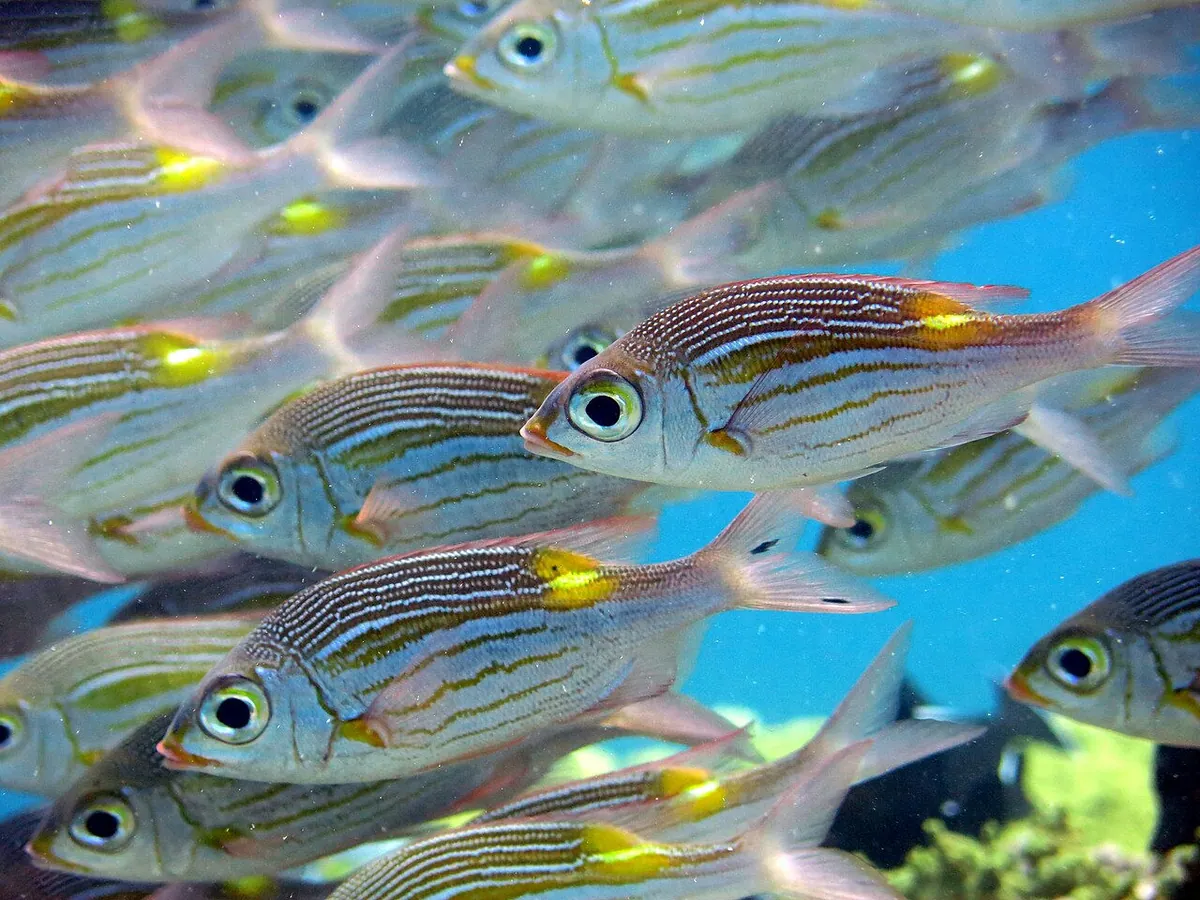
The striped large-eye bream is a silvery reef fish with big eyes, and those eyes tell you how it lives. By day it often does very little, alone or in a group over the reef, and sometimes a hundred or more gather together. It hunts at night, working over the bottom for crabs and sea snails, and now and then taking a small fish. It grows to about 30 cm, though 20 cm is more usual.
Also known as: goldspot emperor, yellowspot emperor, gold-lined large-eyed bream, gold-lined sea bream, goldspot seabream, goldlined emperor, golden-lined sea perch, gold-lined sea bream, glowfish, large-eye bream, gold-spot emperor, gold striped bream, striped large-eye bream, yellowspot emperor, glowspot sea-bream, goldspot emperor, gold-spot bream, gold-lined sea-bream, gold-lined seabream, striped large-eye bream, goldspot seabream, gold-spot emperor, gold-lined sea bream, gold-spot bream, glowspot sea-bream, glowfish
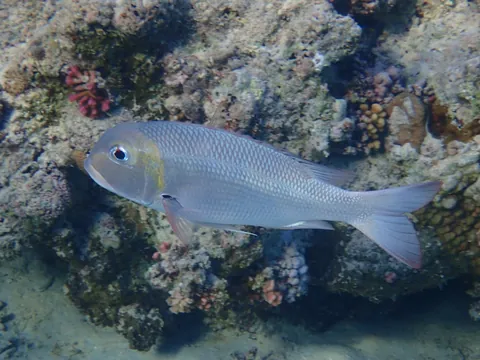
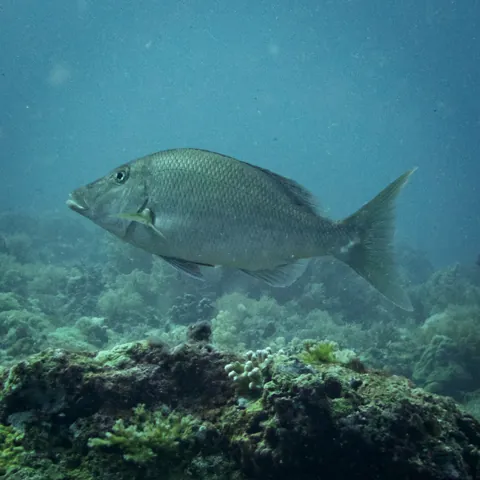
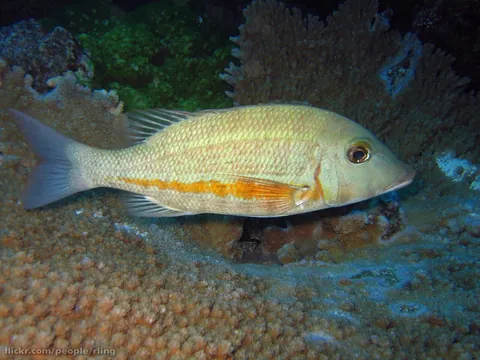
The one mark to check is that gold blotch near the tail stalk. It sits fixed in place and does not fade, unlike a fish's overall colour, so it works even at a distance or in poor light. The orange-brown stripes on the lower flank back it up.
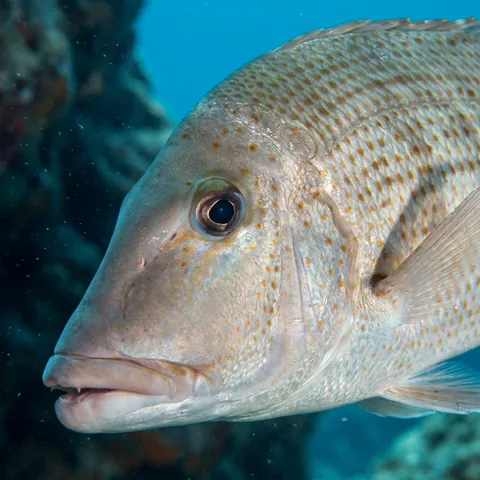
The body is fairly deep and the head slopes down gently to a pointed snout. The eye is large, about as wide as the snout is long. The back is brown and carries narrow silver stripes. The rest of the head and body is silver to grey, crossed on the lower flank by four or five brownish-orange stripes that run from front to back. There is a bright golden-yellow blotch high on the body, just under the back part of the dorsal fin and right in front of the narrow stalk that carries the tail.
The species lives in warm water across the Indo-Pacific, from the coast of East Africa to the islands of the Pacific, but not around Hawaii and not in the Red Sea or the Persian Gulf. It stays close to the reef itself: shallow reef flats, lagoons, and seaward reefs and their slopes. It is recorded from 3 to 30 m.
Its scientific name, aureolineatus, means "gold-lined" - a direct nod to the orange-brown stripes running down its lower body.
Describe what you saw and we name it, then keep every species you find in your Oceandex.