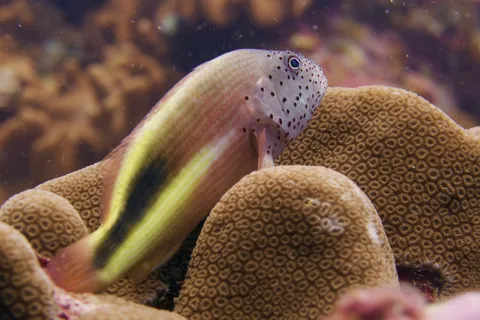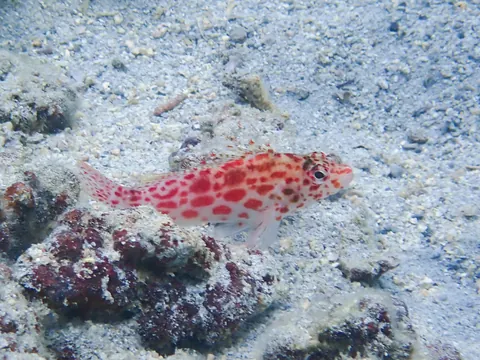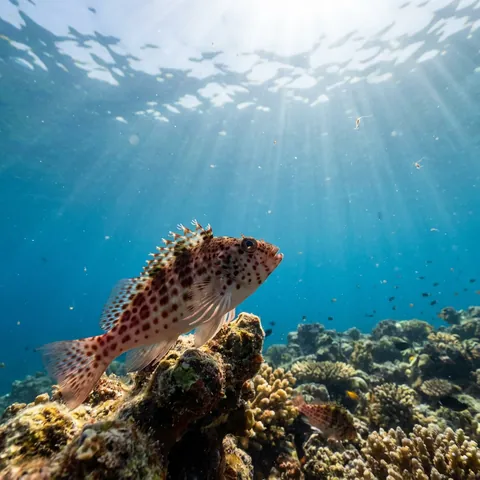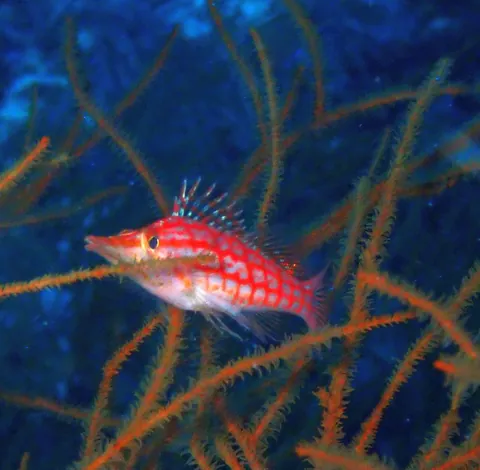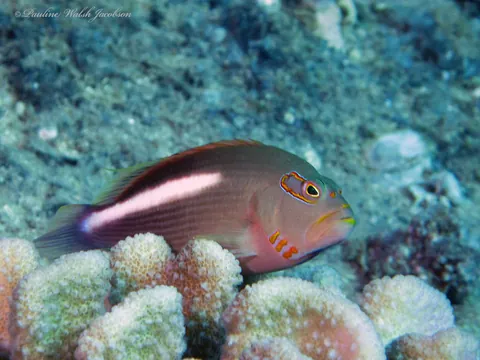
Arc-eye hawkfish
Paracirrhites arcatus
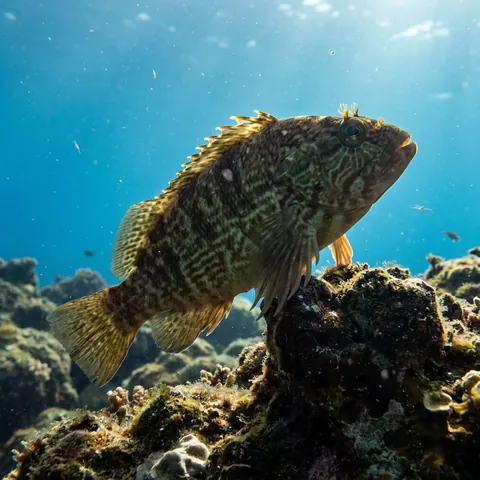
Cirrhitus pinnulatus
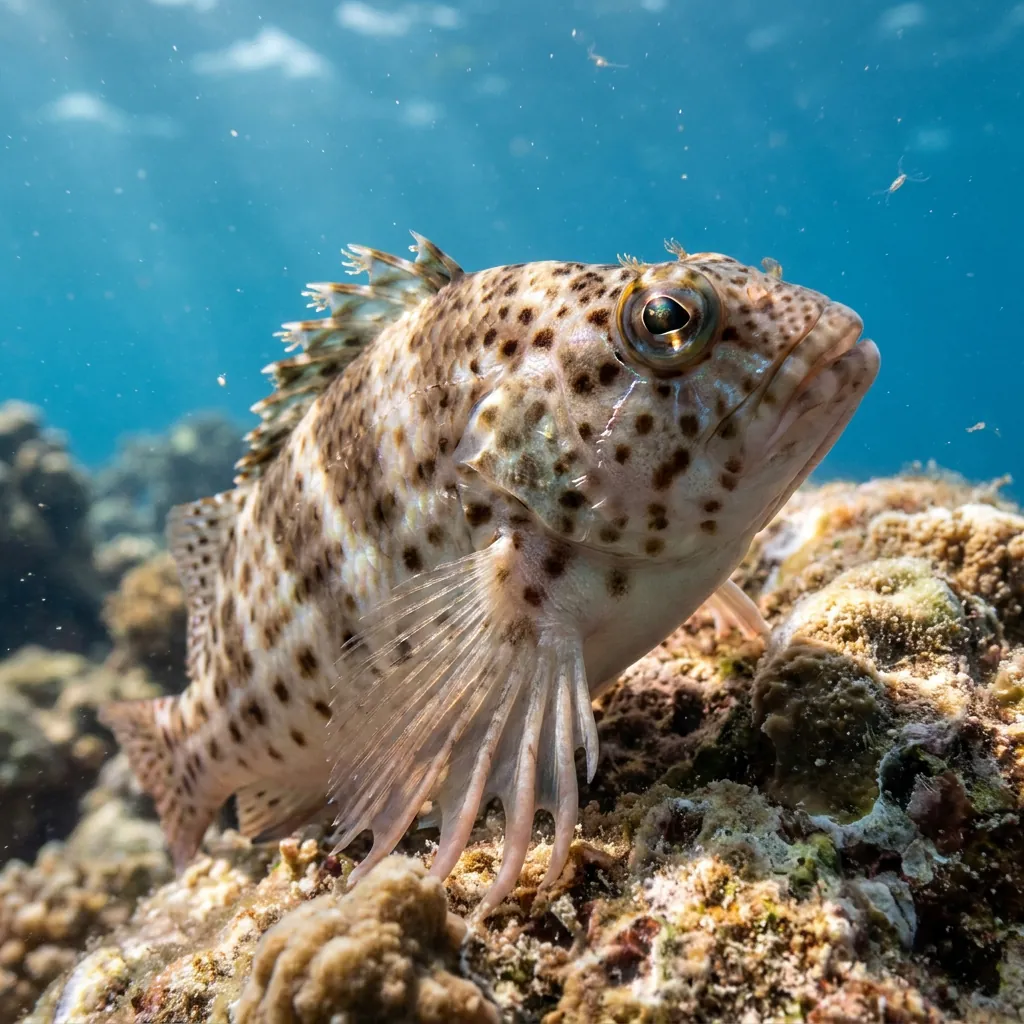
The stocky hawkfish is a heavy-bodied reef fish that perches motionless on rock or coral, waiting to ambush prey rather than chasing it down. Look for it in the roughest, most wave-battered parts of the reef.
Also known as: marbled hawkfish, spotted hawkfish, stocky hawkfish, white-spotted hawkfish, oopukai, redspotted hawkfish, white-spotted hawkfish, hand-fish, marbled hawkfish, whitespotted hawkfish, spotted hawkfish, stocky hawkfish, white spotted hawkfish, whitespotted hawkfish
Other hawkfish share the same tufted spines and mottled brown colouring. Look for a dark, saddle-shaped blotch on top of the tail base, a reliable mark that sets this species apart.
This hawkfish has a thickset body, a short, blunt snout, and a large mouth that reaches back to about the rear edge of the eye. Small fringed filaments called cirri sit along the edge of its nostrils and form little tassels at the tip of each dorsal spine. The dorsal fin runs in one line but has a deep notch between its spiny front part and its soft rear part, and the tail fin is gently rounded. Its body is brown with white blotches and irregular reddish-brown spots, and its head is marked with wavy reddish-orange lines and spots. It grows up to 30 cm, though 23 cm is more typical.
This hawkfish lives on reef fronts and rocky shorelines exposed to moderate to strong surge. It usually stays in very shallow water, just a few metres deep, though it can be found somewhat deeper. It has a wide range across the Indo-West Pacific, from the Red Sea and East Africa to Hawaii and Australia.
It is active at night and hunts mainly crabs, along with other crustaceans, small fish, sea urchins, and brittle stars, striking from its perch on the rock or reef. To spawn, a pair rises up into open water together to release their eggs and sperm.
For a while this fish was split into three separate species and subspecies across its range, before scientists settled on treating them as just one, wide-ranging species.
Describe what you saw and we name it, then keep every species you find in your Oceandex.