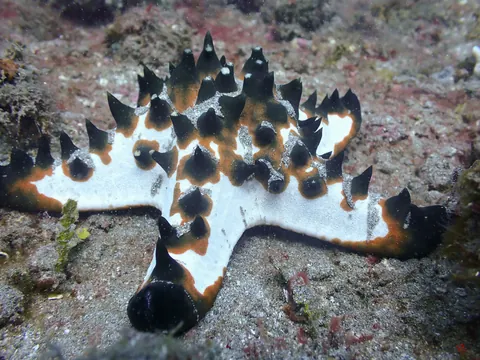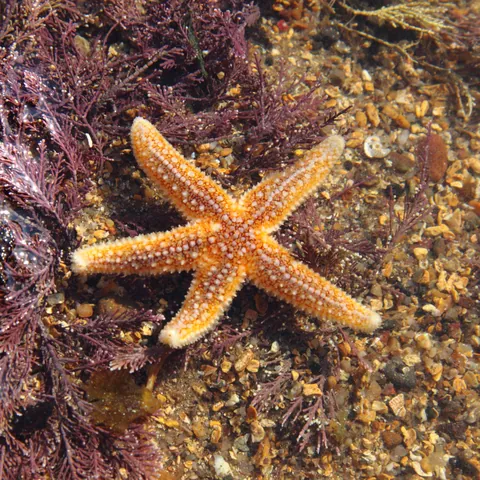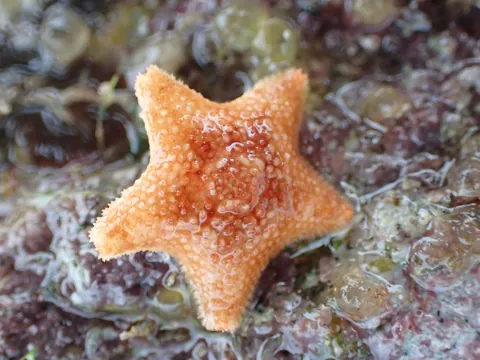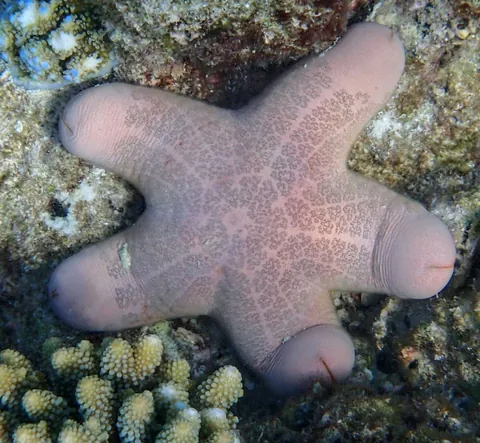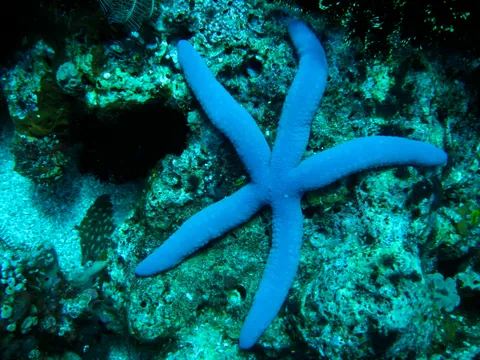
Blue sea star
Linckia laevigata
Linckia multifora
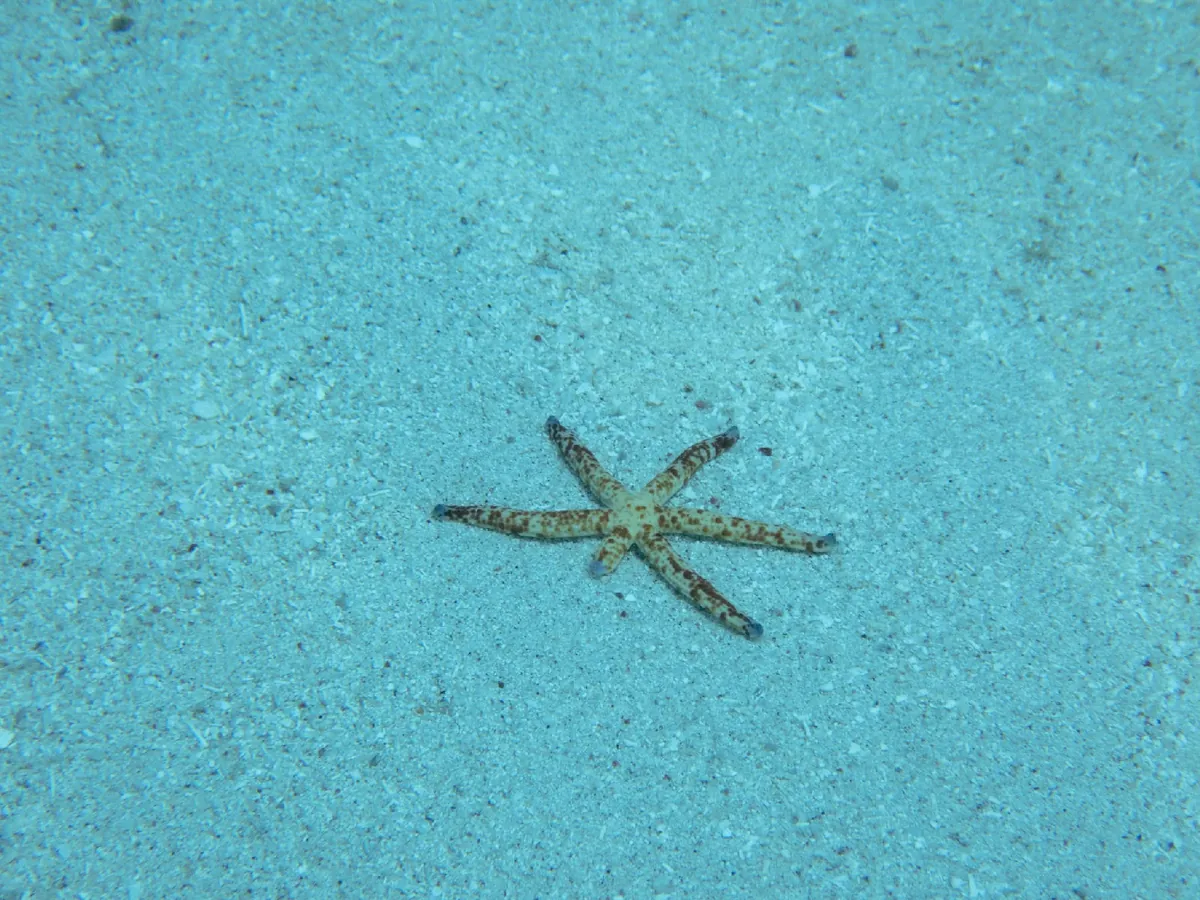
The spotted linckia is a slim, small-bodied sea star of tropical reefs, found across the Indian and Pacific Oceans and in the Red Sea. It lives on hard ground: coral reefs and rocks below the tide line. It is very common on shallow reef flats and also common on seaward reefs, down to 69 m. It grazes algae and the film of microbes on rock and dead coral.
Also known as: multipore sea star
Look for a tiny central disc with five long, pencil-thin arms, and small red dots sprinkled over a brown, pink, red or grey surface that looks grainy rather than smooth. The red speckling stays whatever the base colour. A good extra clue is uneven arms: many of these sea stars are regrowing one or more short arms, so the star looks unbalanced.
The central disc is small and the five arms are long, thin and round in section, tapering a little towards the tips. The base colour varies: brown, pink, red or grey. Whatever the base colour, the surface is scattered with small red spots and feels and looks rough, covered in fine grains. Many individuals are lopsided, with one or more arms shorter than the rest.
This sea star drops its own arms on purpose, and does it often. An arm does not snap off. A small crack opens on the underside and spreads, then the tube feet of the arm and of the body walk in opposite directions and slowly pull the animal apart. The whole event takes about an hour. The wound heals in days and a new arm grows back over some months. Small snails sometimes live in or on the body and feed off it as parasites.
A shed arm does not die. It crawls off on its own as a so-called comet, and over the following months it grows a new disc and a new set of small arms, becoming a whole new sea star. This happens so often that it counts as a way of breeding, and it is hard to find an individual that has never shed an arm.
Describe what you saw and we name it, then keep every species you find in your Oceandex.