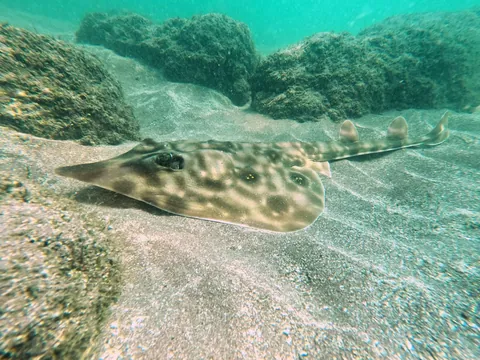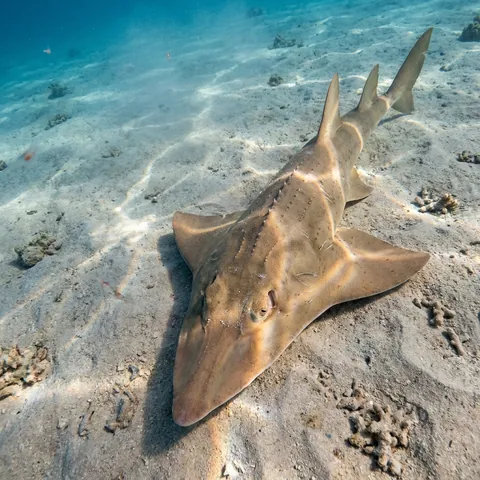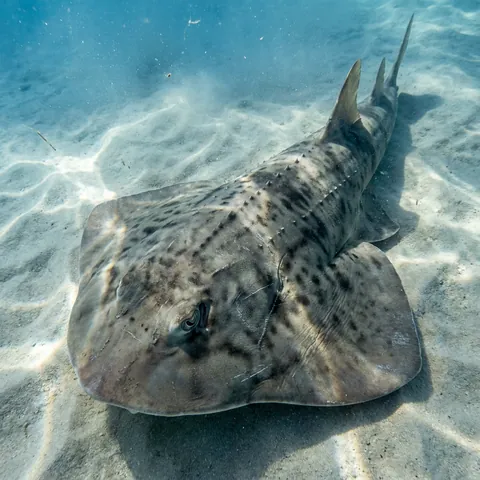
Banded Guitarfish
Zapteryx exasperata
Pseudobatos productus
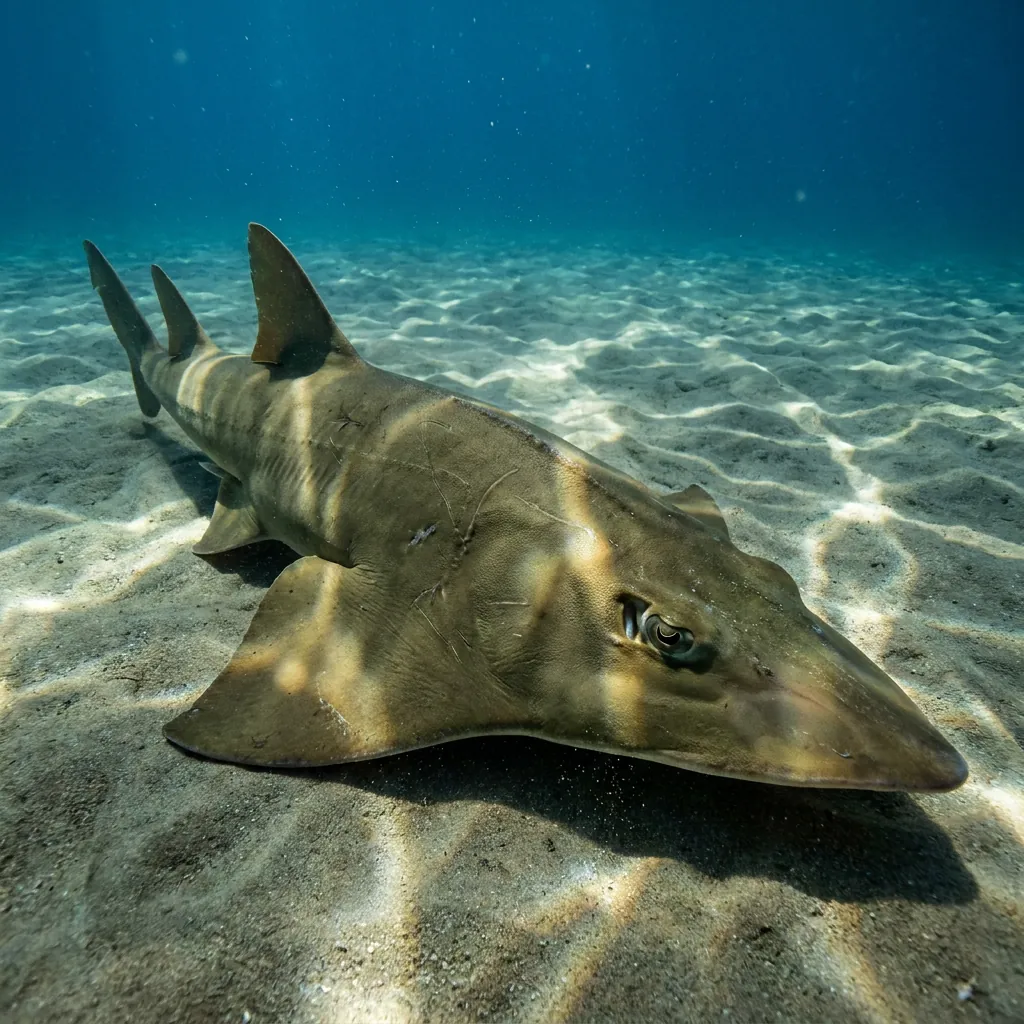
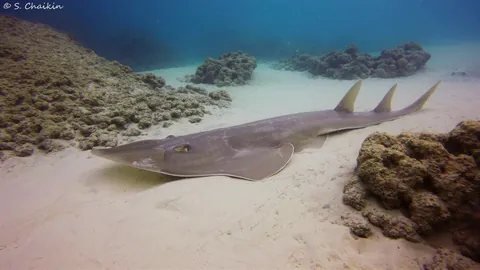
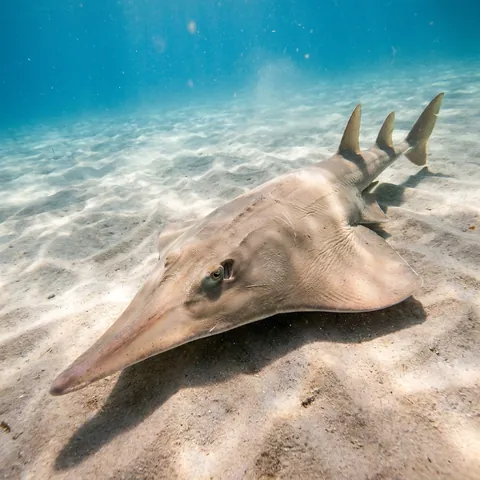
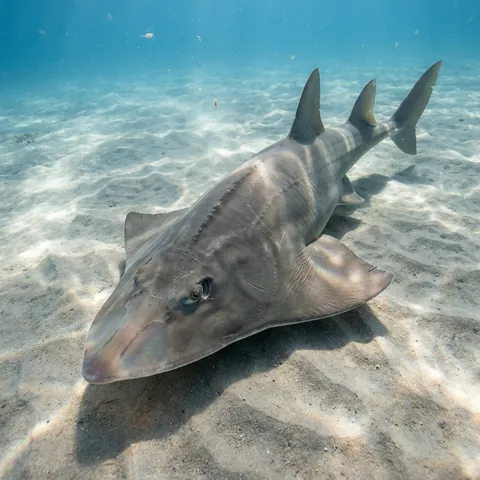
The shovelnose guitarfish gets its name from its flat, shovel-like snout and its body shape, somewhere between a shark and a ray. It grows to about 119 cm long and lives on sandy bottoms along the Pacific coast.
It can be confused with other guitarfish, but the pectoral and pelvic fins running together with no gap is a useful mark to check for on this species.
Its body is flattened top to bottom, olive to sandy brown in colour, which helps it blend into the sand. The snout is broad and flat, the eyes sit up and protrude slightly, and the pectoral and pelvic fins run together with no gap between them. Two small dorsal fins sit close to the tail.
It lives in shallow bays, estuaries, and seagrass beds along the Pacific coast from California to Guerrero, Mexico, including the Gulf of California. It usually stays in water less than about 13 m deep, though it has been found as deep as 91 m.
This guitarfish is most active at night and in the early morning, when it hunts most successfully. It is also more active on incoming and high tides, resting more during cooler water and low tide.
It feeds on worms, molluscs, crustaceans, small fish, and squid-like animals living on the seabed, with crabs and shrimp making up much of the diet. It buries itself in sand using its pectoral fins, leaving only its eyes exposed, then ambushes prey that comes close.
Shovelnose guitarfish give birth to live young rather than laying eggs, with pups developing inside the mother through several stages before birth. Females travel to shallow coastal waters in spring to give birth, and males follow soon after to mate.
The shovelnose guitarfish is listed as Near Threatened. It is heavily fished by small-scale coastal fisheries and often caught as bycatch in shrimp trawling, and pregnant females moving into shallow water are especially exposed to capture. Because it matures late and breeds slowly, its numbers are slow to recover.
Its genus name combines the Greek word for shark and the Latin word for ray, a nod to its body being a cross between the two.
Describe what you saw and we name it, then keep every species you find in your Oceandex.