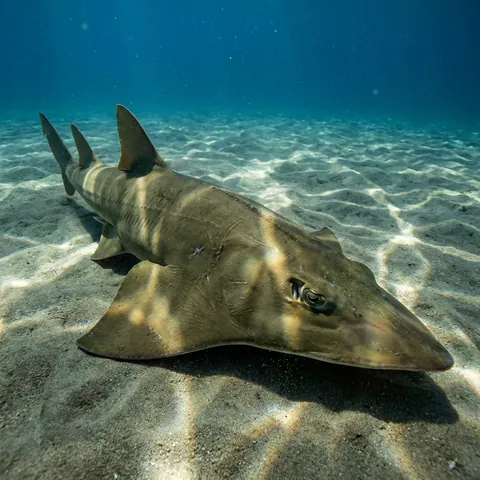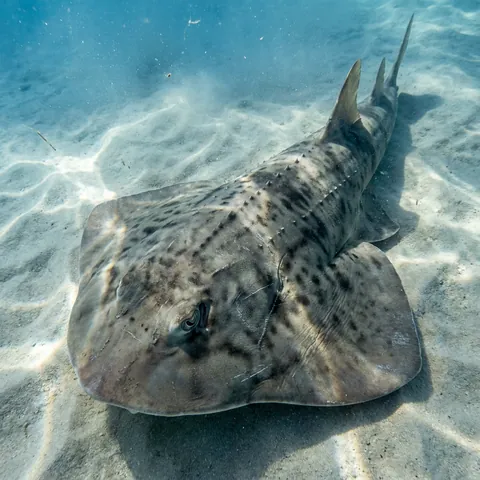
Banded Guitarfish
Zapteryx exasperata
Aptychotrema rostrata
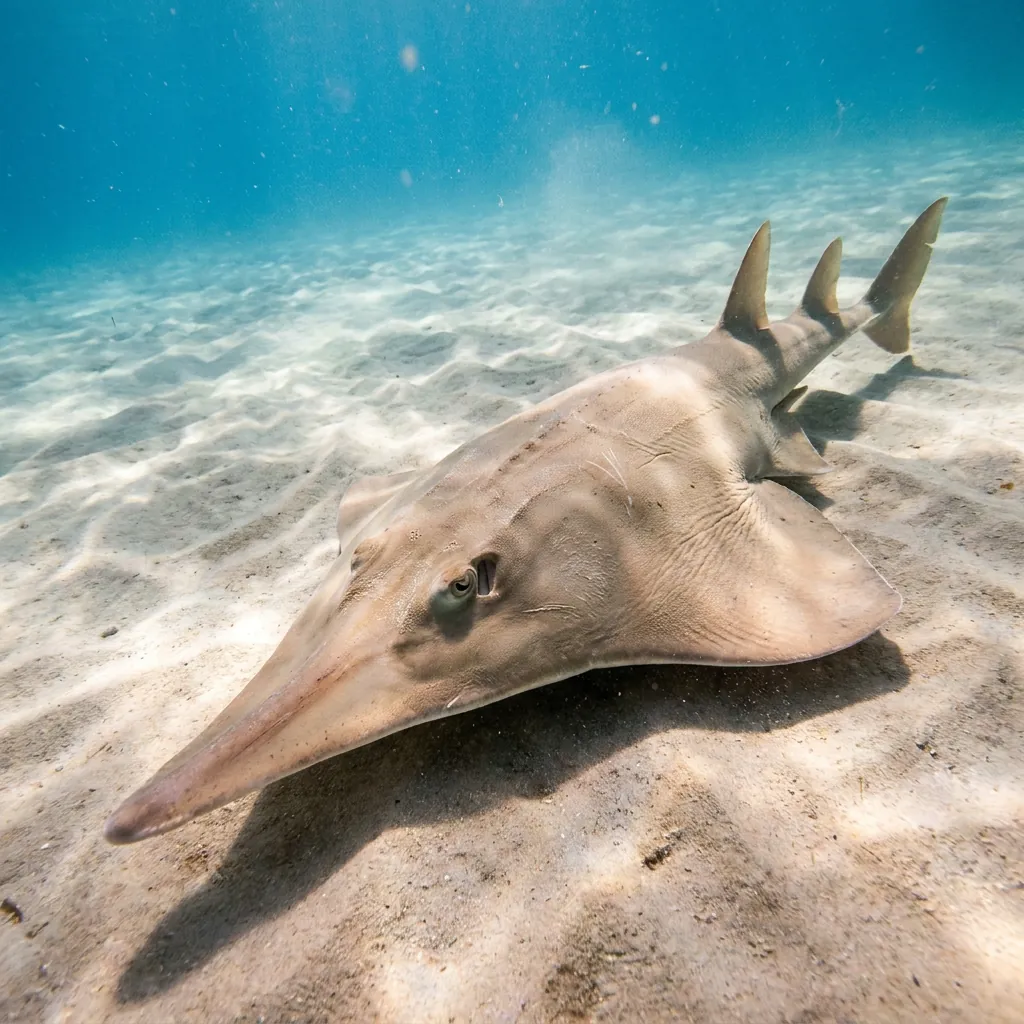
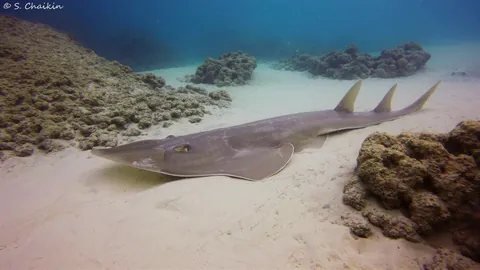
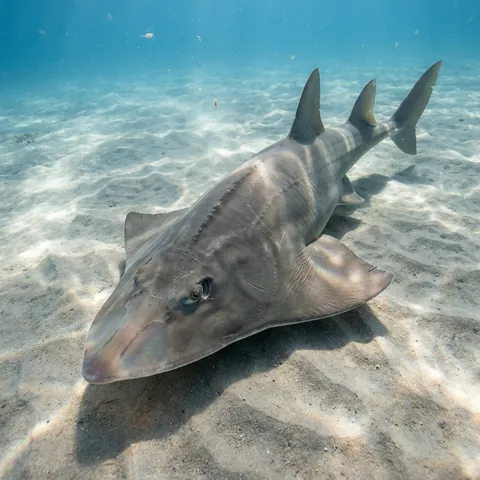
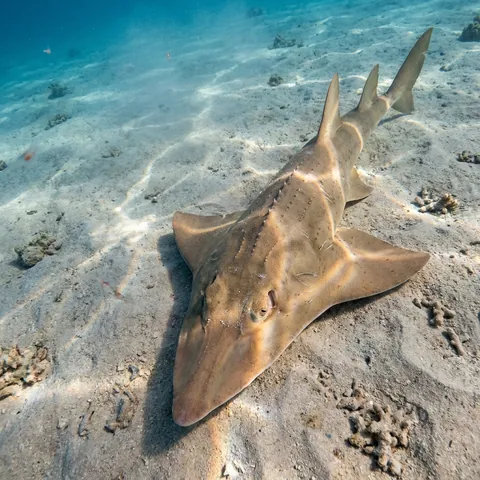
The eastern shovelnose ray is a flat, wedge-shaped guitarfish found only off the east coast of Australia. It grows up to 100 cm long and spends most of its time resting on the sea floor.
Also known as: bank's shovelnosed-ray, bank's shovelnosed ray, southern shovelnose ray, shovelnose shark, shovelnose ray, shovel-nosed ray, long-snout shovelnose ray, guitarfish, eragoni, common shovelnosed ray, banks shovelnosed ray, australian shovelnose ray, banjo fish, bouganville's shovelnose ray
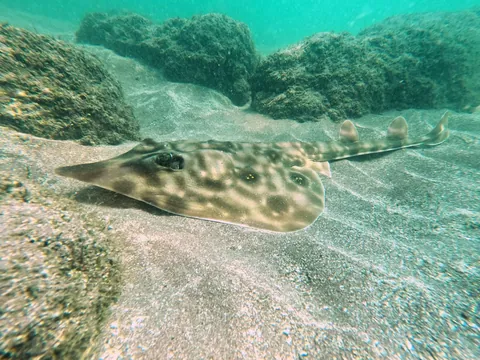
This ray can be confused with other shovelnose rays and guitarfish. Its bold orange patches in front of the eyes are the mark to check for, as most similar species lack them.
This ray has a flat, wedge-shaped disc and a long, pointed snout, with two similar-sized dorsal fins set on a broad tail. It is sandy or brownish with dark patches, a blackish tip on the snout, and bold orange patches in front of its eyes, which sit on top of its head. Its underside is pale with dark flecks.
It lives only off the coast of southern Queensland and southern New South Wales, in subtropical and temperate water. It is usually found in shallow water over mud and sand flats, in estuaries, and on rocky reefs, though it has also been recorded as deep as 220 metres.
This ray mates in winter, and females move into shallower water in summer to give birth. Unlike many related rays, it does not have a busy breeding season in summer.
It eats mainly bottom-dwelling animals such as shrimp, prawns, mantis shrimp, and crabs, along with fish and molluscs. It feeds by sucking prey into its broad mouth, then crushing it with strong, flattened teeth built for hard-bodied prey. It likely forages mostly in shallow water rather than at depth.
The IUCN lists this ray as Least Concern. Even so, prawn trawling is a serious risk to the species on the Great Barrier Reef, and rays caught and thrown back have a lower chance of survival the longer the tow lasts.
As males mature, they grow noticeably sharper, more pointed teeth and a stronger jaw than females, likely to help them grip a mate during courtship.
Describe what you saw and we name it, then keep every species you find in your Oceandex.