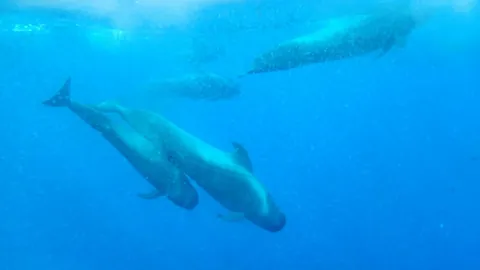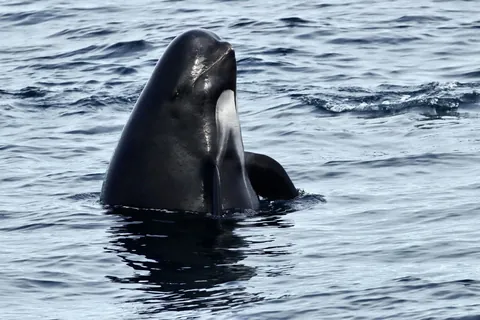
Long-finned pilot whale
Globicephala melas
Globicephala macrorhynchus
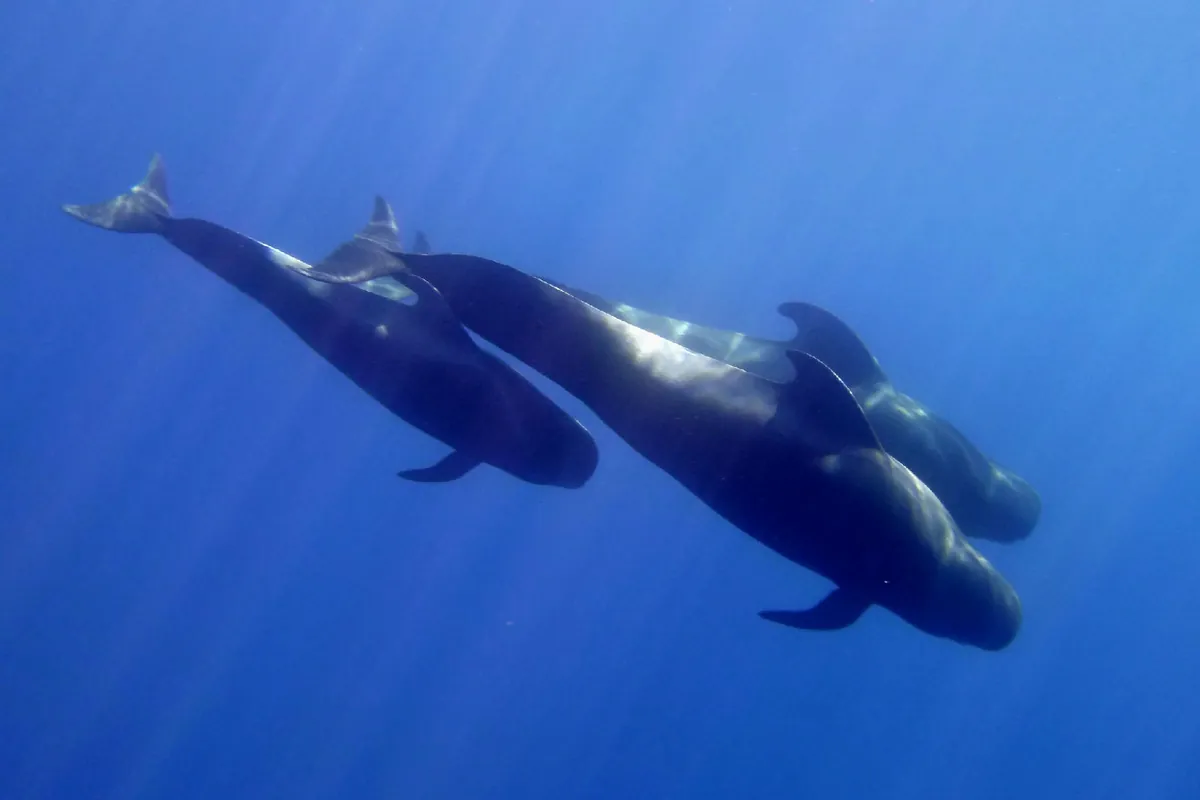
The short-finned pilot whale is a large, dark-bodied dolphin that lives in tight, close-knit family groups. It can grow up to 610 cm long and weigh up to 3,600 kg. Despite its size, it is a fast, deep-diving hunter.
This whale is often confused with the long-finned pilot whale, which shares its dark colour and rounded head. As the name suggests, look at the pectoral fins, the paired fins on the sides of the body: the short-finned pilot whale's are noticeably shorter.
This whale is black to dark grey-brown, with a thick tail base, a bulbous, rounded head, and a broad, sickle-shaped fin on its back. It often has lighter grey or white markings: a pale saddle patch behind the dorsal fin, an anchor-shaped patch under the chin and belly, and a light streak behind the eye. Head shape and markings can vary a little between different populations.
Short-finned pilot whales live in warm and temperate parts of the Indian, Atlantic, and Pacific Oceans. They range over both coastal water and the open ocean, often along the steep slope at the edge of the continental shelf. They dive deep, usually between 600 and 1,000 m, and can reach depths of up to 2,418 m.
This is a highly social, long-lived species. It lives in stable family pods that can stay together for generations, usually led by an older female. Pods sometimes mix for mating before splitting apart again. At the surface, pilot whales are playful, and often slap their tail flukes on the water.
Short-finned pilot whales are apex predators, meaning nothing hunts them. Squid make up most of their diet, along with some fish and octopus, and rarely other marine mammals. They dive deep along the shelf edge to hunt, using echolocation, sound clicks that bounce back as echoes, to find prey in the dark.
Males mate with several females over their lifetime and will sometimes leave their own pod for a time to mate with females from another group, which helps prevent inbreeding. Calves nurse from their mothers for a long time before becoming independent.
harmless
This species is not currently considered at risk of extinction. However, some local populations are small, and much of its range has not been well studied, so the true picture may vary from place to place.
Short-finned pilot whales are sometimes called the 'cheetahs of the deep' for the high-speed chases they use to catch squid far below the surface.
Describe what you saw and we name it, then keep every species you find in your Oceandex.