Pilot Whale
pilot_whale
Globicephala melas
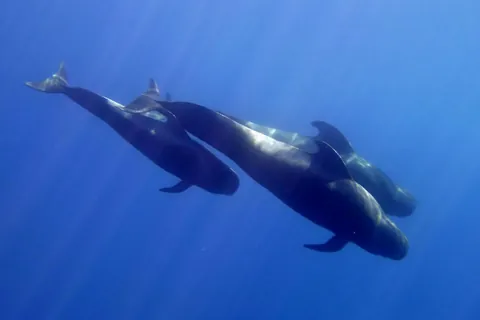
Despite its name, the long-finned pilot whale is actually a large dolphin, second in size in its family only to the orca. It can grow to 670 cm long and weigh up to 2 tonnes, and it travels the ocean in tight-knit family groups.
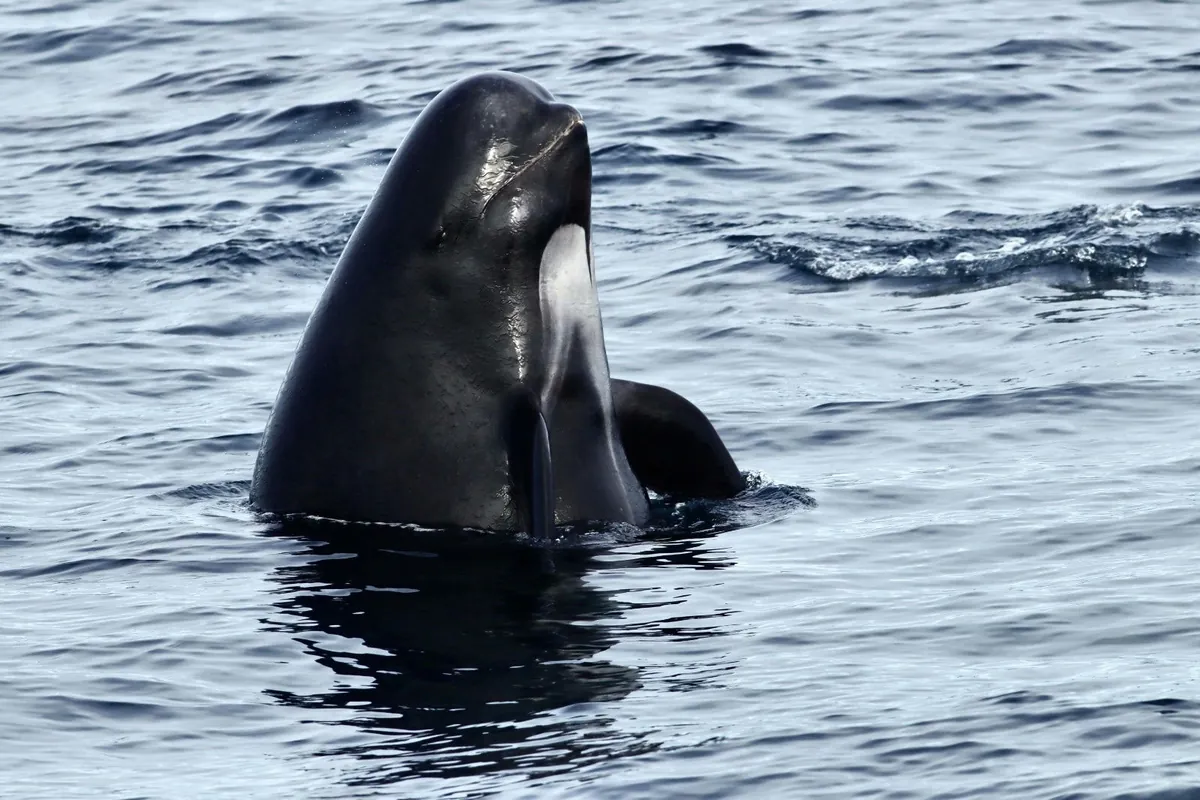
It is easy to mistake for an orca at a distance, but it lacks the orca's bold white eye patch and flank saddle. Instead, look for an almost all-black body broken only by a pale patch on the throat and belly.
This whale is black or dark grey with a rounded, bulbous forehead. A light grey patch on its throat forms an anchor shape, and some animals also show a pale saddle patch behind the dorsal fin or a stripe swept back from the eye. The dorsal fin is thick and curved, set about a third of the way along the back, and the pectoral fins are long and sickle-shaped.
It lives across the North Atlantic and in cooler waters of the Southern Hemisphere. It is a deep diver, ranging from near the surface down to as much as 1,800 m in search of food.
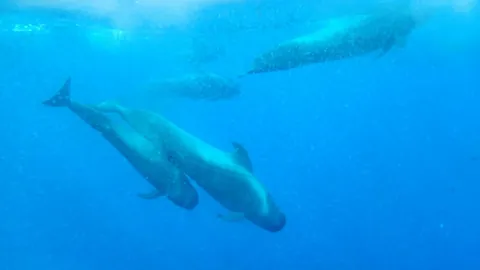
Long-finned pilot whales live in close, socially bonded groups built around related females, and calves often stay with their mothers for life. They communicate with whistles and clicks, use echolocation to find their way in dark water, and are often seen slapping their tails, raising their heads to look around, and occasionally breaching clear of the surface.
Squid make up most of its diet, along with octopus and crustaceans. It also eats fish such as herring, mackerel, hake and dogfish.
Mating can happen at any time of year but peaks in late spring and early summer, usually when different groups meet rather than within a single family unit. Calves stay close to their mothers and nurse for an extended period after birth.
harmless
The long-finned pilot whale is listed as a species of least concern. Some regional populations are still covered by international agreements aimed at protecting migratory whales and dolphins, and the species also supports a whale-watching industry in parts of its range.
The long-finned pilot whale has more neurons in its neocortex than any other mammal studied so far, almost twice as many as a human brain.
Describe what you saw and we name it, then keep every species you find in your Oceandex.