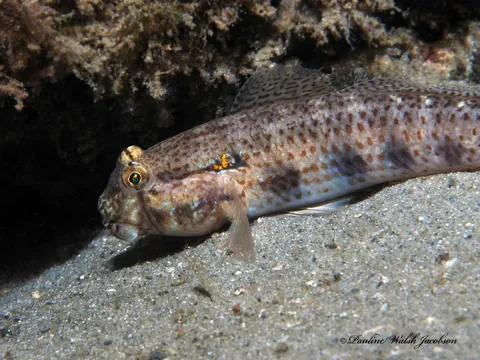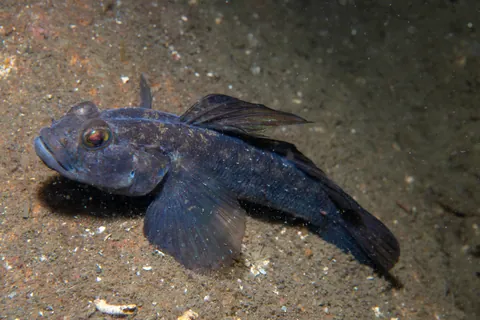
Black Goby
Gobius niger
Amblyeleotris periophthalma
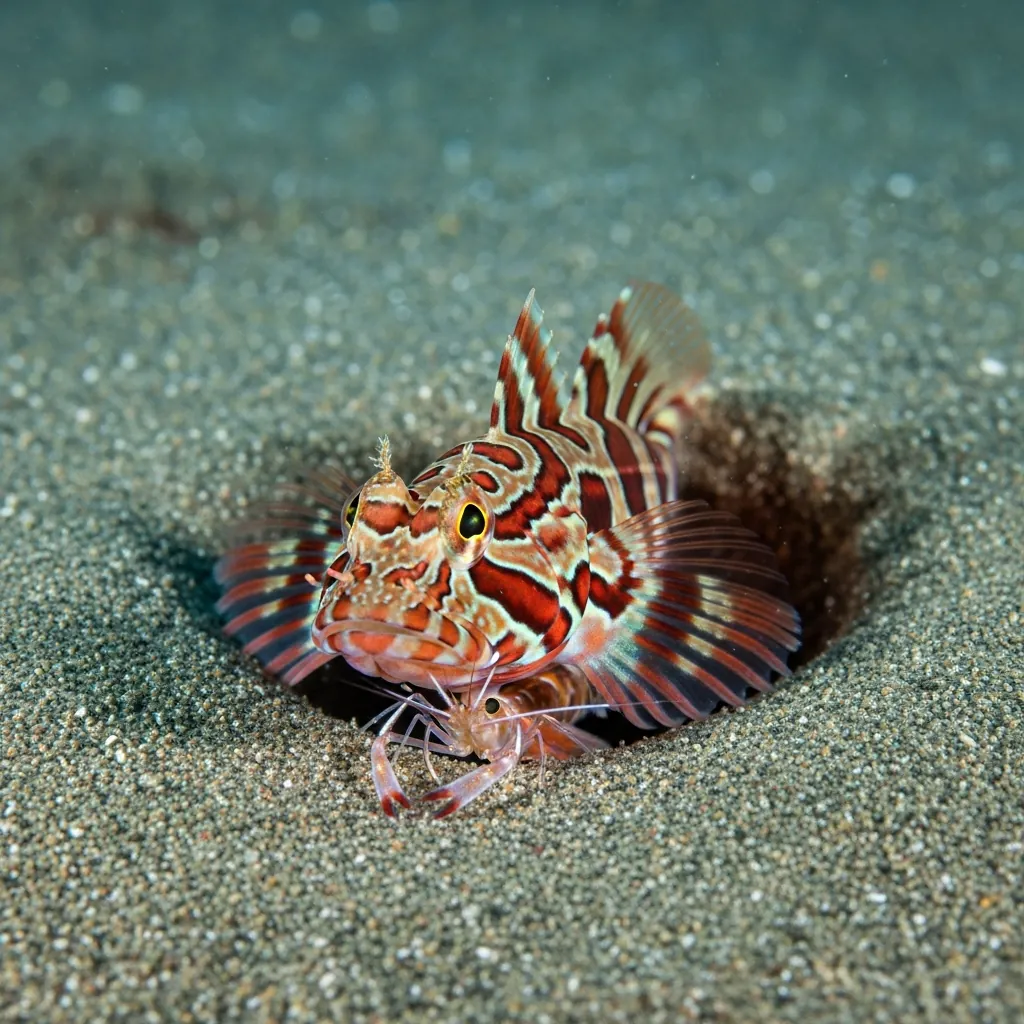
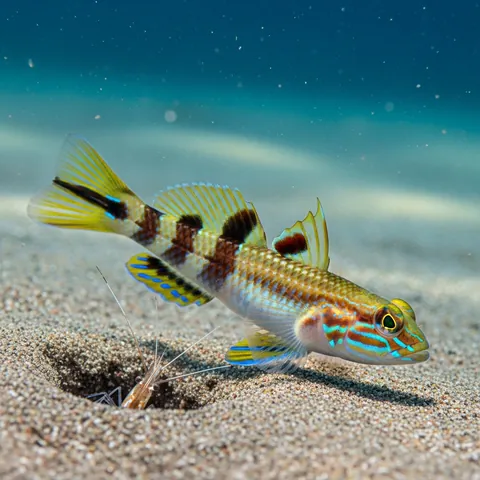
This is one of the shrimp gobies, small barred fish that share a burrow in the sand with a snapping shrimp. The goby sits at the entrance and keeps watch while the shrimp does the digging. It grows to about 11 cm. On a sandy slope it is easy to miss until you notice the pair working together.
Also known as: broad-banded shrimp-goby, broad-banded shrimpgoby, broadbanded shrimpgoby, broad-banded shrimp-goby, broadbanded shrimpgoby, broad-banded shrimpgoby
Several shrimp gobies share this pale barred look on sand, so the bars alone will not name it. Check the cheek instead. There is a red blotch low on the cheek, just behind the mouth, and the head carries red or orange spots with dark rims. Those head marks hold steady while bar strength changes from fish to fish.
The body is long and rounded, whitish, and crossed by about six broad brown to reddish bars over the head and side. Between the bars the pale spaces carry uneven brown blotches, and many small brown dots are scattered over the upper half of the fish. How strong the bars look varies from fish to fish. The eyes are round and stand out on top of the head. The mouth is large and curves like an upside-down U. The pelvic fins are separate, linked only by a low flap at the base, and the tail is longer than the head.
This goby lives on sand, not on hard coral. Look for it on sandy patches in lagoons and on sandy slopes of outer reefs, in warm water of roughly 22 to 28 C. It has been recorded from 5 to 35 m, but most sit between 10 and 20 m. Its range covers the Indo-West Pacific, including the Red Sea. Each fish shares a burrow dug and kept clear by a snapping shrimp, and it stays close to that hole.
Describe what you saw and we name it, then keep every species you find in your Oceandex.