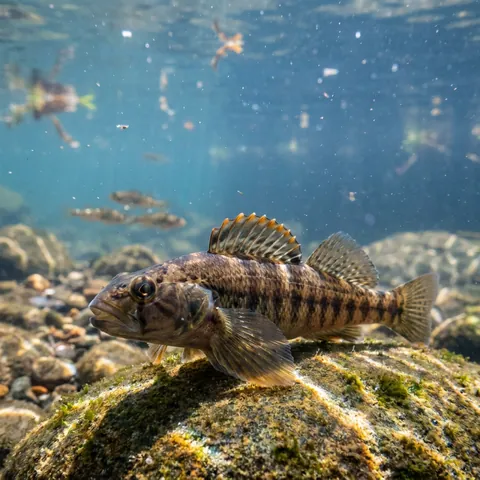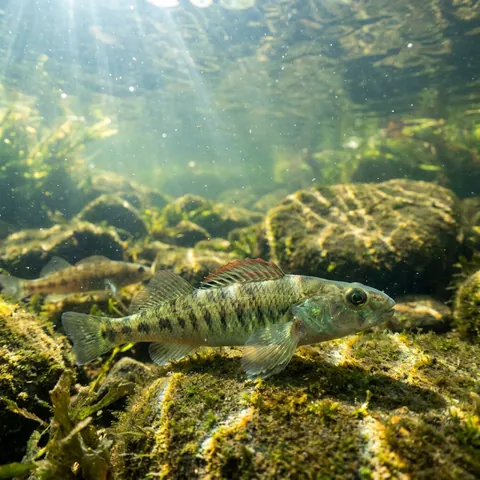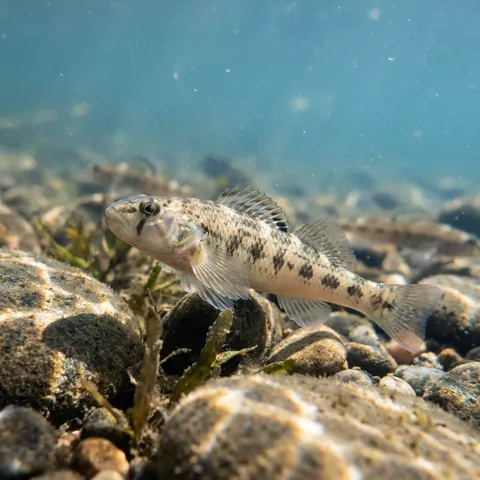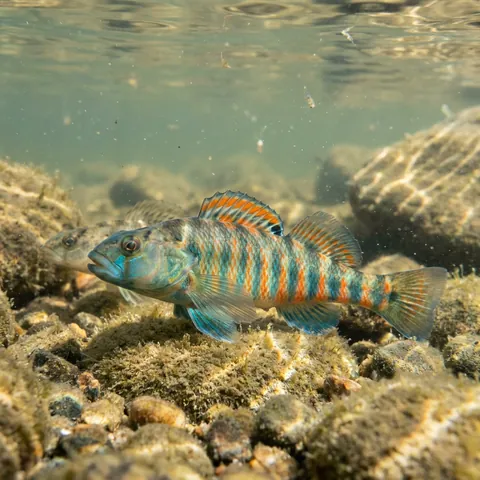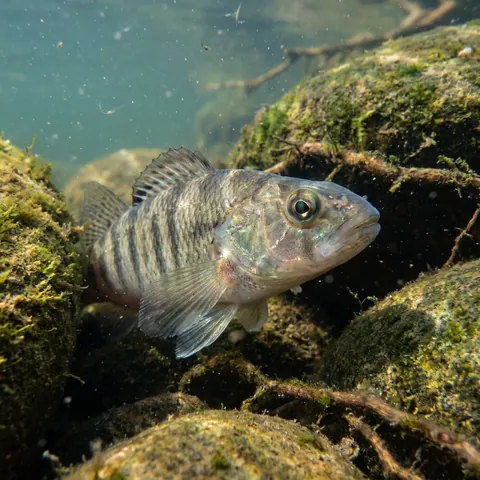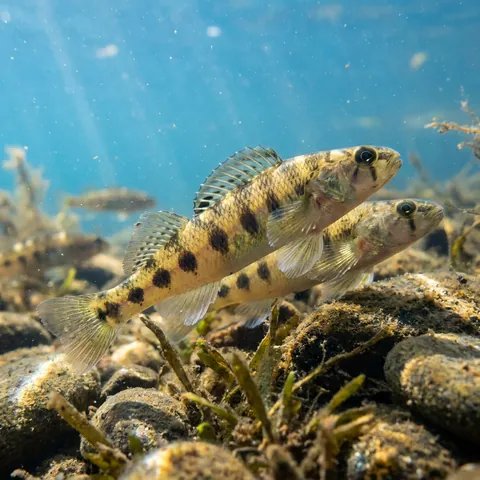
Blackbanded Darter
Percina nigrofasciata
Perca fluviatilis
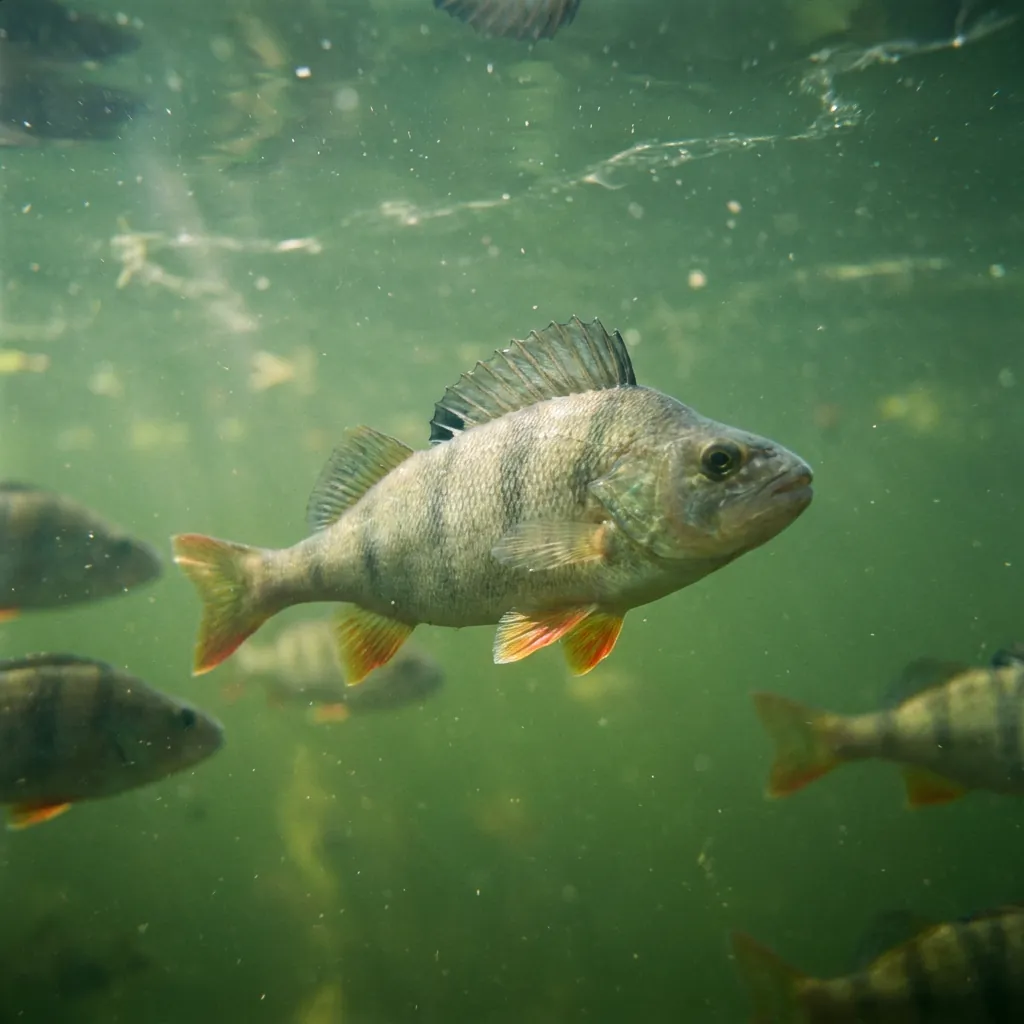
The European perch is one of the most familiar fish in European lakes and rivers, easy to spot by its bold stripes and bright red fins. It can grow up to 60 cm long and weigh as much as 4.75 kg, though most are much smaller.
Also known as: perca fluviatilis, english perch, eurasian perch, european perch, reddie, redfin, redfin perch, river perch
Several fish in the perch family share its greenish, striped look. The clearest check is the back fin: the European perch has two clearly separate dorsal fins, and the first one carries a dark blotch near its rear edge.
This fish has a greenish body marked with five to eight dark bars running down its sides, and its pelvic, anal and tail fins are a bright red. As it grows older and larger, a hump often forms on its back between the head and the first dorsal fin.
The European perch lives in fresh water across most of Europe and into Siberia, and it also tolerates the low-salt water of the Baltic Sea. It favours slow rivers, ponds and lakes, usually at depths of 3 to 4 m, and tends to avoid cold, fast-flowing water.
Perch feed mainly around sunrise and sunset, taking whatever prey is easiest to find. Young perch stay in open water at first, then move closer to the shore and bottom as they grow through their first summer.
Young perch eat plankton and small bottom-dwelling invertebrates, sometimes including other perch fry. Adults eat both invertebrates and fish, especially sticklebacks, roach, minnows and smaller perch.
Male perch mature earlier than females. Spawning happens in the colder months of the year, when the female lays her eggs in a long, sticky ribbon draped over water plants or submerged branches. The eggs hatch into tiny larvae that drift in open water, feeding on plankton before moving toward the shore.
harmless to humans (sharp dorsal spines)
The European perch is Finland's national fish.
Describe what you saw and we name it, then keep every species you find in your Oceandex.