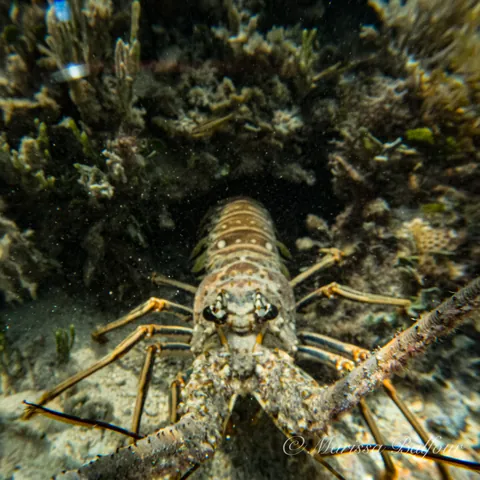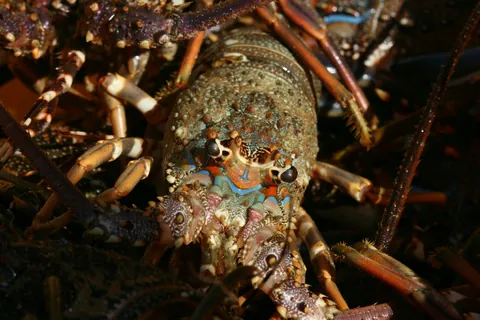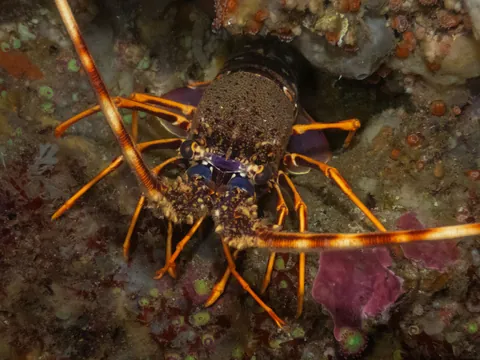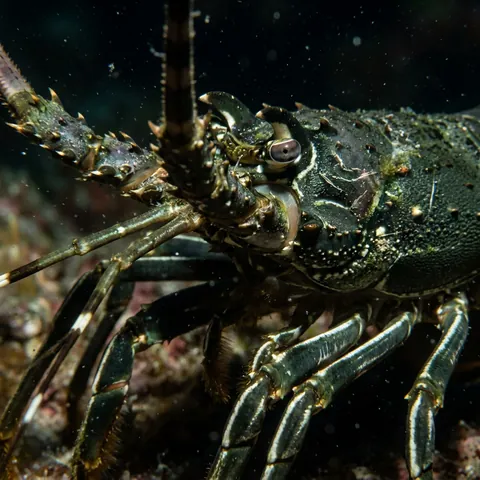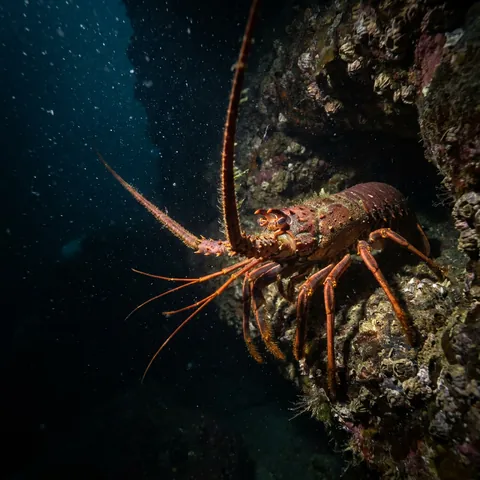
California Spiny Lobster
Panulirus interruptus
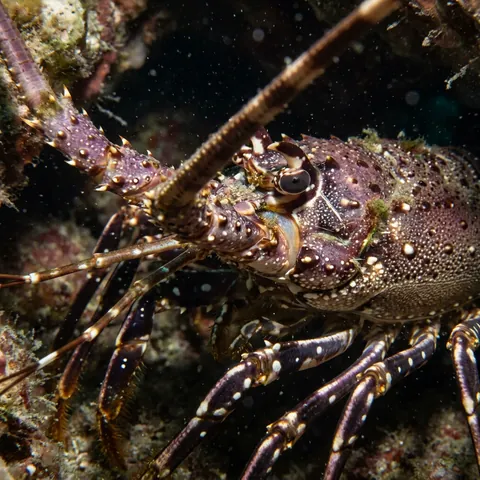
Panulirus versicolor
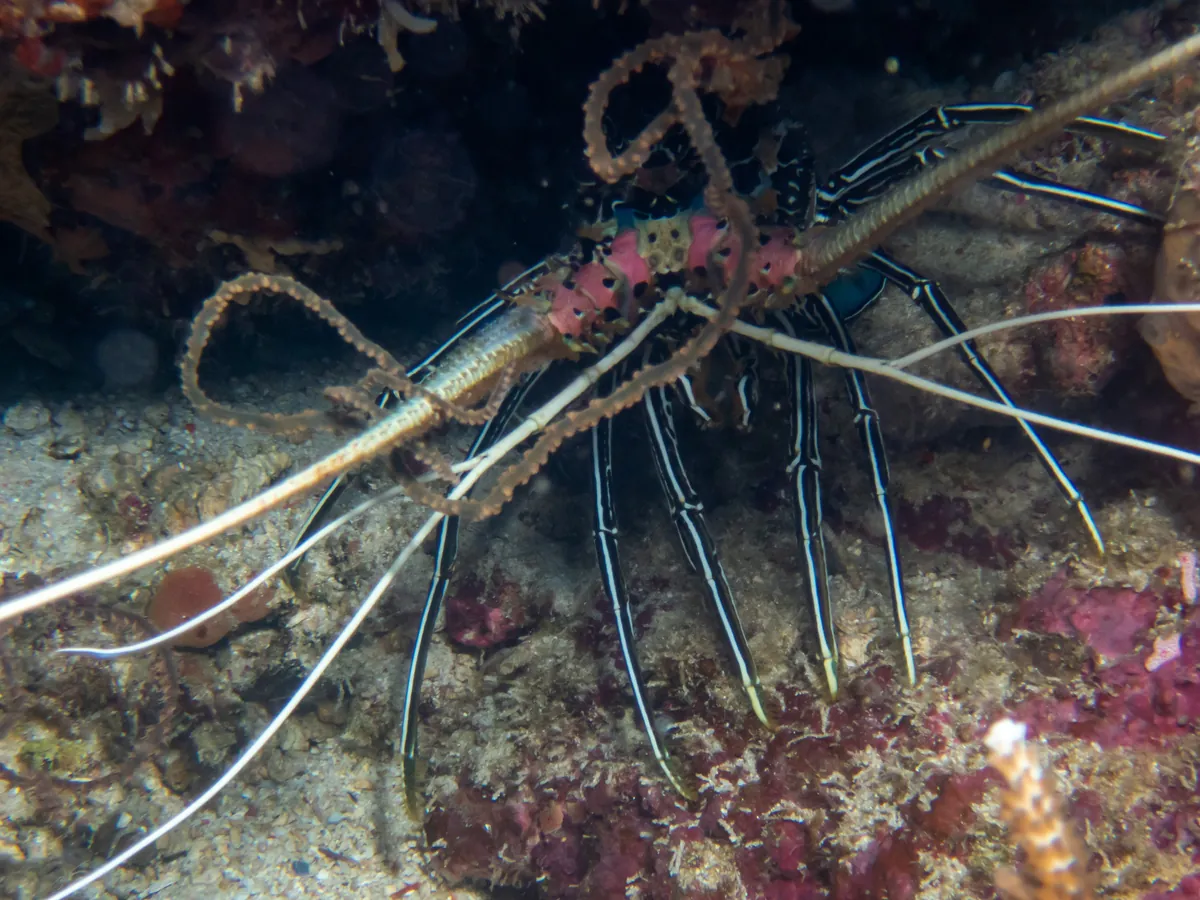
The painted spiny lobster is a boldly marked reef lobster of the Indo-Pacific, growing to 40 cm. Like all spiny lobsters it has no claws; instead it carries two pairs of long antennae and two spiny spikes above the eyes. It shelters by day and comes out at night to feed. It is heavily fished for food across its range and has become scarce or has disappeared in some places.
Also known as: painted rock lobster, spiny blue lobster
It is easily confused with two close relatives, sharing the same reefs. The white antennae, the easiest thing to spot from a distance, are the detail to trust: the look-alikes do not carry them this boldly white. None of the three has claws, so that will not help tell them apart.
The shell is hard, cylindrical and unbending. The abdomen, the tail section, is green with black and white bands across it. The legs are dark blue to black with white stripes. The tail fan is blue-green with a white margin. The two pairs of antennae are usually white; the first pair is thin and the second pair is hard and spiny. Young animals are bright blue with white lines, and the base of their antennae is white rather than pink.
It lives in shallow tropical water on coral reefs, often along the seaward edge of the reef plateau, and in clear water it will also live in the surf zone. Its range covers the Indian Ocean from the east coast of Africa up through the Red Sea and across to South East Asia, and the western and central Pacific from southern Japan south to north-eastern Australia.
It is active at night and does not live in groups. During the day it hides in small caves, crevices and cavities in rock and coral, so on a day dive you usually see only the white antennae sticking out of a hole. It is a meat eater, taking both carrion and freshly caught animals: other crustaceans and occasional small fish. Mating happens belly to belly, and the female then carries her eggs beneath her abdomen before a long larval phase out in open water.
Its scientific name says exactly what it looks like: versicolor is Latin for "of different colours", and the animal carries green, blue, black and white on different parts of one body.
Describe what you saw and we name it, then keep every species you find in your Oceandex.