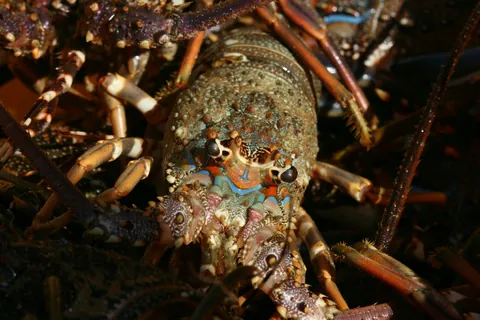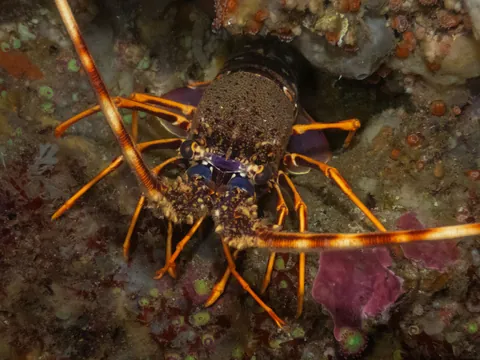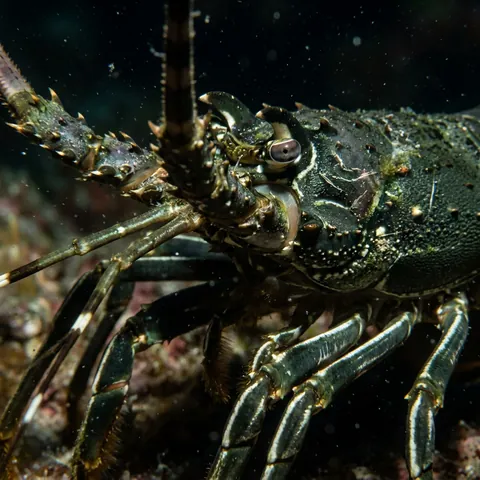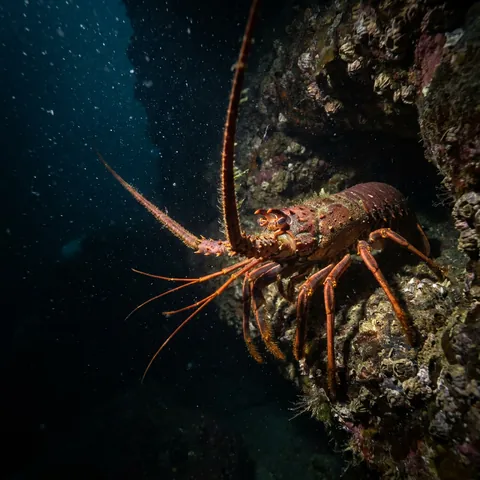
California Spiny Lobster
Panulirus interruptus
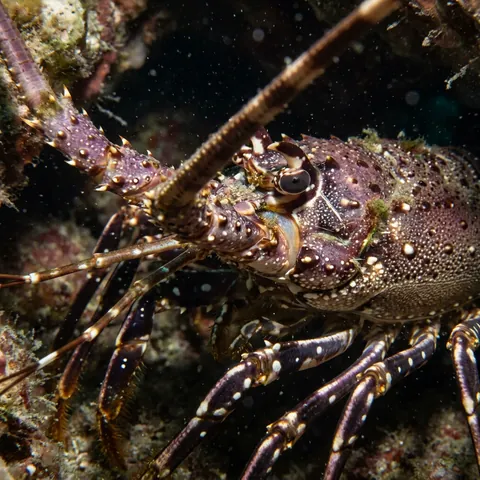
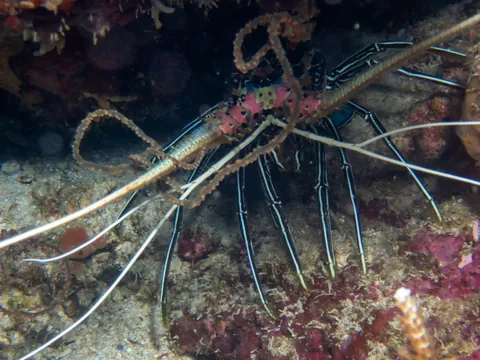
Panulirus argus
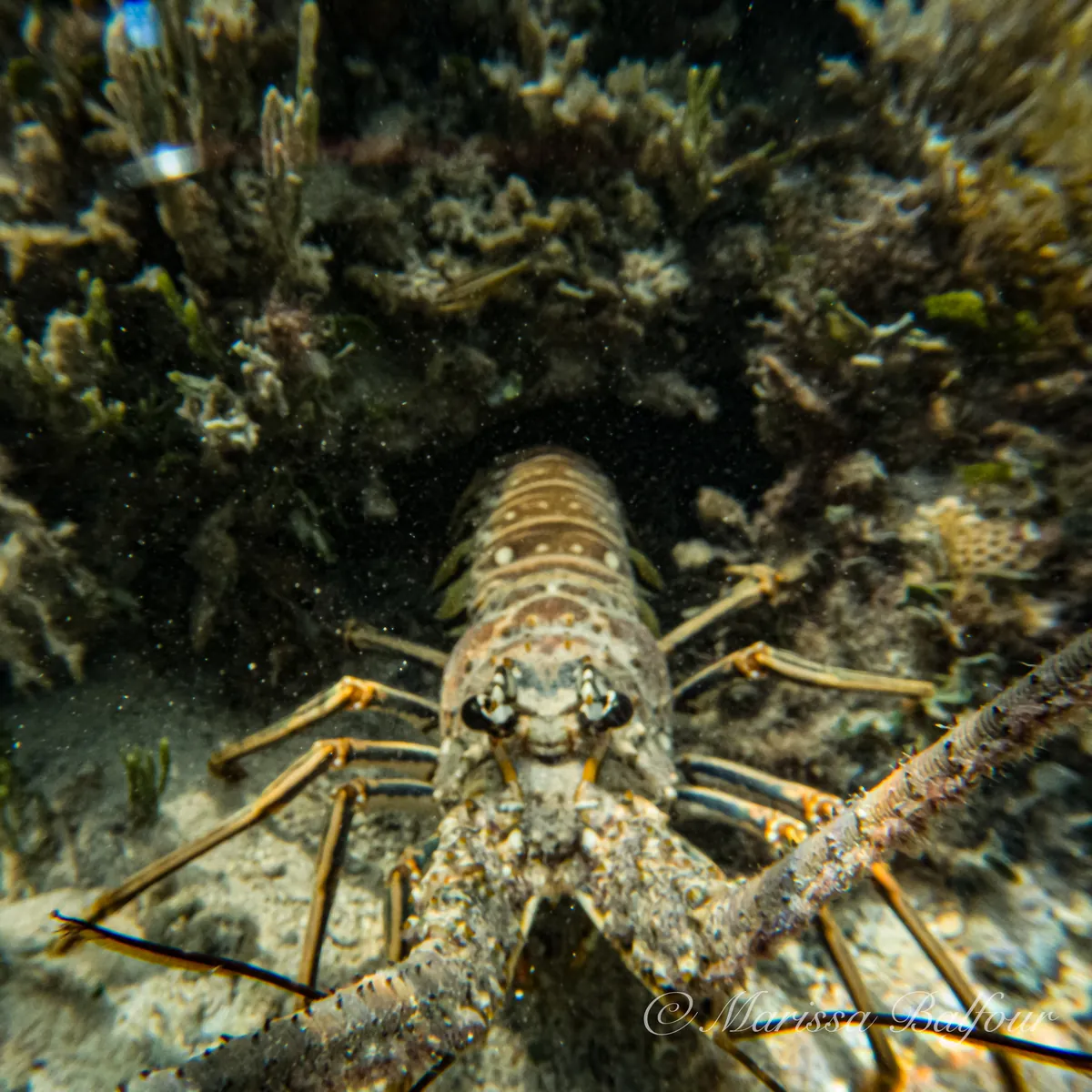
The Caribbean spiny lobster is the reef's armoured wanderer, a spine-covered crustacean that spends its days tucked in a crevice and its nights out hunting. It grows to about 45 cm, though most are closer to 20 cm.
Also known as: bermuda lobster, bermuda spiny lobster, caribbean spiny crawfish, florida spiny lobster, panulirus argus, panulirus argus (latreille, 1804)
Other spiny lobsters in the region can look similar, but the blue-and-yellow striped legs are a reliable giveaway for this species.
The body is long, cylindrical, and covered in spines, with two large forward-pointing spines like horns above the eyes. Colour ranges from olive-green or brown to tan or dark reddish-brown, with pale yellow to cream spots scattered on the carapace and larger spots, usually four to six, on the tail segments. The long antennae are covered in forward-pointing spines, and the legs are striped lengthwise in blue and yellow.
It lives on coral reefs, rocky ground, seagrass beds, and among mangrove roots, anywhere that offers a crevice or overhang for cover. Depths range from shallow water down to about 90 m, and it is found across the western Atlantic and Caribbean.
This lobster is nocturnal, staying hidden by day and coming out at night to feed on molluscs, crustaceans, worms, and dead animal matter on the bottom. After moulting, its new shell stays soft for a time, so it stays especially cautious until it hardens. In autumn, groups can form long single-file lines and march across the seabed together, each animal keeping antennae contact with the one ahead.
In autumn, hundreds of these lobsters can line up nose-to-tail and march together across the seabed in single file, a migration whose purpose is still not fully understood.
Describe what you saw and we name it, then keep every species you find in your Oceandex.