Angel sharks
angel_shark
Squatina californica
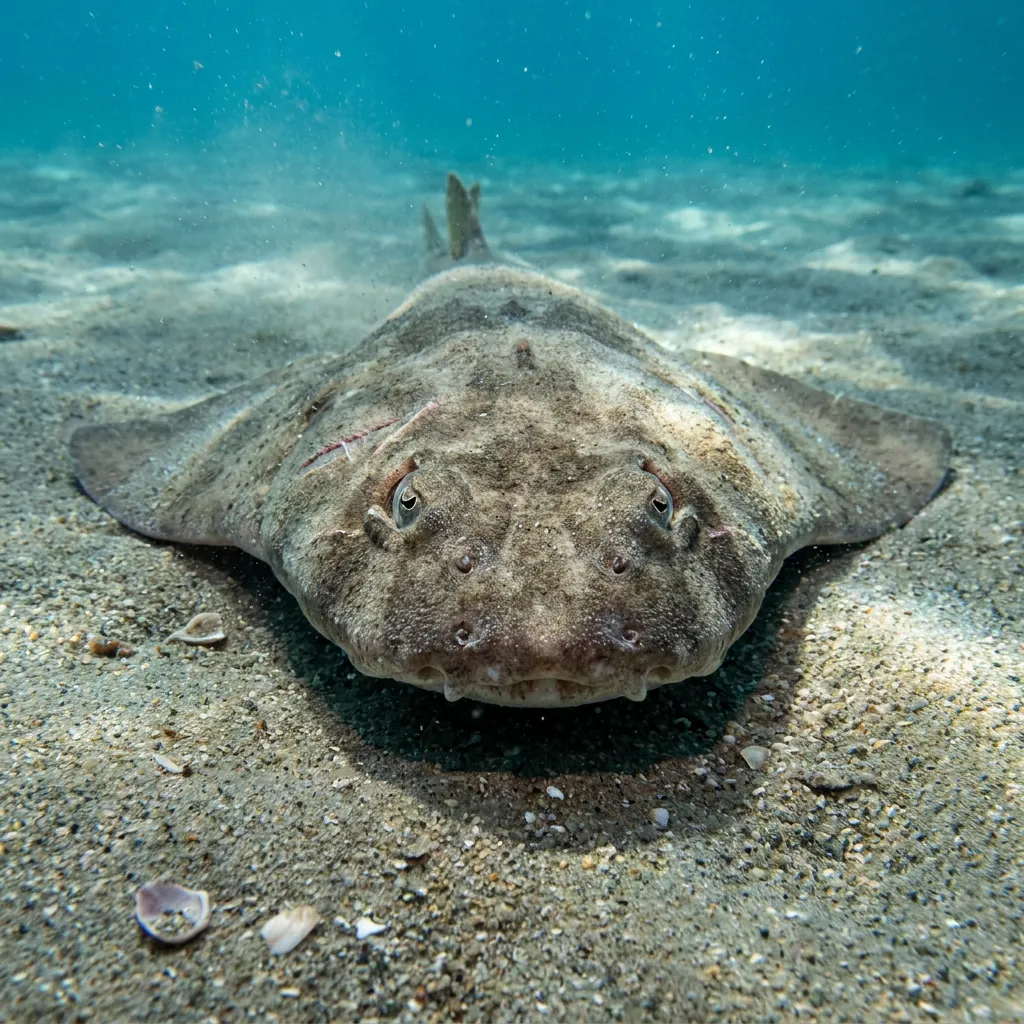
The Pacific angelshark spends its days hidden under a thin layer of sand, waiting to ambush fish that swim too close. It grows up to 152 cm long and lives along the eastern Pacific coast.
Also known as: pacific angel shark
At a glance it can look like a ray, but its gill slits sit on the side of the head rather than underneath, and its pectoral fins are separate from the head rather than fused to it.
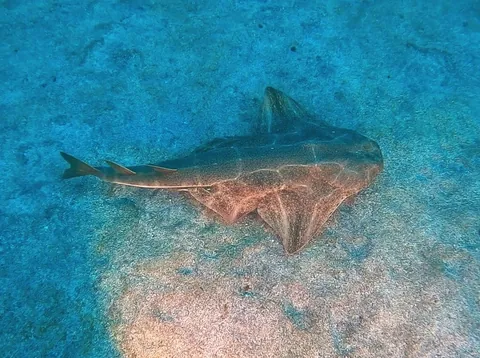
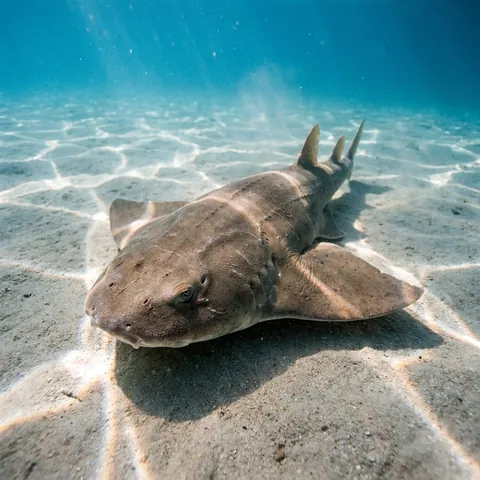
Its flat body and wing-like pectoral fins give it a ray-like shape. The eyes sit on top of the head, with the breathing openings just behind them. The mouth is wide and sits right at the front of the snout, with a pair of barbels above it. The back is gray, brown, or reddish brown, with large blotches ringed by tiny spots in adults and pairs of eye-like spots in young sharks. The underside is white. A row of small thorns runs down the middle of the back and tail, and these shrink or disappear as the shark grows older. The two dorsal fins sit far back near the tail, which has a larger lower lobe.
It lives on soft, flat seabeds close to shore, including bays and estuaries, and is often found near rocky reefs, submarine canyons, and kelp forests. It usually stays in shallow water down to about 46 m, but can be found much deeper.
By day it lies buried and motionless on the seabed, hidden by a thin layer of sediment. At night it may stay still and wait for prey, move around unburied, or swim actively. It often settles at one good ambush spot for a while, then shifts to a new site after local prey learn to avoid it. Great white sharks, sevengill sharks, and elephant seals are known to eat it.
It is an ambush predator that waits at the edge of sandy and rocky ground near reefs, then strikes at passing fish. It feeds mainly on bony fish such as kelp bass, croakers, flatfish, damselfish, mackerel, and sardines, and turns to squid when they gather to spawn in winter and early spring.
If touched, provoked, or speared, it can whip its head around and snap fast enough to cause a painful cut.
Describe what you saw and we name it, then keep every species you find in your Oceandex.