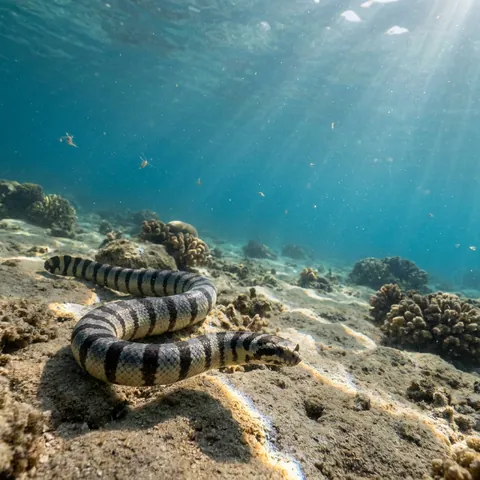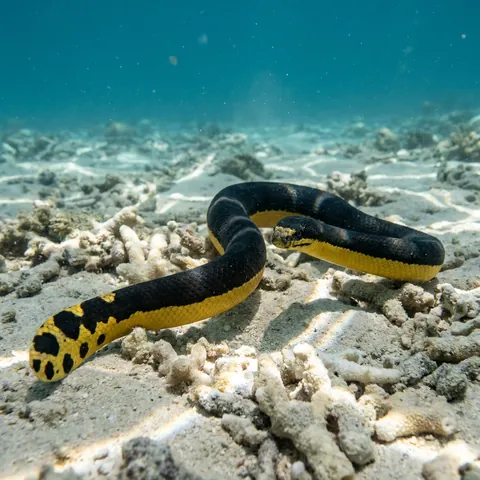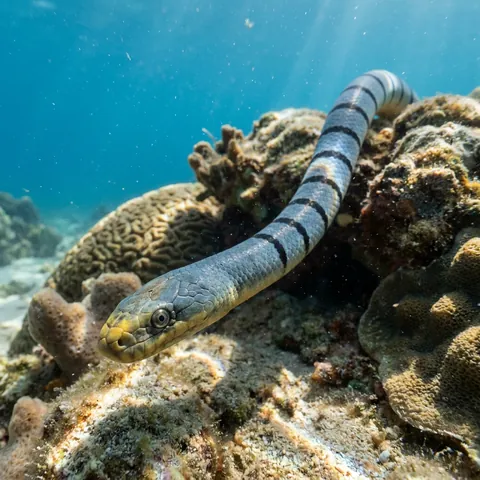
Banded Sea Krait
Laticauda colubrina
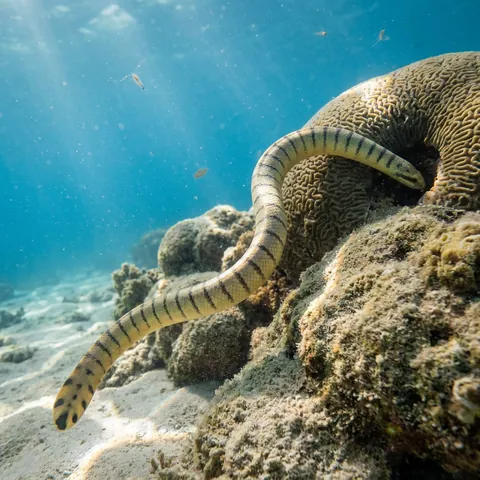
Aipysurus laevis
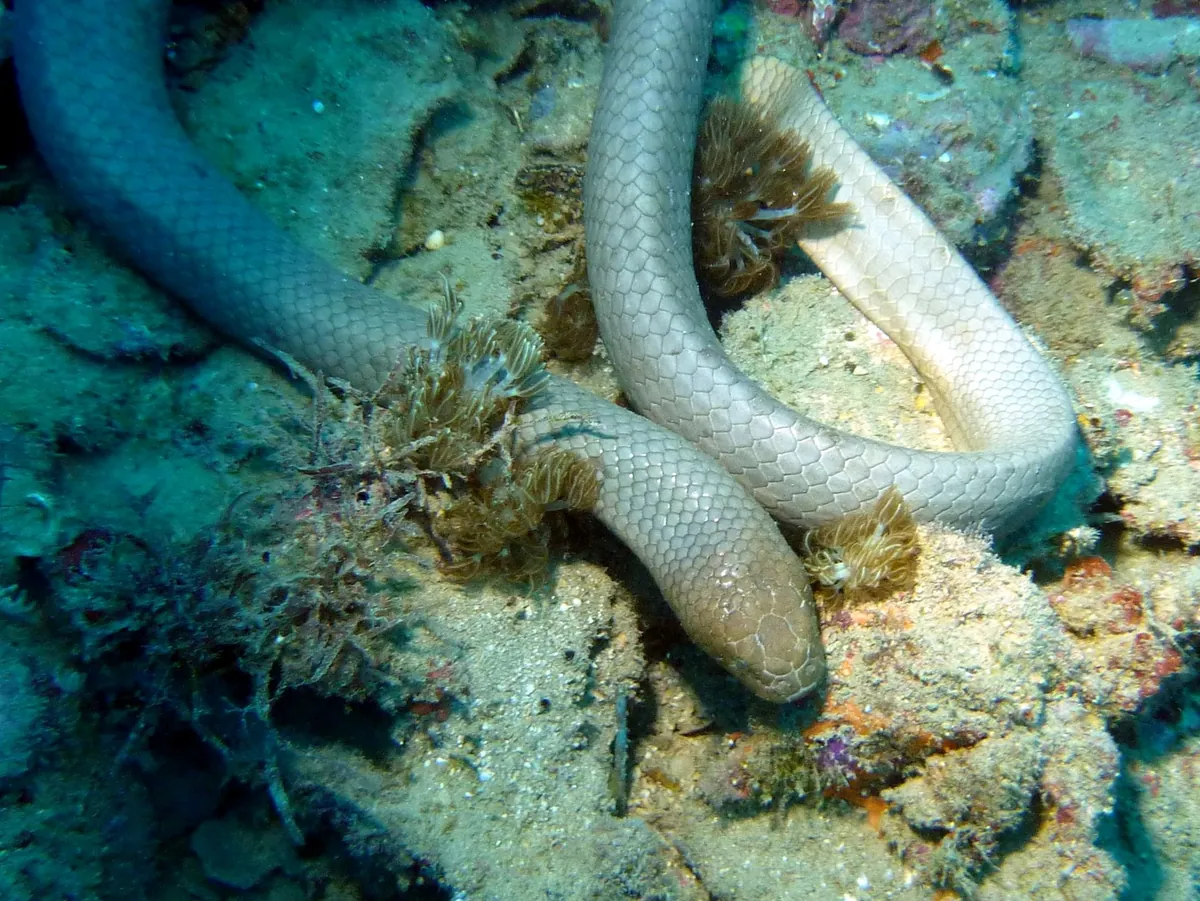
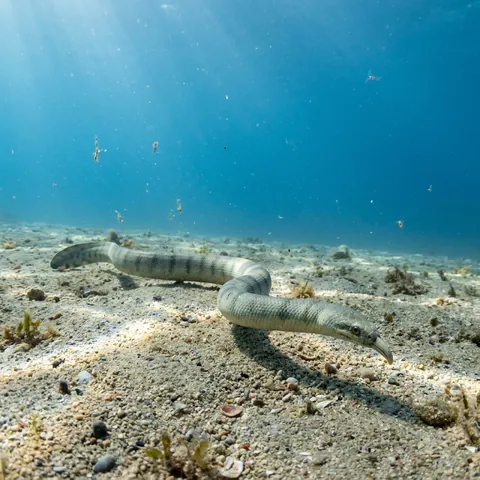
The olive sea snake is a venomous but famously curious reef dweller of the Indo-Pacific. It is usually calm around divers, sometimes swimming in for a closer look rather than fleeing.
Also known as: olive-brown sea snake, olive-brown seasnake
Several sea snakes look alike on a reef. The olive sea snake's habit of hunting by probing its head into crevices, rather than cruising in open water, is a useful clue to its identity.
This snake has brownish, purple-toned scales along its back and a white underside. It swims with a flattened, paddle-like tail. It can grow up to 200 cm long, though most adults are closer to 150 cm.
It lives on coral reefs, including the Great Barrier Reef, across the tropical eastern Indian Ocean and western Pacific, from Indonesia to New Caledonia. It is usually found between 3 and 50 m deep, hiding in small coves and coral crevices when it is not hunting or surfacing to breathe.
The olive sea snake is most active at night and will strike at anything bright and moving nearby. It hunts by poking its head into reef crevices in search of crabs, prawns, fish, and fish eggs, rather than chasing prey in open water. Its venom breaks prey down internally, making it easier to digest. Light-sensitive skin on its tail may help it keep the whole body hidden inside coral holes during the day. It rarely bothers divers unless provoked, and sharks and ospreys are its main predators.
Courtship takes place in open water, where several males often compete for one female. This sometimes leads male snakes to approach divers, apparently mistaking them for a mate. Females give birth to live young rather than laying eggs.
The IUCN lists the olive sea snake as least concern. Its biggest threat is prawn trawling, which kills or injures snakes caught as bycatch. Devices fitted to trawl nets to let turtles escape also help more snakes survive.
The olive sea snake has light-sensing skin on its tail, which may let it tell whether the tip is still tucked out of sight inside a coral hole while the rest of it sleeps during the day.
Describe what you saw and we name it, then keep every species you find in your Oceandex.