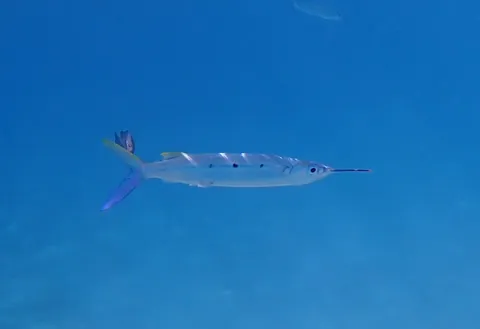
Black-barred halfbeak
Hemiramphus far
Hyporhamphus ihi
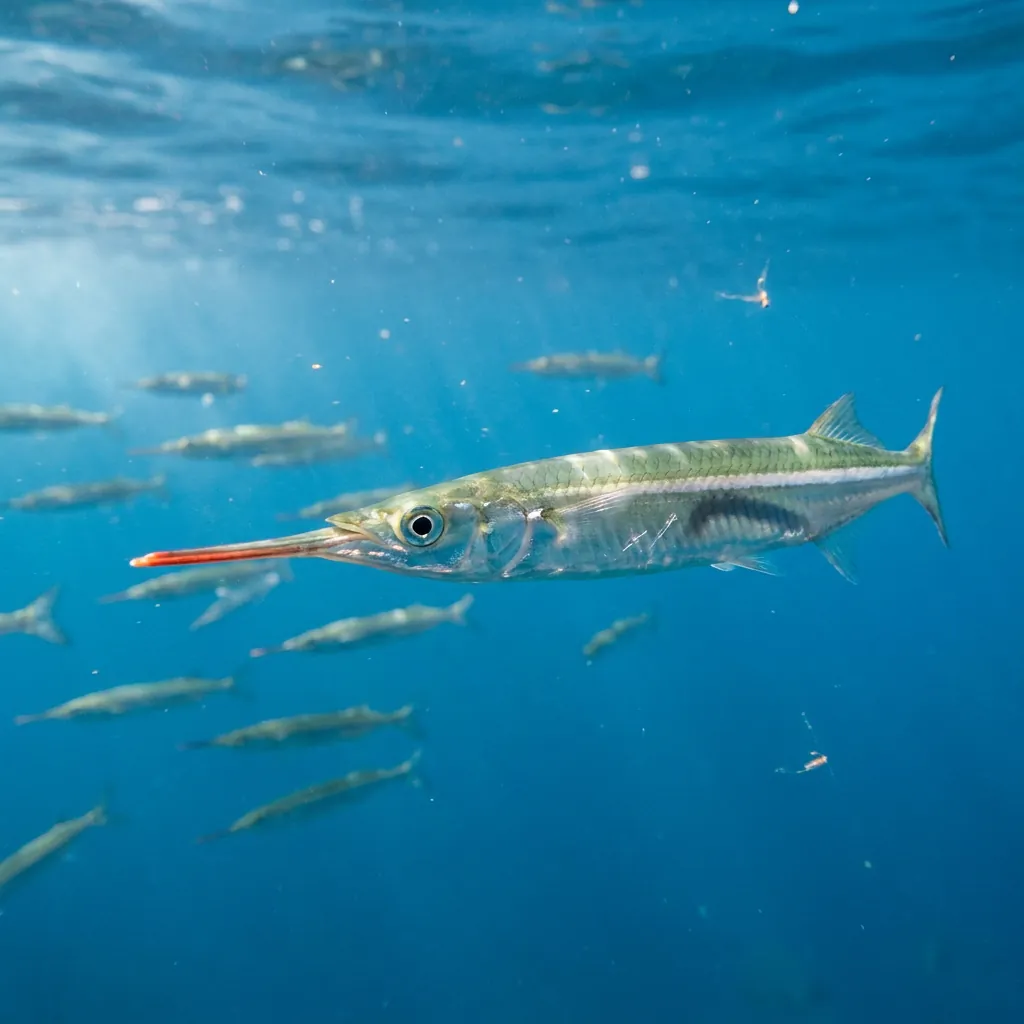
The New Zealand piper is a slender, silvery fish known for its odd, elongated lower jaw. Found only in New Zealand waters, it often skims just under the surface in tight, fast-moving schools.
Also known as: piper, new zealand garfish
A similar species, the southern garfish, lives in Australian waters. The bright orange tip on this fish's long lower jaw, visible even from above, is the clearest way to confirm this one.
This fish has a long, slender body with a greenish-blue back flecked with brown, a silver-white belly, and a silver stripe running from the base of the pectoral fin to the tail. Most fins are dusky, though the fin on the underside near the tail is pale. Its tail is forked with a larger lower lobe. Its standout feature is a long lower jaw tipped with orange, much longer than the shorter upper jaw.
It lives only around New Zealand, including the Chatham Islands and nearby southwest Pacific waters, and is most common in the north and central inshore areas. It favours shallow water in sheltered gulfs, bays, and large estuaries, especially around seagrass meadows and shallow reefs. During the day it stays near the surface in open water, then moves into harbours and estuaries in the evening.
This species forms tight, localised schools rather than mixing widely with other populations. It spawns in shallow bays in late spring and early summer, releasing eggs that sink and stick to underwater plants. Because separate schools mix so little, local populations can be slow to recover if numbers drop in one area.
It is omnivorous, feeding on eelgrass, seaweed, and small crustaceans such as zooplankton, mysids, and the larvae of crabs and worms. It feeds mainly at night and does not rely on eyesight to find food, instead likely using sensory cells along its lateral line and long beak to detect prey nearby. Its schooling habit draws in predators such as kingfish, dolphins, and seabirds like gannets, shags, and penguins.
In Maori, this fish carries several distinct names, including hangenge, ihe, kareha, takeke, and wariwari.
Describe what you saw and we name it, then keep every species you find in your Oceandex.