New Zealand Piper
Hyporhamphus ihi
Hemiramphus far
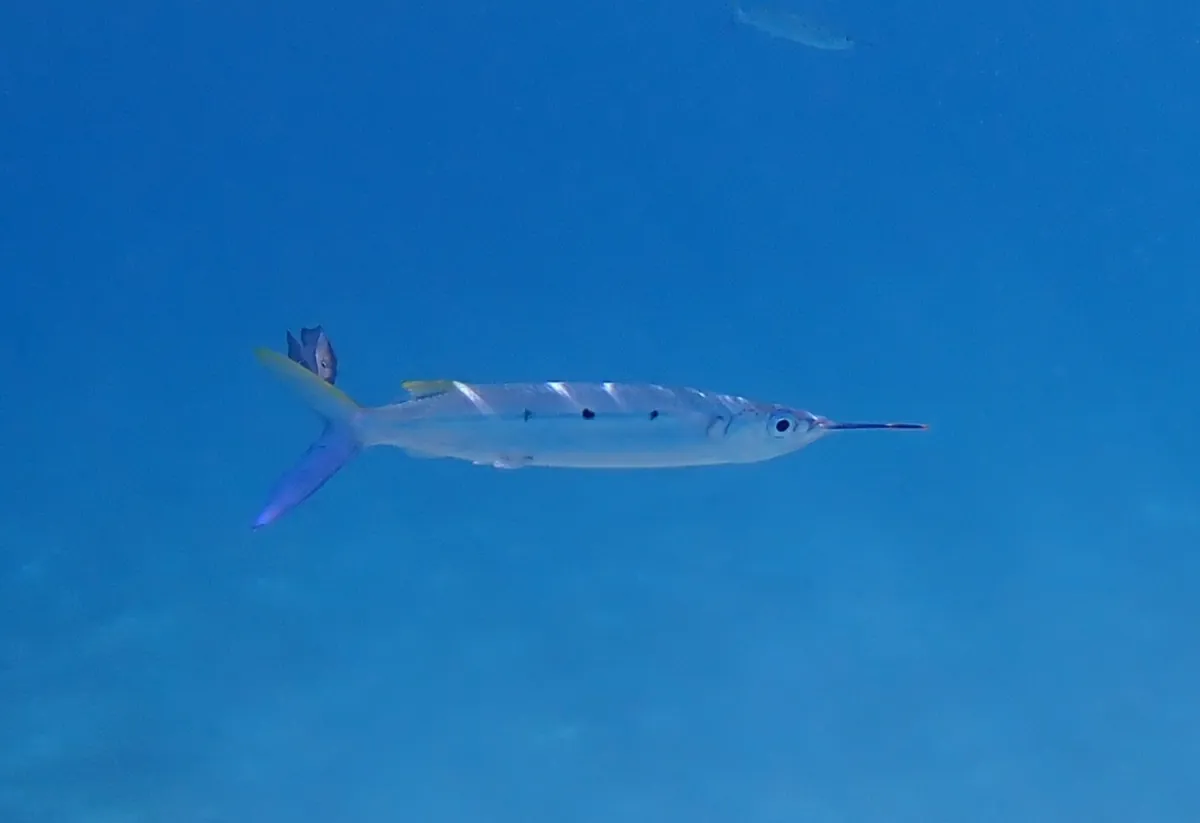
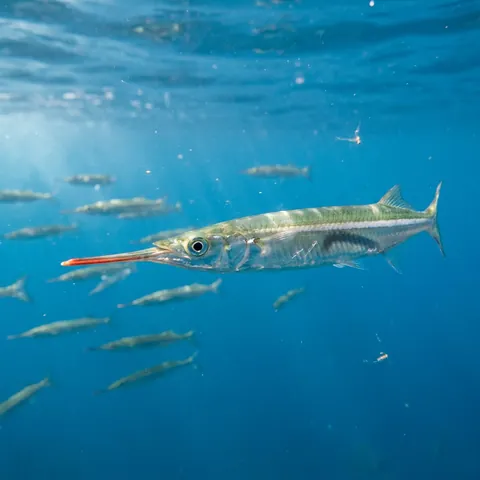
The black-barred halfbeak is easy to spot once you know the trick: a needle-thin body topped by a jaw that looks broken in half. It grows to about 45 cm, though most you see will be closer to 30 cm.
Also known as: blackbarred halfbeak, spotted halfbeak, halfbeak, black-barred garfish, garfish, spotted halfbeak, half beak, blackbarred garfish, barred halfbeak, black barred garfish, barred garfish, spotted halfbeak, barred garfish, blackbarred garfish, black-barred garfish, needlefish, needle-fish
Other halfbeaks share the same split jaw, but the dark vertical bars along this one's sides set it apart.
The lower jaw is a long, beak-like spike, while the upper jaw is short and triangular. The back is bluish and the sides are silvery, crossed by 4 to 6 dark vertical bars. The tail fin is uneven, with the lower lobe longer than the upper. The dorsal and anal fins sit far back near the tail and are dark in colour.
It lives in coastal waters close to shore, over sand flats and beds of seagrass, from the surface down to about 6 m. Its range runs from the Red Sea and East Africa across the Indian Ocean into the Pacific, and it has also spread into the eastern Mediterranean.
This is a social fish that swims in schools near the surface. Adults feed mainly on seagrass, with some green algae and diatoms added in. They breed in estuaries, laying eggs that stick to plants with fine threads until the young hatch and drift as plankton.
This species swam through the Suez Canal into the Mediterranean and is now common along its eastern shores, far from its native Indo-Pacific range.
Describe what you saw and we name it, then keep every species you find in your Oceandex.