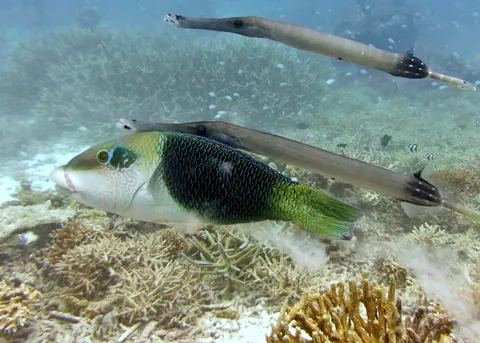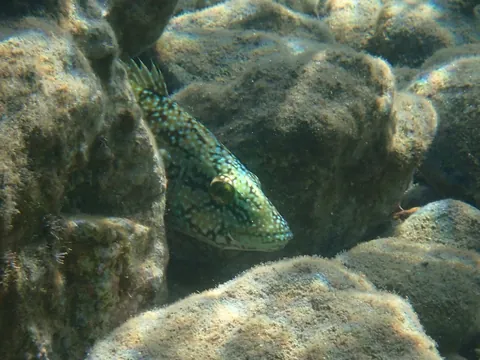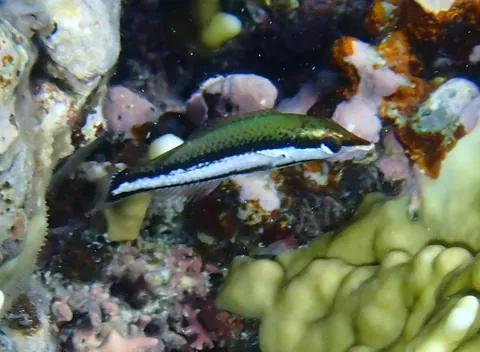
Bird wrasse
Gomphosus varius
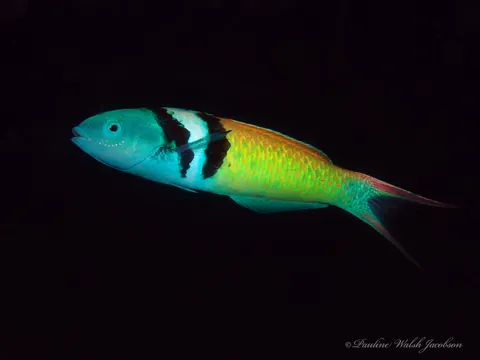
Thalassoma lunare
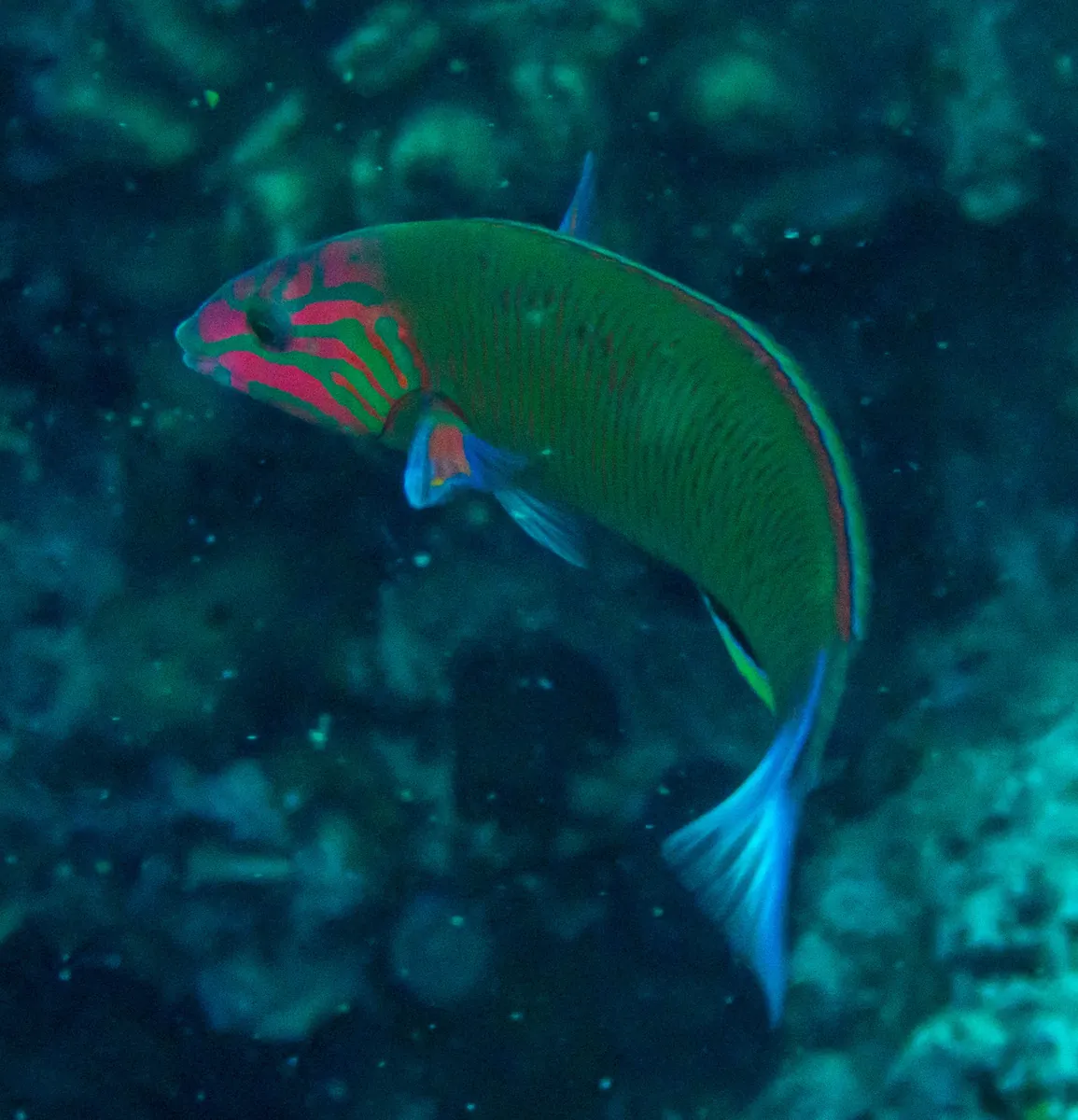
The moon wrasse is a bright green and blue reef fish that never seems to stop moving. It lives on coral reefs and the open ground around them, on the upper parts of lagoon reefs, coastal reefs and sheltered seaward reefs, usually between 1 m and 20 m. It hunts small animals on the bottom and eats fish eggs. The species can reach 45 cm.
Also known as: crescent wrasse, crescent-tail wrasse, lyretail wrasse, moon wrasse, parrotfish, rainbow fish, wrasse, moon wrasse, moon wrasse, crescent wrasse, crescent-tail wrasse
Use the tail. A big yellow crescent across the back edge of a crescent-shaped tail is the giveaway, and it holds at a distance and in poor light. Back it up with the fine red to purple lines that outline every scale on the green body. Head colour is not reliable, because dominant males shift between green and blue.
The body is slim and streamlined, dark green to blue, with narrow red to purple-red lines running down across the scales, so each scale stands out. The head is green to blue with uneven pink to violet bands that give it a broken, patchy look. The tail is cut into a crescent and carries a large yellow crescent mark at the back. The pectoral fins, on the sides behind the gills, are blue with a big pink patch towards the tip. Large males turn blue on the head, and the blue fades into green towards the tail. Young fish look plainer: blue on the lower half of the body, with a dark spot in the middle of the fin along the back and a dark smudge where the tail joins the body.
This wrasse is active all day and always on the move. It is also pushy, and will nip and chase other fish that get in its way. It hunts by sight, though it has a reasonable sense of smell too. At night it rests in a gap under a rock or a similar shelter, and if the space is too tight it will swim through the gap again and again until it has worn out a hole that fits. Every moon wrasse starts life as a female and later becomes a male. Some live in groups made up of one dominant male and a number of other fish.
The dominant male keeps time with the tide. At each low tide he swaps his green head colour for blue and goes round the group nipping and chasing the others, and in the breeding season, just before high tide, he turns blue all over and gathers the females for spawning.
Describe what you saw and we name it, then keep every species you find in your Oceandex.