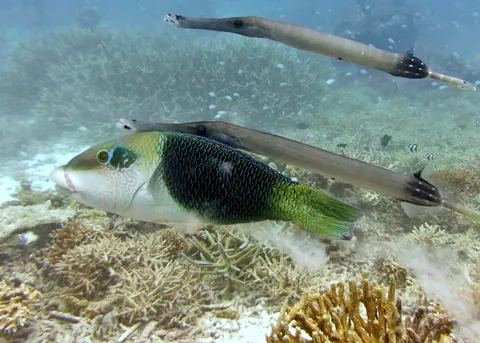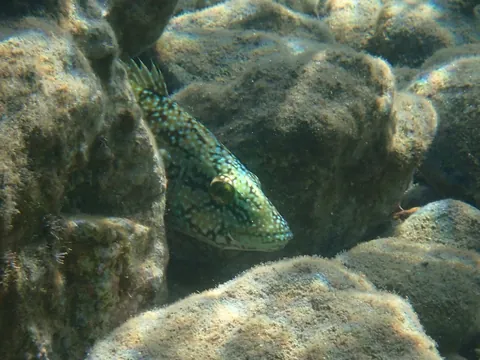
Bird wrasse
Gomphosus varius
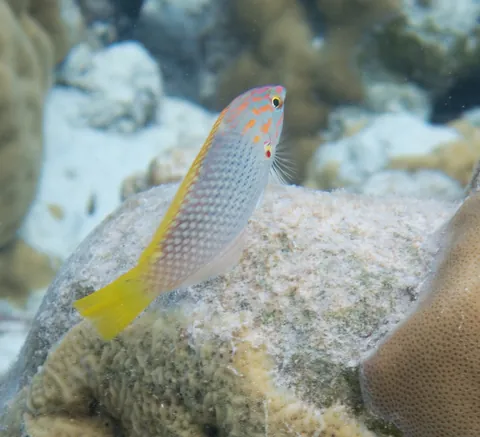
Thalassoma bifasciatum
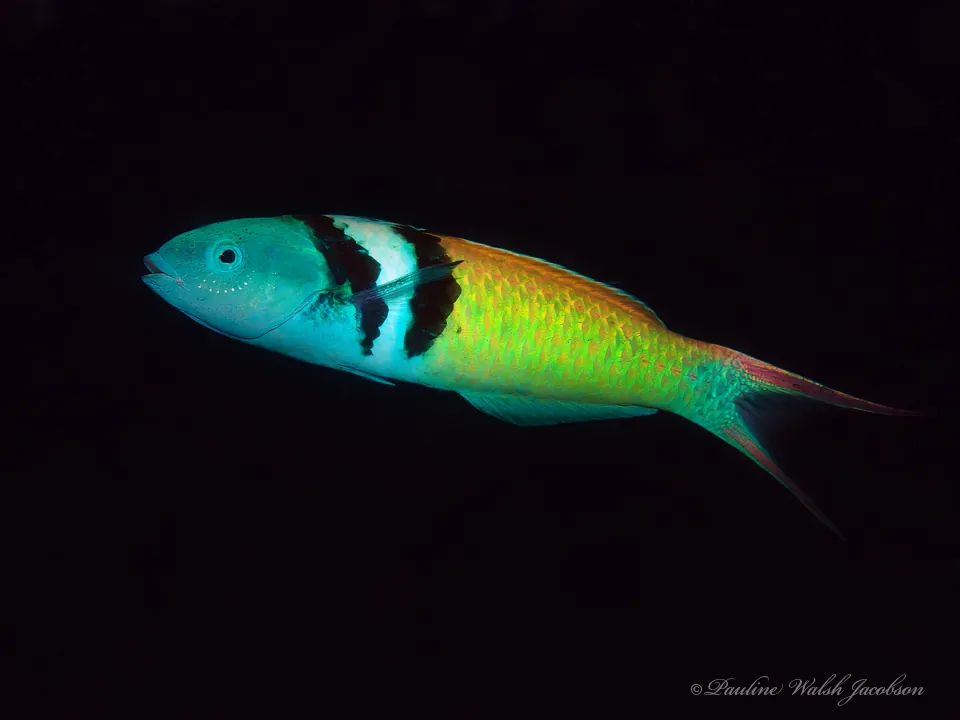
The bluehead wrasse is one of the most common fish on Caribbean reefs, darting between corals in loose groups. It stays small, reaching at most about 25 cm.
Also known as: blue mah, tikitiki
Its yellow-and-white juvenile colouring looks like several other small reef wrasses and can change in moments, so it is not reliable for identification. The large terminal-phase male is unmistakable instead: look for the solid blue head.
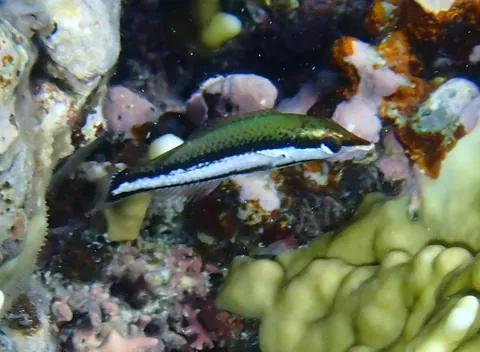
Young fish and many females are yellow on top and white below, sometimes with a black stripe or dark bars along the side, and they can shift these colours and patterns within moments. Large, older males look completely different: a bright blue head, a green body, and two black bars edged in pale blue just behind the head.
It lives on coral reefs across the Caribbean Sea and the southeast Gulf of Mexico, usually between about 3 and 30 metres deep. It also turns up in sheltered inshore bays and seagrass beds close to reefs.
Bluehead wrasses live in a ranked male society. The largest, most aggressive males hold territory at set breeding sites, while smaller males mate opportunistically when they get the chance. A male's colour shifts with what it is doing: it turns metallic green while chasing rivals and pink-grey with black fin markings while courting a female.
It picks zooplankton, small crustaceans like shrimp, worms, and other small invertebrates from the water and reef. It will also eat the eggs of smaller fish and pick parasites off other fish.
Every day, females travel to breeding sites defended by large males and spawn there. Females tend to stay near the same spawning spot their whole life, while males may leave or be displaced by rivals. A female can change into a male, a permanent switch that can happen within about eight days.
The bluehead wrasse is listed as Least Concern and is one of the most abundant fish on reefs near Puerto Rico and the Virgin Islands. It is sometimes caught for the aquarium trade because of its bright colours, though this is not considered a threat to the species.
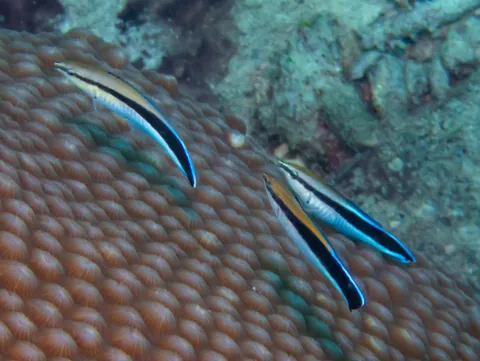
This wrasse often works as a cleaner fish, picking parasites off other fish. But it is choosy about its customers: it avoids cleaning ambush hunters like the spotted moray, since those fish are just as likely to eat it as let it clean them.
Describe what you saw and we name it, then keep every species you find in your Oceandex.