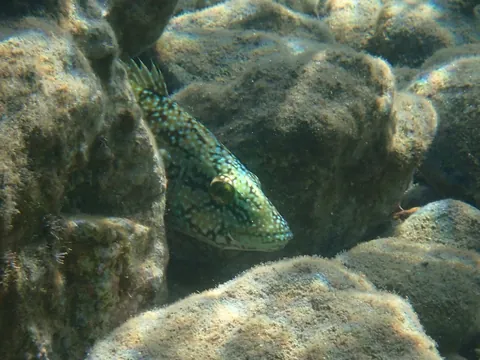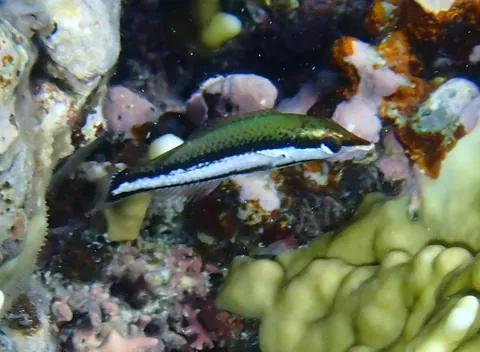
Bird wrasse
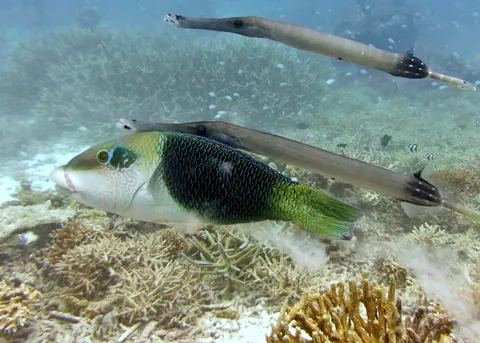
Gomphosus varius
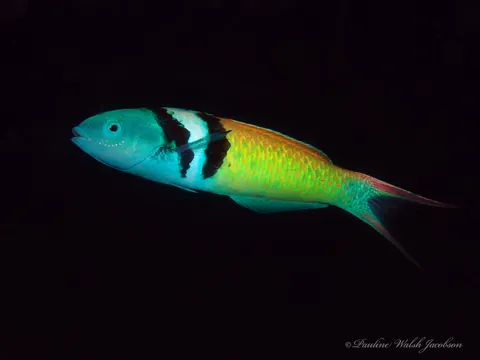
Coris julis
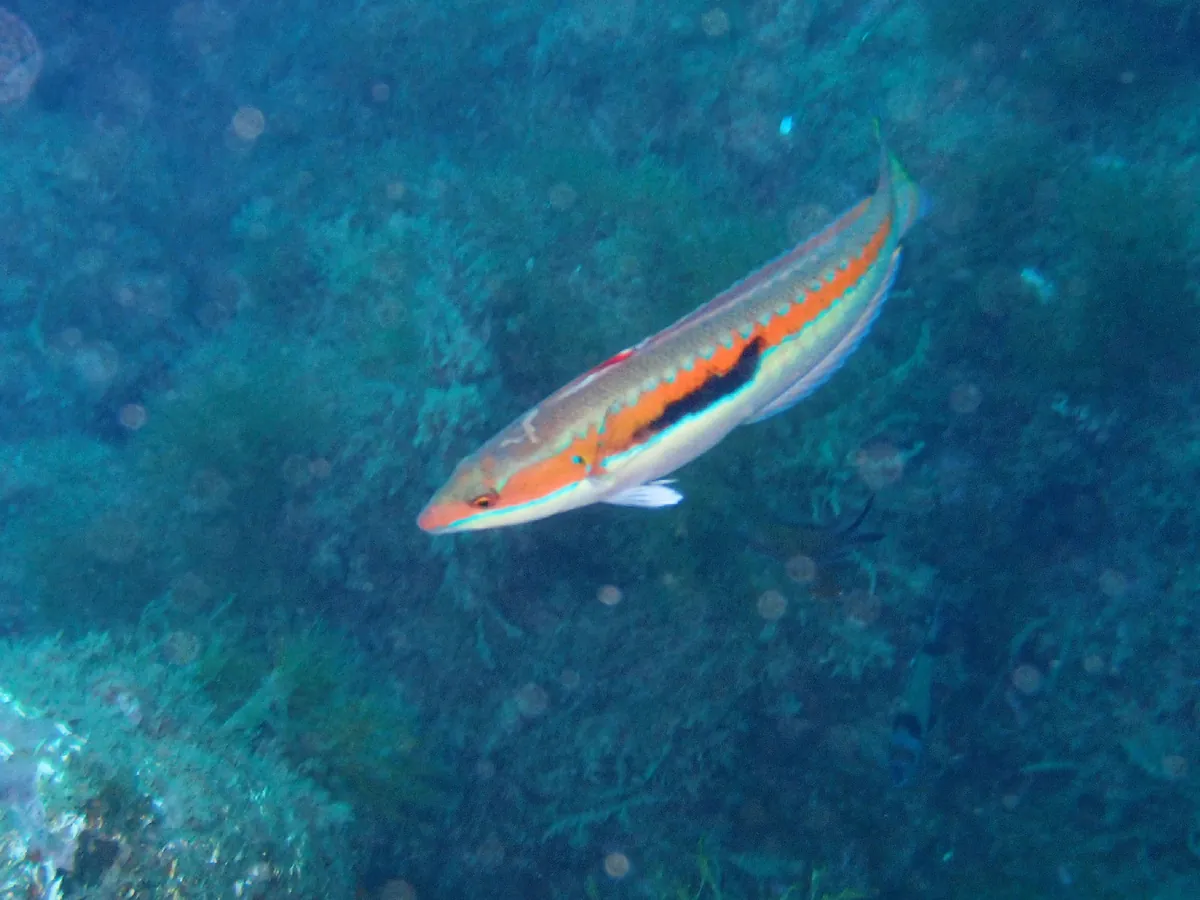
The Mediterranean rainbow wrasse changes both its colour and its sex over its lifetime, so much so that scientists once mistook its two forms for two different fish. It grows to about 30 cm, though most divers see fish closer to 20 cm.
Also known as: rainbow wrasse, mediterranean rainbow wrasse, mediterranean rainbowfish, girelle, Coris julis
The two colour forms look so different they were once classed as separate species. Either way, look for the long stripe running from snout toward the tail on a small, slender wrasse: black in the earlier form, orange in the brighter males.
Younger and female fish have an orange-brown back, a whitish-yellow belly, and a black stripe running along the side. Males in the brighter, later phase turn bluish-grey to greenish-brown with a white belly, and carry an orange zig-zag stripe from the snout to the base of the tail, with a black band running below it.
It lives over rocky and sandy sea floor and in seagrass beds, in shallow coastal water down to about 60 m, occasionally to 120 m, in water around 18 to 22 degrees Celsius. It is common across the Mediterranean and along nearby Atlantic coasts, from Norway south to West Africa.
It forages over the bottom by day, often in groups, and buries itself in the sand at night, becoming much less responsive while hidden. The brighter, later-phase males defend territories against rival males, though they do not control where females in that territory choose to spawn.
During mating, males swim rapidly with their dorsal fin held up and down. Eggs hatch after about two days, and the young drift as plankton for around a month before settling to the bottom. In parts of its range, such as the Balearic Islands, spawning peaks between May and July.
Harmless.
It is listed as Least Concern, with a stable population. There is no targeted commercial fishery for this species, though it is sometimes caught as bycatch or for food, and it faces the same general pressures as other coastal fish, such as pollution and coastal development.
Its brighter males show off a bold orange stripe, even though orange light barely travels underwater. Studies suggest the males can still tell rivals apart by colour, which is what drives them to defend their territory.
Describe what you saw and we name it, then keep every species you find in your Oceandex.