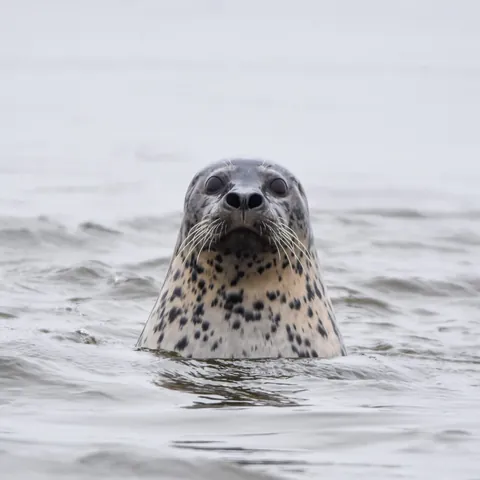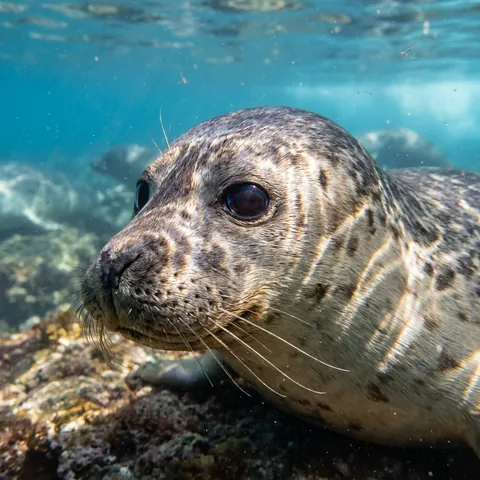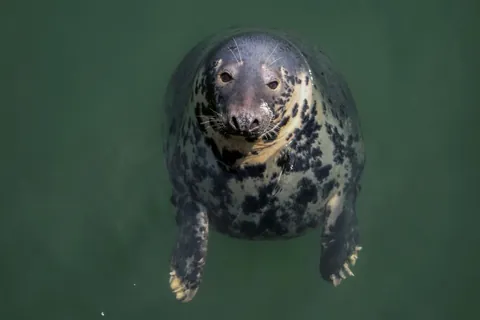
Grey Seal
Halichoerus grypus
Pagophilus groenlandicus
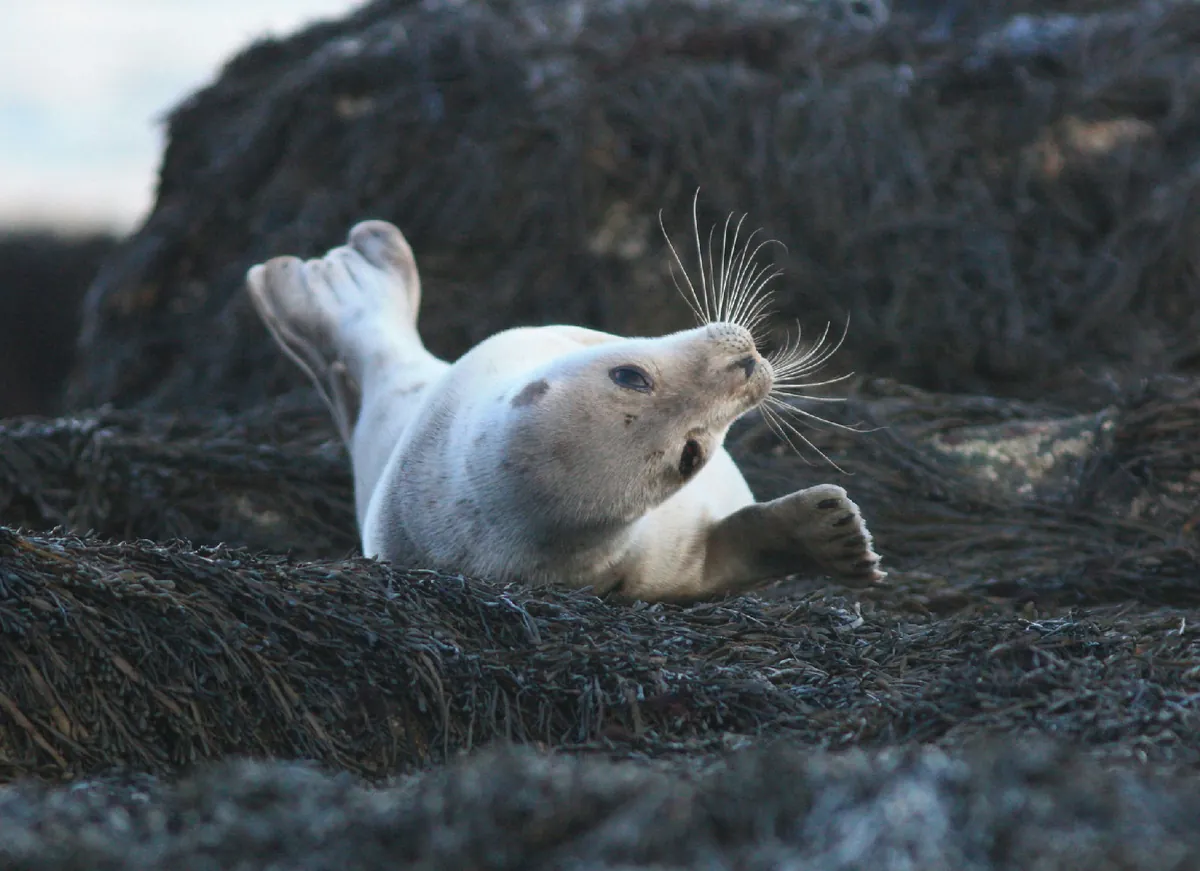
The harp seal is a pack-ice specialist of the far north Atlantic and Arctic, named for the black harp-shaped marking across its back. Adults grow up to 190 cm long and weigh as much as 135 kg.
Also known as: greenland seal, saddleback seal
Adults stand out from other seals by the black, harp-shaped patch across the back; young pups lack this mark entirely and are pure white instead.
Adults have silver-grey fur, pure black eyes, and a black, harp- or horseshoe-shaped marking across the back. Pups are born pure white and keep that coat for their first few weeks, then moult into a silvery grey coat covered in black spots. The adult harp pattern develops later, often abruptly in males but more gradually in females, and some females never fully develop it.
Harp seals depend on seasonal pack ice for breeding, which limits them to the northernmost Atlantic and Arctic Oceans. Major breeding grounds lie off Labrador and Newfoundland and in the Gulf of St Lawrence in Canada, off eastern Greenland, and in the White Sea off northern Russia.
Harp seals are only modest divers, generally staying shallower in spring and summer near the pack ice and diving deeper in late fall and winter. Adults are highly social and often gather in groups, while young seals tend to keep to themselves.
It hunts a wide range of fish and invertebrates, including krill, capelin, herring, flatfish, and various cod species, with the exact mix depending on what is locally abundant.
Harp seals breed on the pack ice between mid-February and April, though mating itself usually happens in the water. After fertilisation, the embryo pauses its development and does not implant right away, delaying birth until there is enough pack ice for the pup. Females usually bear a single pup at a time.
The harp seal is Near Threatened. Its numbers have swung dramatically over the past century and a half because of commercial hunting, mainly by Canada, Norway, Russia, and Greenland. Catch quotas introduced in recent decades have allowed some recovery.
Courting male harp seals perform underwater displays for females, blowing bubbles and calling out while moving their flippers in elaborate patterns.
Describe what you saw and we name it, then keep every species you find in your Oceandex.