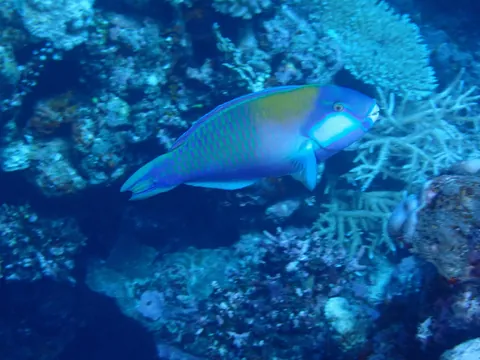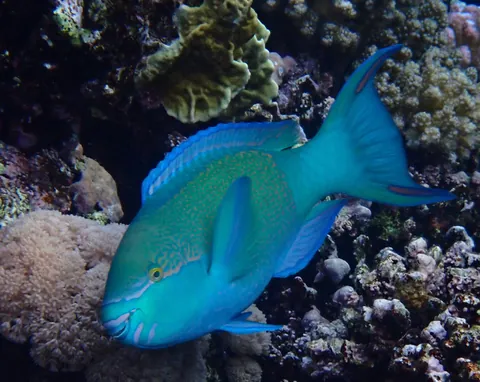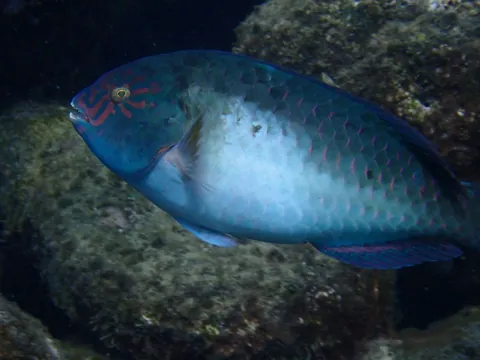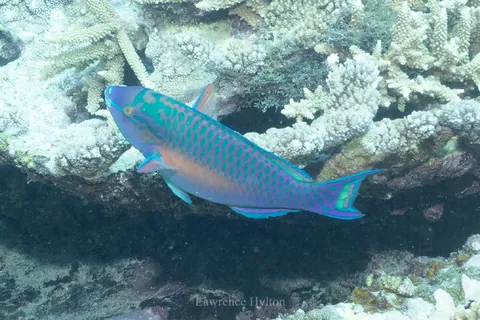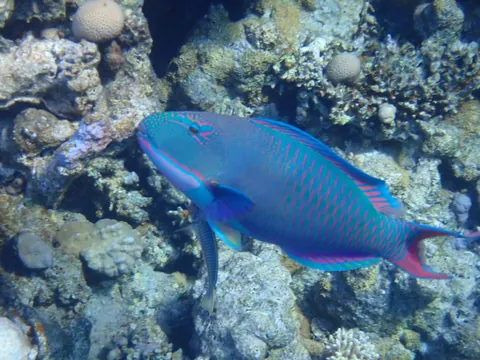
Bicolour parrotfish
Cetoscarus bicolor
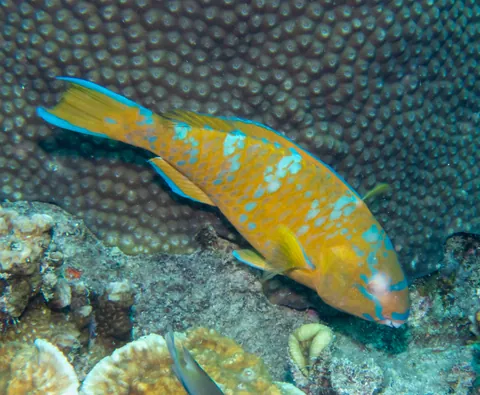
Scarus spinus
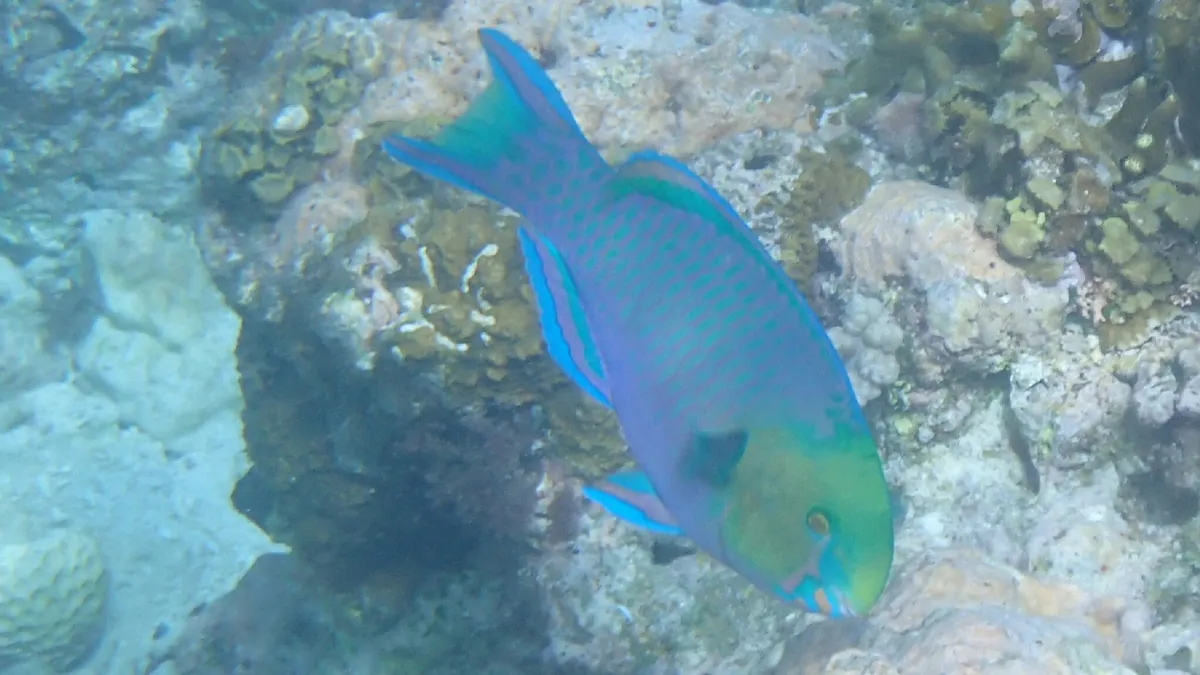
The greensnout parrotfish is one of the harder parrotfish to tick off a dive. It is never common, and it turns up only in patches across its range. It grows to about 30 cm, so you are looking for a mid-sized fish working the coral, not a bulky one.
Also known as: pygmy parrotfish, spiny parrotfish, yellow-head parrotfish, parrotfish, yellow-head parrotfish, yellowhead parrotfish, pygmy parrotfish, spiny parrotfish, yellowhead parrotfish
Mixed parrotfish groups are the problem here, since a drab female can pass for several other species. Go to the mouth. On this fish the lips cover the beak almost completely, so you see little or no bare tooth plate, while most reef parrotfish show an obvious pale beak. Check that first, then use the yellow head to confirm a male.
Males and females look so different that they are easy to take for two fish. A male shows a bright yellow head underwater. Females are much plainer, with pale spots and white teeth that catch the light. The scales are large, and the cheek carries three rows of them. The tail shape also shifts with life stage: rounded to square-cut in younger fish, and notched or forked in a full-grown male.
Look for it on coral-rich ground, both in outer lagoons and on seaward reefs. It favours the shallow band, mostly between 2 and 15 m, and rarely goes past 25 m. It lives in the tropical western Pacific, from the Philippines east to Samoa, north to the Ryukyu Islands and south to the southern Great Barrier Reef. Christmas Island holds a population too. Females usually feed in small groups with a male close by, and they will mix in with females of other parrotfish.
Describe what you saw and we name it, then keep every species you find in your Oceandex.