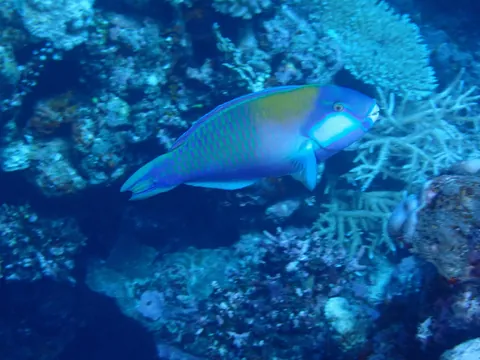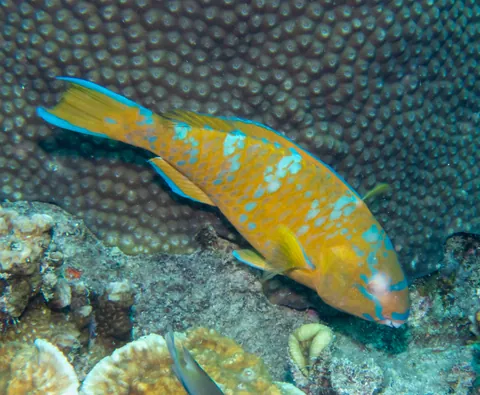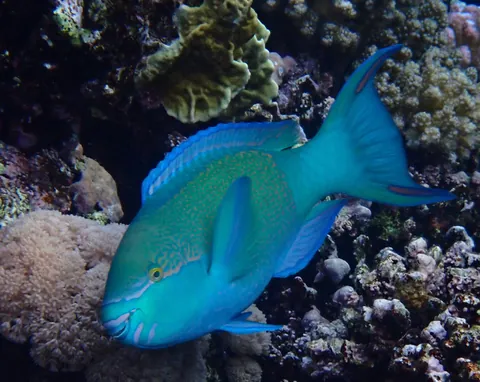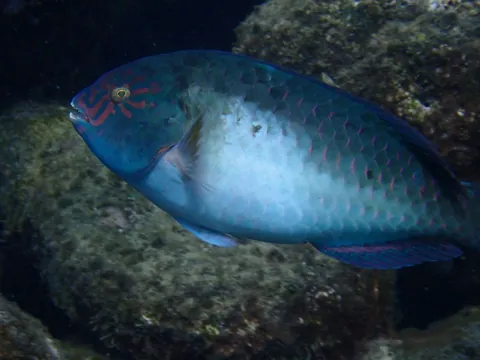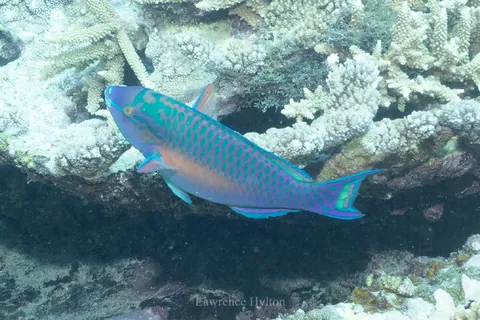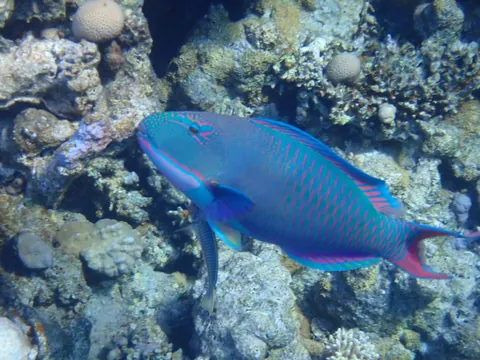
Bicolour parrotfish
Cetoscarus bicolor
Bolbometopon muricatum
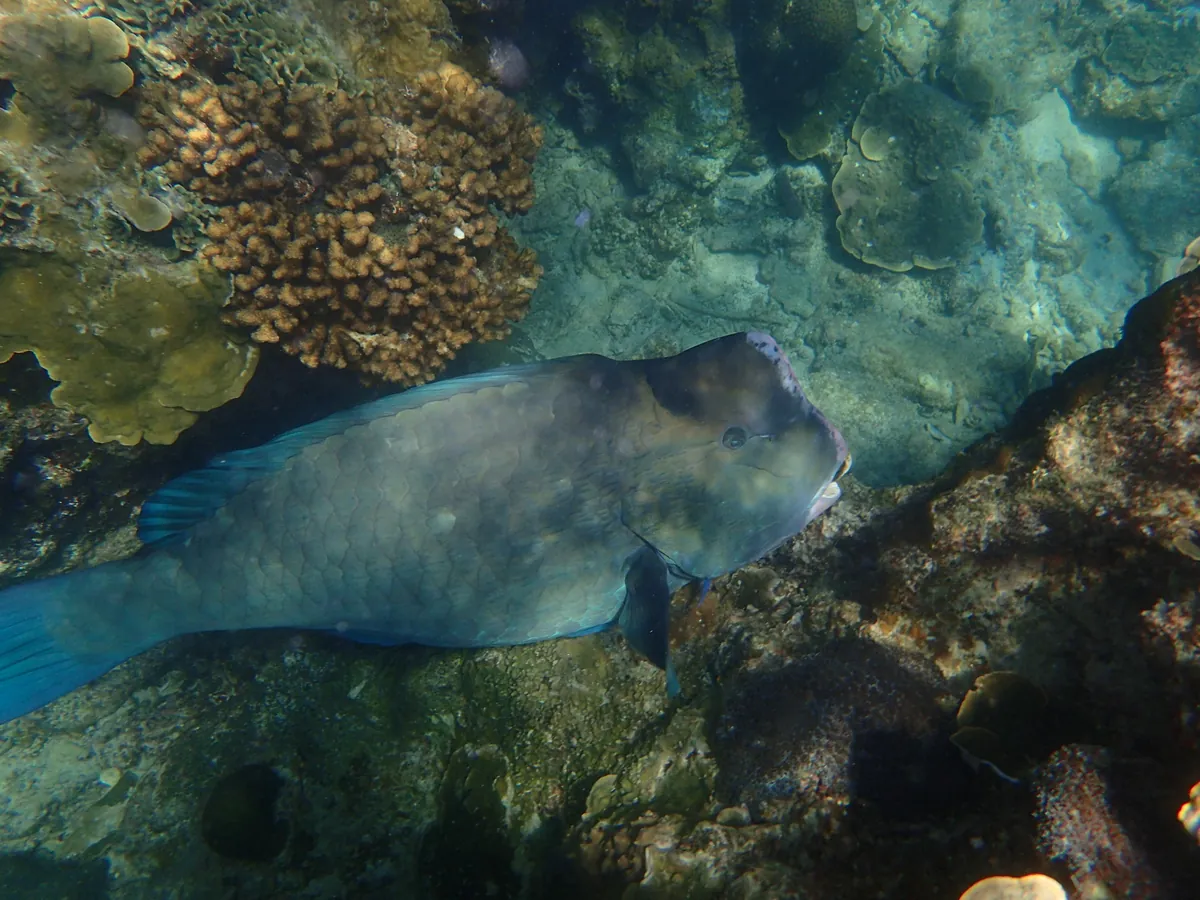
The giant of the parrotfish family, this bulky, deep-green reef dweller is hard to miss once you know its shape. It commonly reaches about 70 cm but can grow to 130 cm and weigh up to 46 kg, making it a true reef heavyweight.
Also known as: bolbometopon muricatum, bumphead parrotfish, double-headed parrotfish, humphead parrotfish, napoleon's fish
This is the largest parrotfish on the reef, and its most obvious tell is the bulging, hump-like forehead that no other large parrotfish has.
Adults are a uniform dark green, with a paler patch of light green to pink along the front edge of the head. Unlike other parrotfish, scales cover the whole head and body. Its tooth plates are exposed and only partly covered by the lips, and it holds its head in a more upright, vertical position than typical reef wrasses. Juveniles look different, coloured dull grey with scattered white spots.
This species is gregarious, sleeping in large groups at night inside caves and even shipwrecks. By day it feeds on benthic algae and live coral, sometimes ramming its head against coral heads to break them open. Around spawning time, males sometimes fight head-on with enough force to make a loud, jarring crash, then continue the contest by biting each other; more often, rival males simply swim side by side to size each other up.
harmless
Listed as Vulnerable. Its large size, slow growth, and habit of sleeping in groups make it an easy and attractive target for spearfishers and netters, and overfishing has driven declines across its range. Habitat degradation, including sediment runoff that harms the shallow lagoons juveniles depend on, adds further pressure. Some areas now protect it through fishing bans or export restrictions.
Rival males sometimes settle disputes by charging head-first into one another, colliding hard enough to produce a loud jarring crash, a use of their forehead hump that has been compared to bighorn sheep butting horns.
Describe what you saw and we name it, then keep every species you find in your Oceandex.