Fur Seal
Arctocephalus pusillus
Arctocephalus galapagoensis
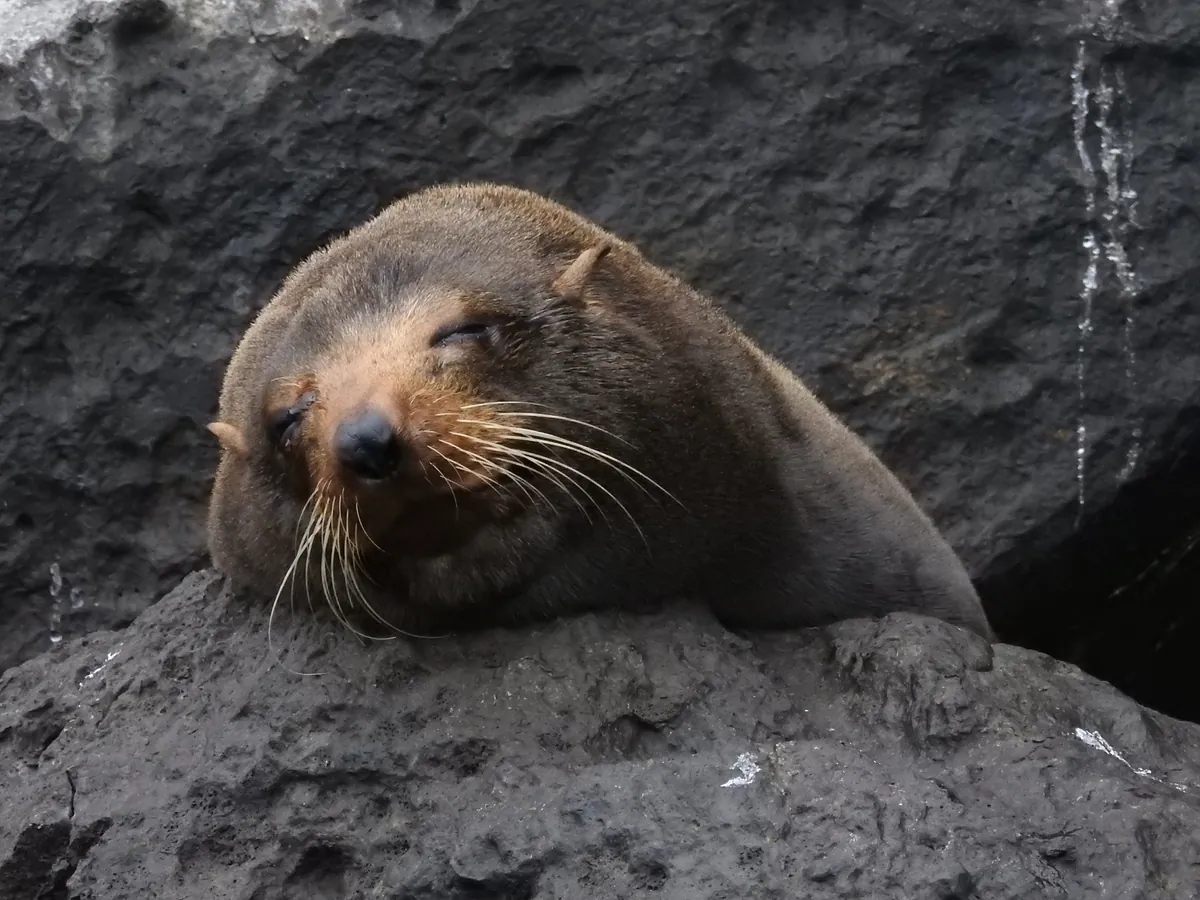
The Galapagos fur seal is the smallest eared seal in the world, found nowhere but the Galapagos Islands. It can reach 160 cm in length and weigh up to 68 kg, and its large eyes hint at a life spent hunting after dark.
Also known as: galápagos fur seal
It is often confused with the Galapagos sea lion. Look for its noticeably larger eyes and smaller, more compact body to tell the two apart.
Pups are born with a black coat, which they shed for a lighter brown one as they grow. Males and females look fairly alike for this family of seals, though males grow noticeably larger and heavier than females. Its eyes are unusually large, an adaptation for finding prey at night.
This fur seal lives along the rocky coastlines of the Galapagos Islands, sheltering from the sun in crevices, under ledges, and between boulders and lava rock. It rarely travels far and does not migrate, staying close to its home colony year-round.
It feeds mainly on fish, squid, and shellfish, hunting close to shore and near the surface, usually at night when prey is easier to catch. Food becomes scarce during El Niño years, and many pups die when adults must compete harder to feed themselves first.
Breeding runs from mid-August to mid-November, peaking in late September and early October, when males claim territories on the beach. A female has just one pup and stays with it for its first week before beginning short trips to feed, returning to nurse for a few days at a time. Pups depend on their mother's milk for up to eighteen months, longer if food is scarce.
This species has not yet been formally assessed for its conservation status. Hunting drove a sharp population decline in the 19th century, and although protection under Ecuadorian law let numbers recover, pollution, disease, and invasive species have caused a renewed decline since the 1980s. Boat traffic and the risk of oil spills remain ongoing threats near the islands.
It has the lowest reproductive rate of any seal species, and pups can take two to three years to be weaned when food is scarce.
Describe what you saw and we name it, then keep every species you find in your Oceandex.