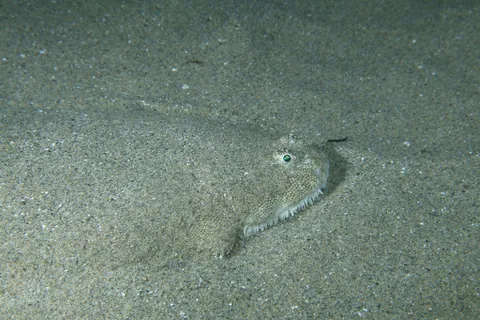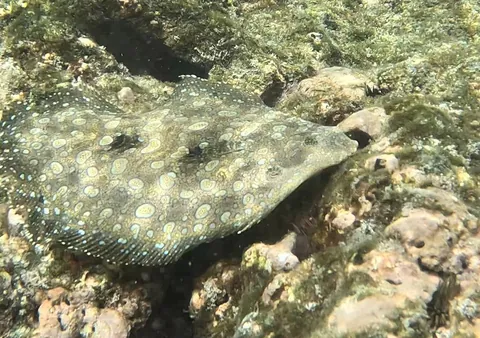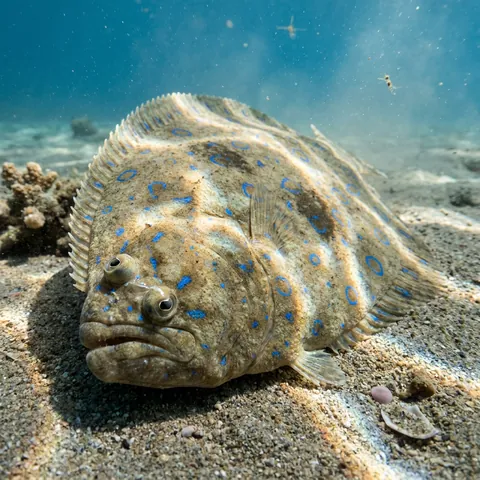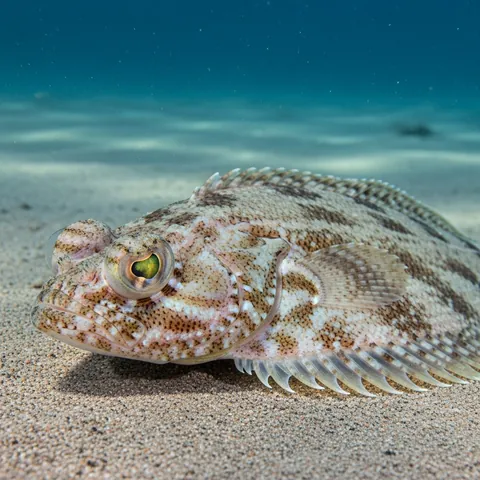
Cape Scaldfish
Arnoglossus capensis
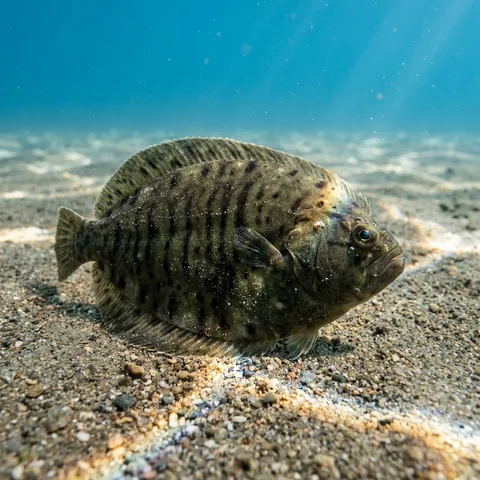
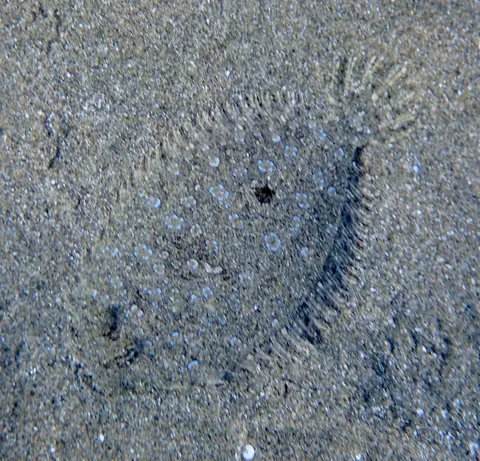
Platichthys flesus
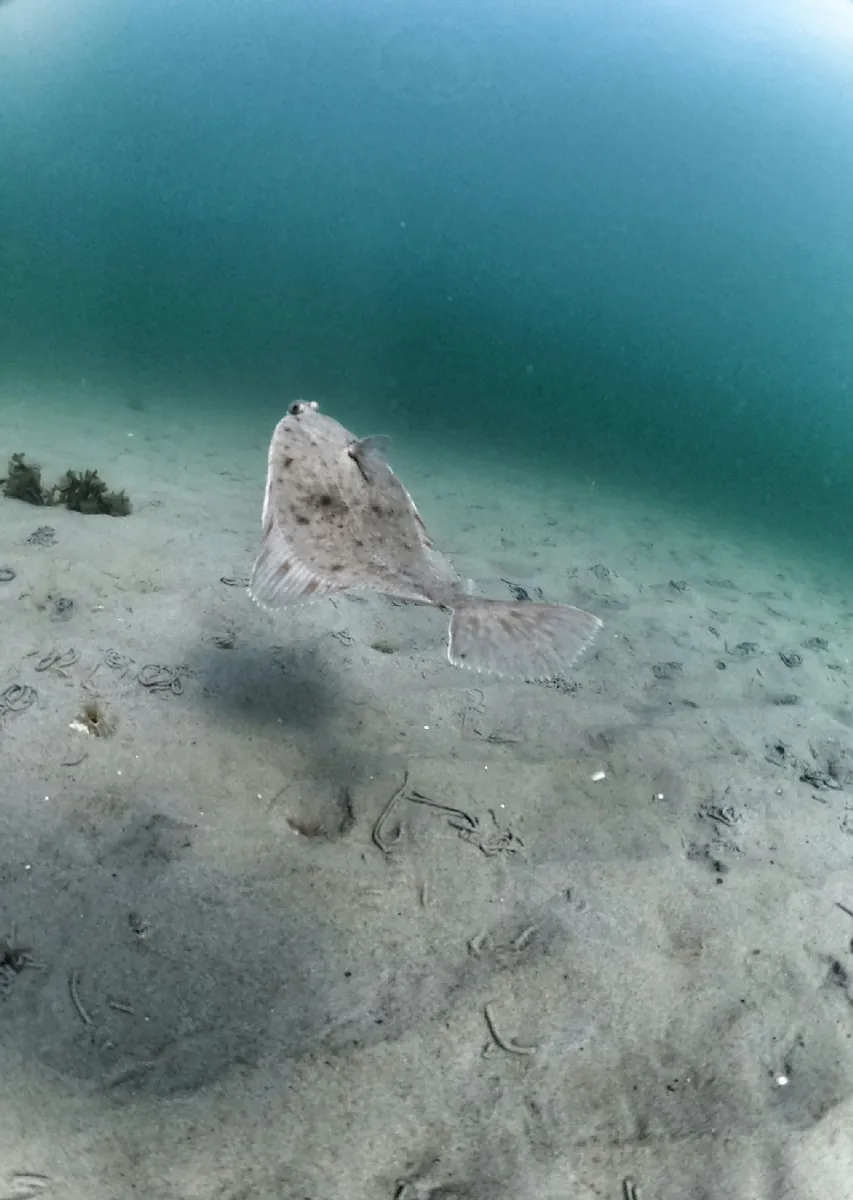
The European flounder is a flatfish that lies camouflaged on the seabed, one of the few flatfish willing to swim far up rivers. It commonly reaches about 50 cm, with the largest known individuals up to 60 cm and 2.93 kg.
Its mottled brown colouring is shared with several other flatfish, such as plaice and dab. Feel is not an option underwater, but a close look shows a rough line of small bumps along the base of its fins and lateral line, which smoother-skinned lookalikes lack.
This is an oval, flattened flatfish, about twice as long as it is wide, that rests and swims on its side. Most individuals have both eyes on the right side of the head, though in roughly three out of ten fish the eyes sit on the left instead. The upper side is fawn, olive green, or pale brown, covered in darker brown spots and patches with occasional reddish flecks, while the underside is a plain pearly white. It has a small mouth on a blunt, rounded snout.
Found across the north-eastern Atlantic and the Mediterranean, from the Barents and Baltic Seas south to the Black Sea and North Africa, on sandy, shingle, or muddy bottoms from the shore down to about 100 m. Unlike most flatfish, it tolerates low salinity well and often moves into estuaries and even rivers.
It is mainly active at night, spending the day half-buried in sand or mud on the seabed. In autumn it leaves fresh water and estuaries for deeper water offshore, then migrates to spawning grounds again in spring.
Young fish under a year old feed on plankton and insect larvae. Older juveniles and adults switch to bottom-dwelling prey, including bivalve molluscs, shrimp, worms, snails, and small fish.
harmless
Listed as Least Concern overall, thanks to a wide range and large population. Locally, though, it has struggled: in parts of the Baltic Sea, especially the Gulf of Finland, breeding grounds have shrunk so much that the species has nearly disappeared there.
Unlike almost every other flatfish, this species regularly swims far up rivers, sometimes many miles inland, before heading back to the sea to spawn.
Describe what you saw and we name it, then keep every species you find in your Oceandex.