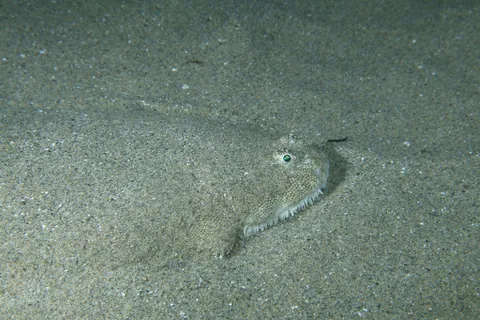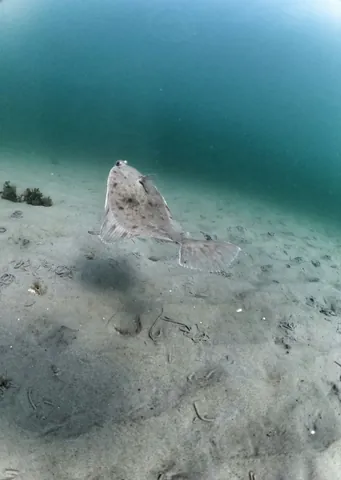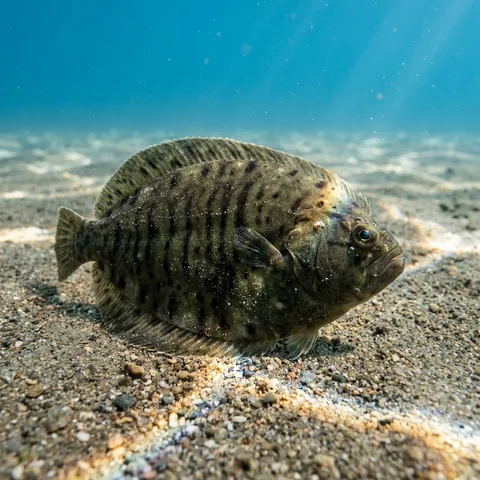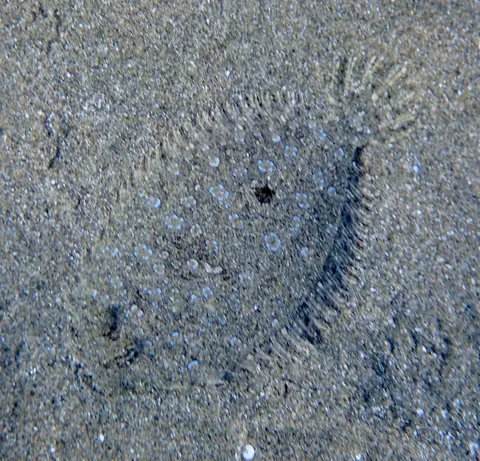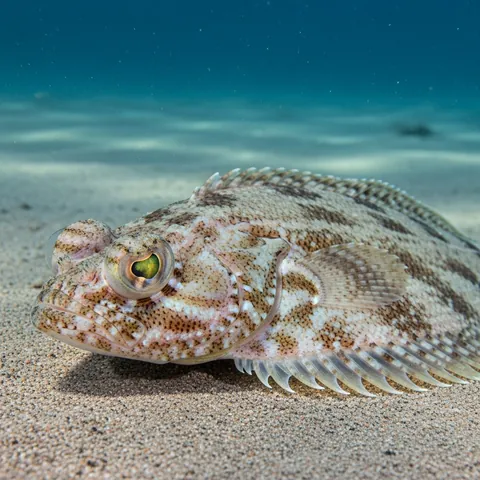
Cape Scaldfish
Arnoglossus capensis
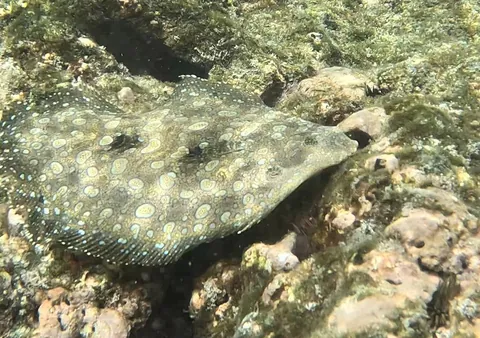
Bothus mancus
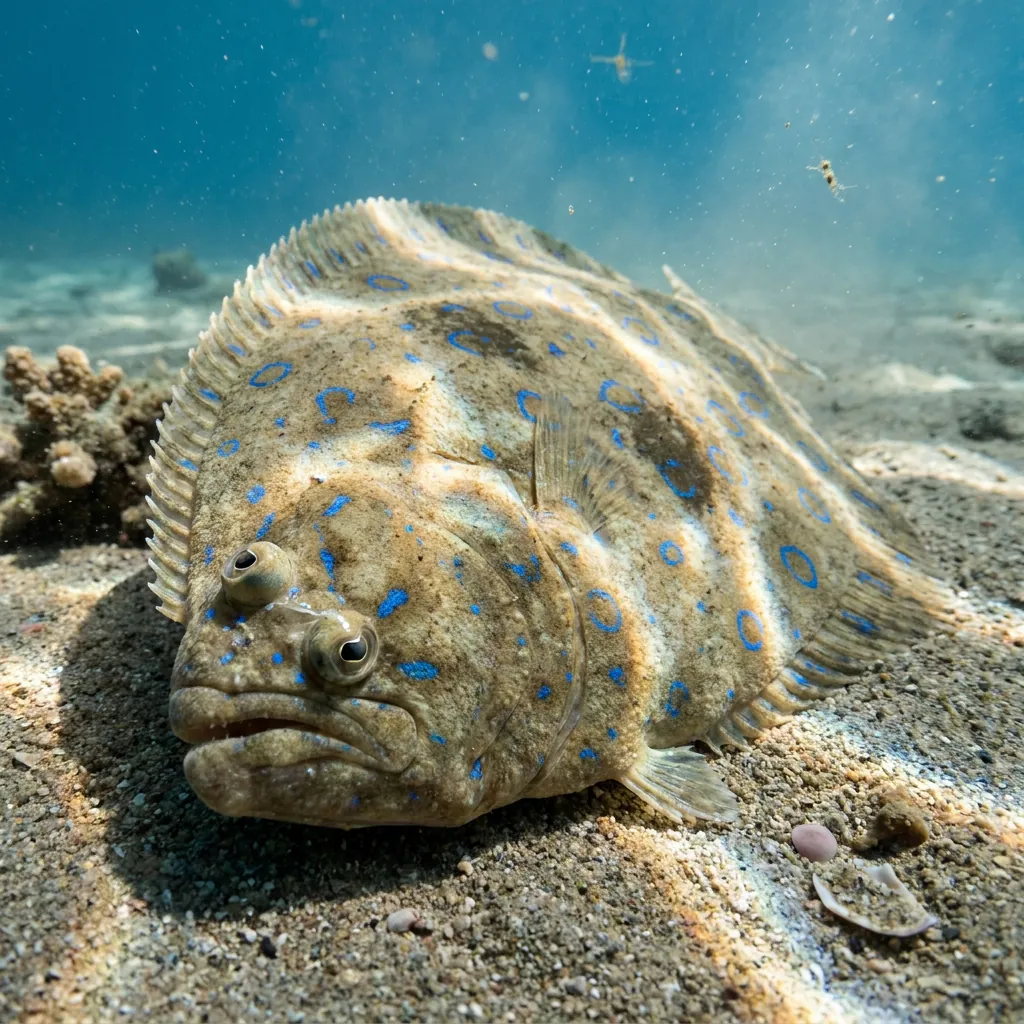
Half-buried in the sand, this flounder can vanish into a checkerboard of light and shadow in seconds - and can weigh up to 1.75 kg when fully grown.
Also known as: peacock flounder, flowery flounder, tropical flounder, sandy flounder, sand flounder
This is a lefteye flounder, not a righteye species - whichever way it settles on the sand, both of its eyes sit on the left side of the head, the single check that separates it from similar-looking flatfish with eyes on the right.
The body is flat and oval, pale brown to light grey, covered in small flower-like bluish spots with dark margins, plus scattered smaller dark spots and three dark blotches along the lateral line (the faint sensory line down the side). The dorsal and anal fins carry a row of widely spaced dark spots, and the pectoral fin on the eyed side shows dark crossbars. Both eyes sit on top of the head on short raised stalks that move independently of each other, giving the fish a near all-round view while it lies flat on the bottom.
Breeding happens in late winter and early spring. A female releases two to three million eggs, which the male then fertilizes. The eggs float near the surface, carried by currents, and hatch after about 15 days. For the following months the young drift in open water, sometimes far from where they hatched, while one eye slowly migrates around the head to sit beside the other.
In a study, this flounder matched the pattern of a checkerboard it was placed on, changing its skin colour and pattern to fit in as little as eight seconds.
Describe what you saw and we name it, then keep every species you find in your Oceandex.