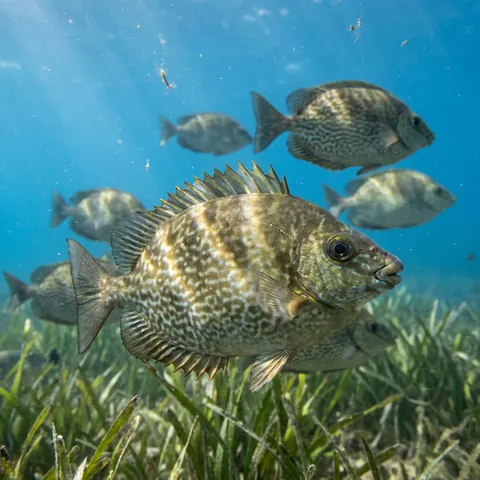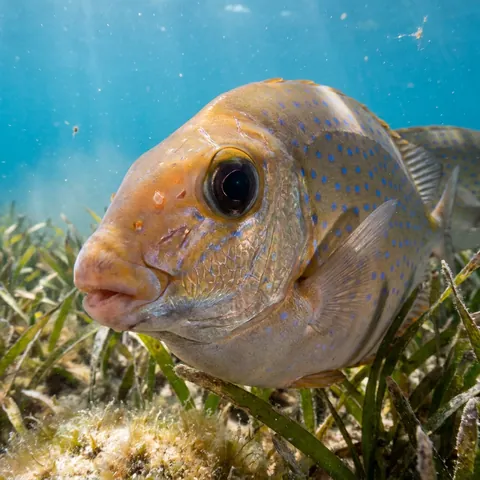
Blue-spotted spinefoot
Siganus corallinus
Siganus virgatus
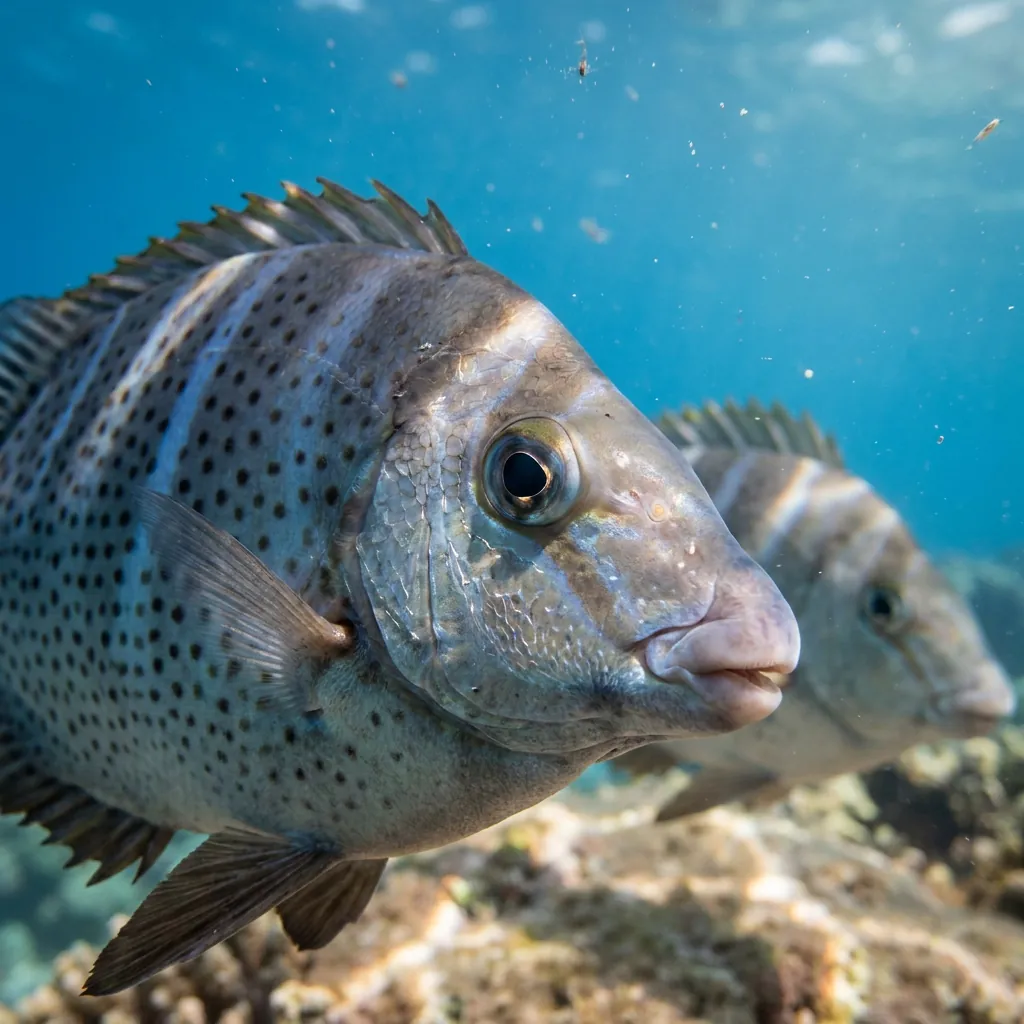
Two bold diagonal bands across a pale, silvery body make the doublebar rabbitfish stand out on the reef. It grows to about 30 cm, usually closer to 20 cm.
Also known as: virgate rabbitfish, doublebar spinefoot, double-bar rabbitfish, doublebarred spinefoot, double-barred rabbitfish, double-barred rabbit-fish, barhead spinefoot
The two diagonal dark bands across a pale body separate it from other rabbitfish, which typically show spots or a single band rather than this double-bar pattern.
Its body is flattened side to side, pale with a silvery white belly, and crossed by two wide dark diagonal bands: one from the nape to the chin, another from the middle of the back to the base of the pectoral fin. Light bluish spots and lines mark the head and these bands. The dorsal fin, the fin along its back, and the tail fin are yellow, often with a yellow back and tail base. Fin spines carry venom glands.
It lives on tropical coral reefs and in lagoons, favoring rocky and hard coral areas with sand patches, and tolerates turbid, murky water. It is found from the shallows down to 20 m, and small juveniles shelter in mangroves before moving onto the reef.
Large juveniles and adults are usually seen in pairs on reef slopes and flats. They feed mostly on algae growing on the seabed, along with some small invertebrates. Active by day, they hide in reef cracks at night, turning brown and dulling their colors to blend in.
The French zoologist Achille Valenciennes described this fish in 1835 from a specimen collected in Java, naming it virgatus, Latin for "striped," after its two diagonal bands. In parts of the Indo-Malay region, it interbreeds with a closely related rabbitfish, Siganus doliatus.
Describe what you saw and we name it, then keep every species you find in your Oceandex.