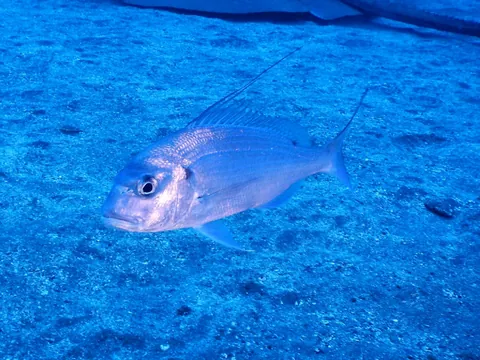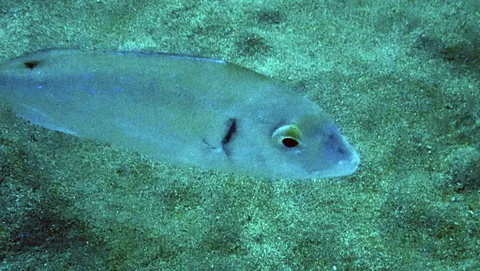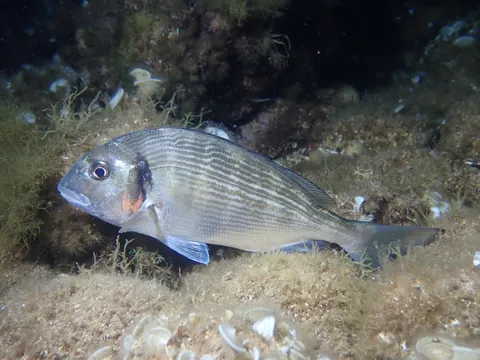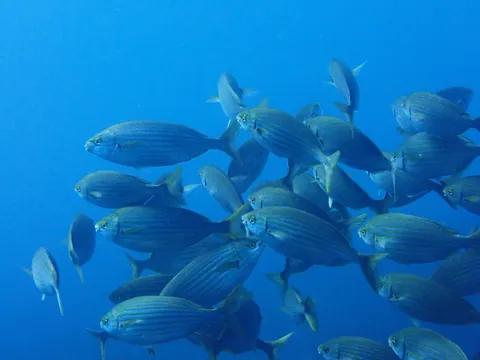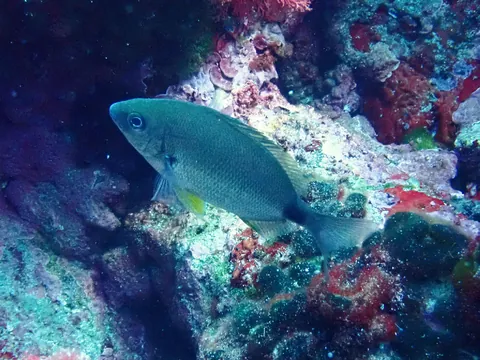
Annular Seabream
Diplodus annularis
Diplodus vulgaris
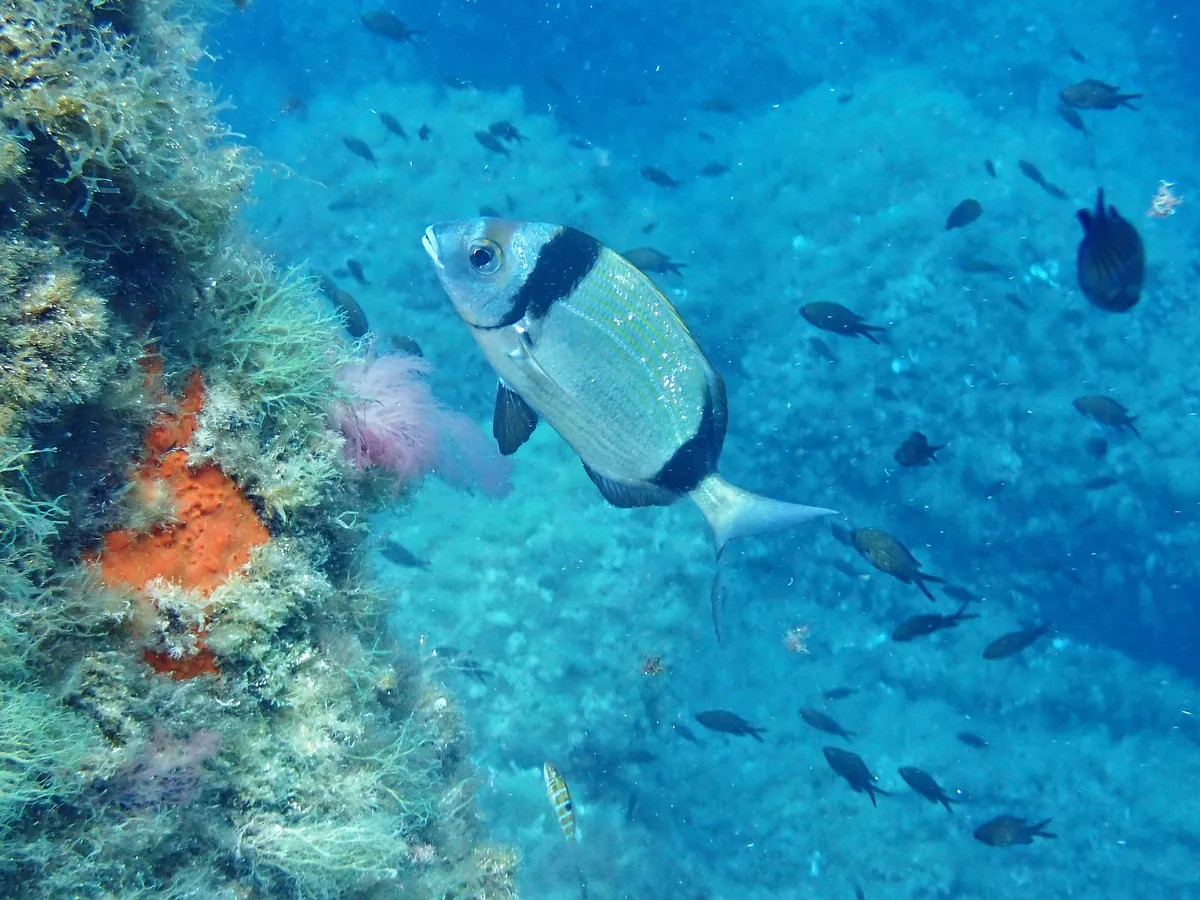
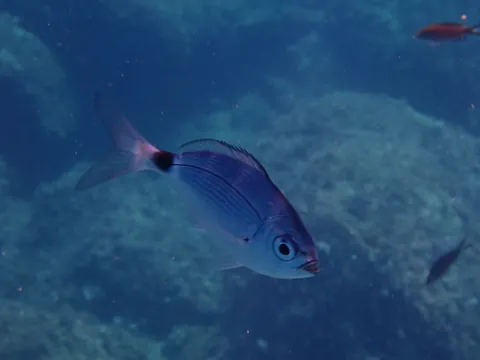
The common two-banded seabream is a familiar sight over rocky and sandy ground in the Mediterranean and nearby Atlantic waters. Its two bold, dark bands make it one of the easier seabream to name on sight.
Several similar seabream in this family show only one dark body band. This species is the one with two, so a quick count at a glance is usually enough to confirm it.
This fish has a deep, oval, flattened body and a moderately fleshy mouth that can push slightly forward. Its overall colour is grey, greenish, or brownish, paler underneath. A dark band runs from the back of the head down to the base of the pectoral fin and the rear edge of the gill cover, and a second dark band rings the body just behind the dorsal and anal fins, near the base of the tail; this second band can be fainter in young fish. There is also a black spot at the base of the pectoral fin. The tail fin is dark, darkening further toward its edge, and the other fins are greyish with darker margins. It grows up to 45 cm and can weigh as much as 1.3 kg, though most individuals are closer to 22 cm.
It lives over rocky and sandy bottoms, from the shallows down to fairly deep water, though it is most common above 30 m. Young fish often shelter in seagrass beds. It ranges through the north-eastern Atlantic and across the Mediterranean and Black Sea, tolerating a range of salinities.
It is a carnivore, feeding on crustaceans, molluscs, worms, and sea urchins, with smaller fish leaning more on tiny drifting animals and larger fish taking more bottom-dwelling prey. Like some other seabream, it changes sex during its life, starting out male before later becoming female.
Its species name, vulgaris, means common, and may echo an old Arabic name for it in Egypt that translates as sea rat.
Describe what you saw and we name it, then keep every species you find in your Oceandex.