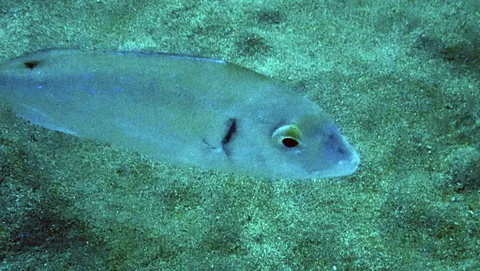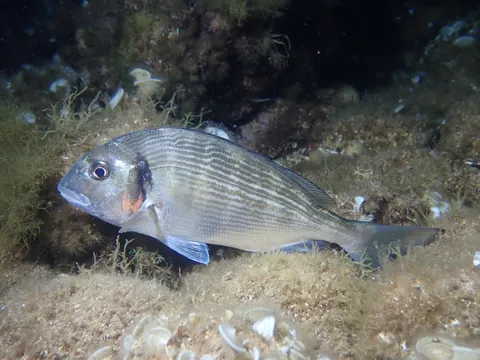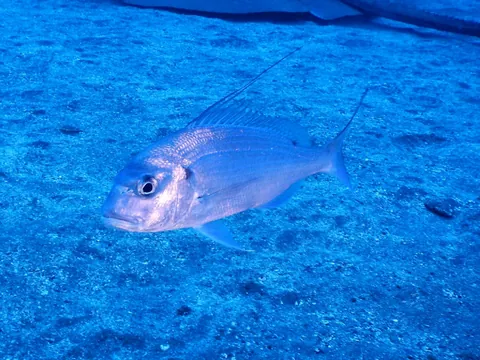
Common Dentex
Dentex dentex
Diplodus annularis
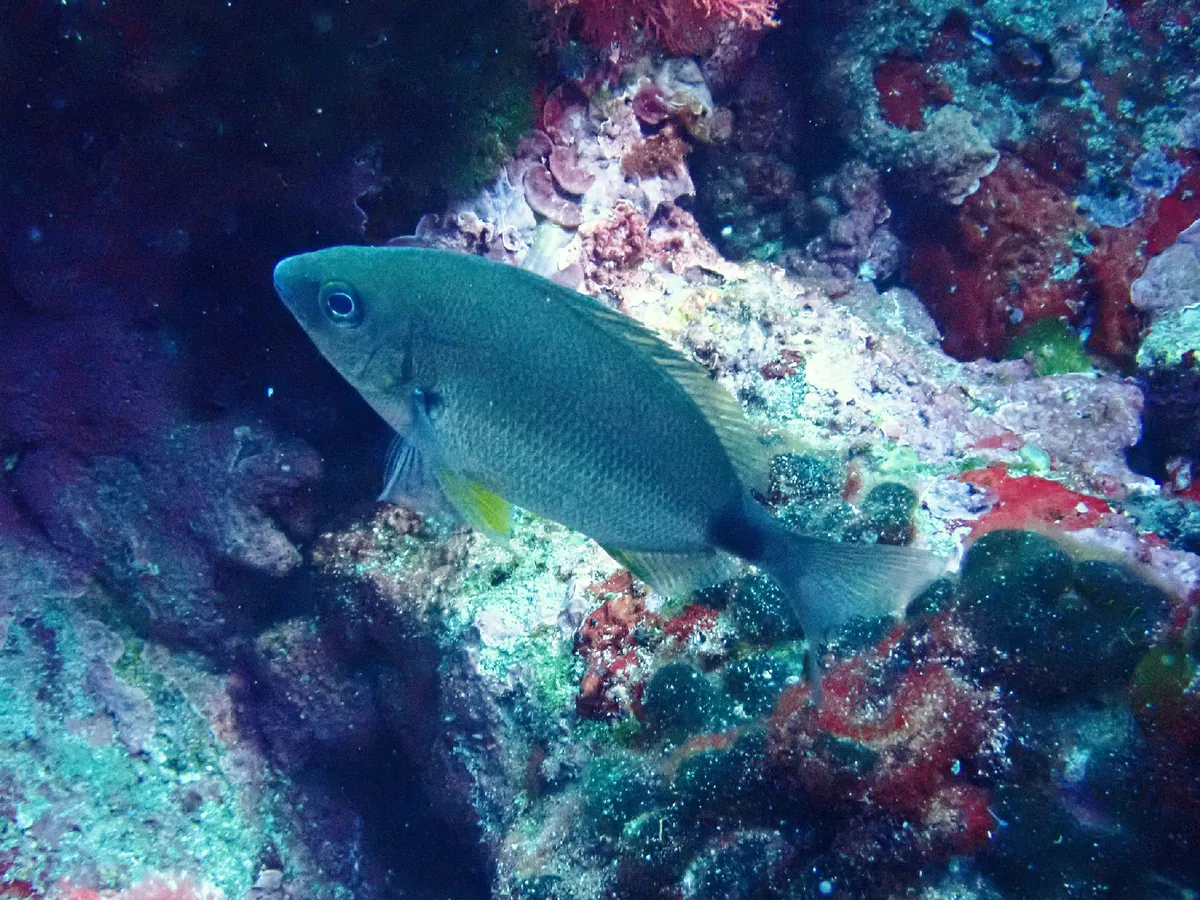
The annular seabream is a small, silvery fish named for the dark ring circling the base of its tail. It is a common sight over seagrass meadows and sandy patches across the Mediterranean and nearby Atlantic coast.
Also known as: annular sea bream
Several small seabreams share this silvery, deep-bodied shape. The dark ring circling the base of the tail, which gives this species its name, is the clearest way to tell it apart from similar seabreams.
This fish has a deep, oval body, flattened from side to side, in silvery grey with a yellowish tint. Its pelvic fins are yellowish while the other fins stay pale. A dark ring runs almost all the way around the base of the tail, just behind the dorsal and anal fins. Young fish show dark vertical bars and a complete ring, while adults keep the ring but lose the bars. It grows up to 24 cm, though most are closer to 12 cm.
It lives over seagrass meadows, sandy bottoms, and occasionally rocky ground, from the surface down to about 90 m. It is common throughout the Mediterranean, the Black and Azov Seas, and the eastern Atlantic from the Bay of Biscay south to the Strait of Gibraltar, including Madeira and the Canary Islands.
The annular seabream hunts for molluscs, crustaceans, worms, echinoderms, and small fish over the seagrass and sand it lives on. Fish become mature as either males or females, though some individuals change from male to female as they grow. Spawning takes place mainly in spring, running from March into June.
harmless
This fish plays a middle role in the life cycle of a flatworm parasite that also uses snails and gulls. Off the coast of Valencia, infection rates rose after gulls started feasting on fish discarded by trawlers.
Describe what you saw and we name it, then keep every species you find in your Oceandex.