Alexander's Spiny Brittle Star
Ophiocomella alexandri
Ophiothela mirabilis
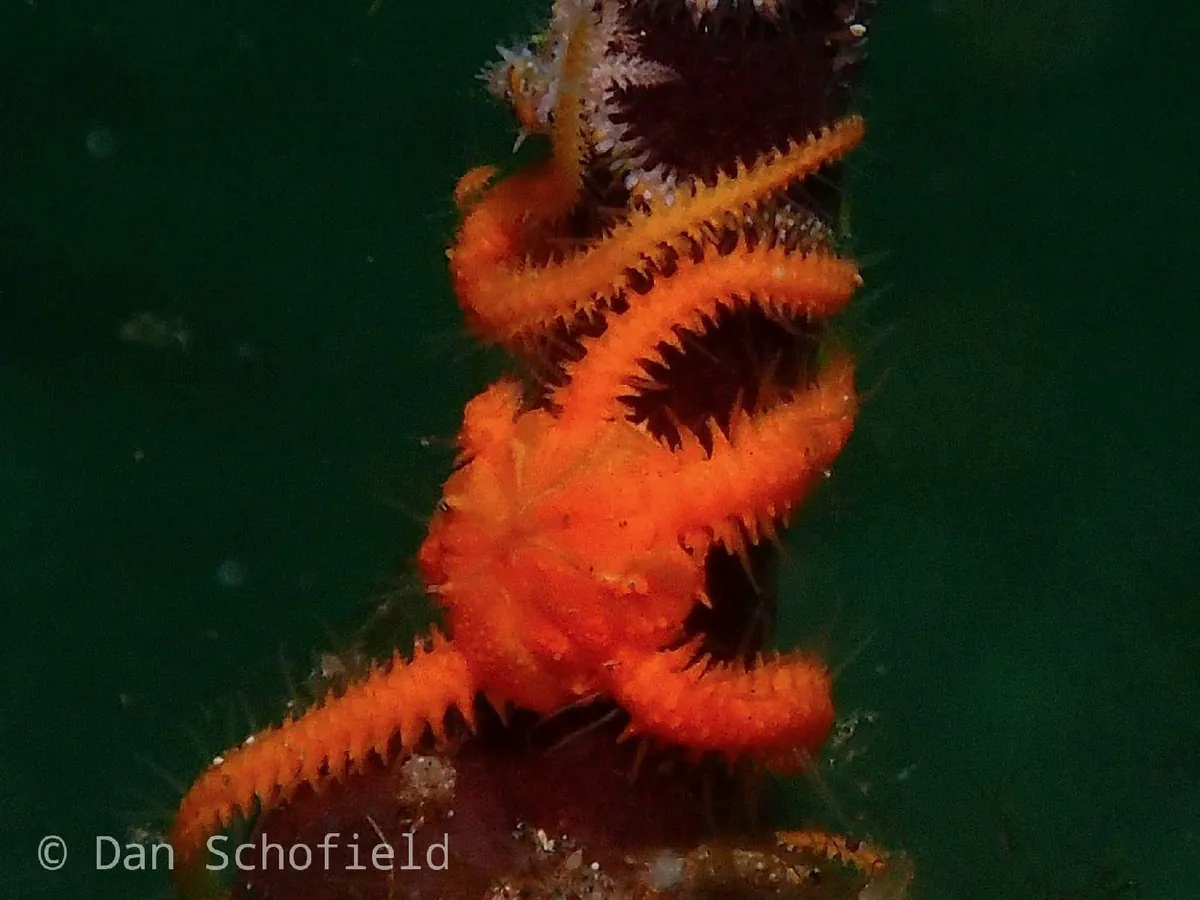
This tiny brittle star spends its life clinging to other reef animals, most often soft corals, instead of living free on the seabed. Look closely at a gorgonian or sponge and you may spot dozens clustered together.
Also known as: dana's brittle star
Small brittle stars on the same corals and sponges can be easy to mix up. This one is usually the most common and clustered species present, and its arms are often uneven in size or odd in number, since it splits itself in two.
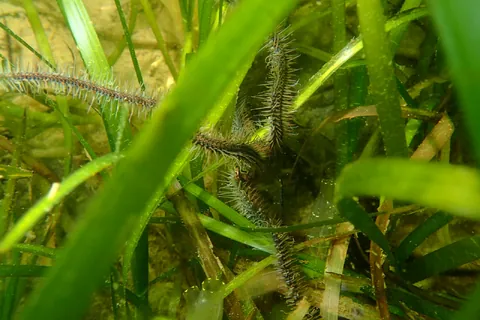
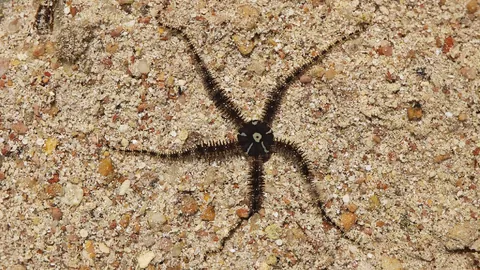
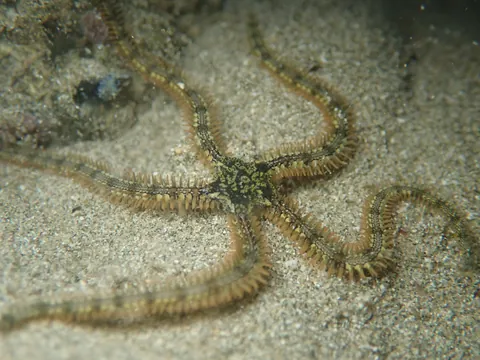
It is very small, usually with six thin, bendy arms, though the arm count often varies because of how it breeds by splitting in two. Colour varies a lot: it can be plain orange, or white with bright yellow and blue spots, sometimes with ringed arms. The arms carry thin, see-through, spiky bristles, and the central disc is covered in spines and small spiky bumps.
This species lives stuck to host animals in shallow water, most often soft corals such as gorgonians, but also sponges, other stinging animals, moss animals, sea urchins, and algae. It does not always stay on one host; it sometimes moves to another. It first came from the Pacific, but has since spread to the Caribbean and off south-western South America, likely carried by ships.
It moves its arms using a web of muscles that let it bend, twist, and coil around a host's branches or arms. Under stress, it can shed part of its own body as a defence and later regrow the missing piece.
It does not feed on its host. Instead, it eats settled waste, thread-like algae, and slime from the coral or sponge it lives on. It can also filter tiny drifting food from the water using its arm spines, helped by the high perch its host gives it.
In several populations studied, scientists found no reproductive organs in this brittle star at all. It appears to spread mainly by splitting its own body in two, with each half regrowing into a complete animal within about a month.
Describe what you saw and we name it, then keep every species you find in your Oceandex.