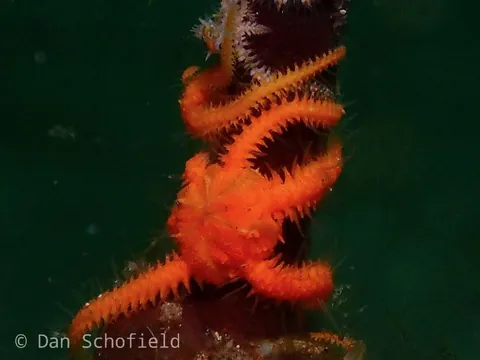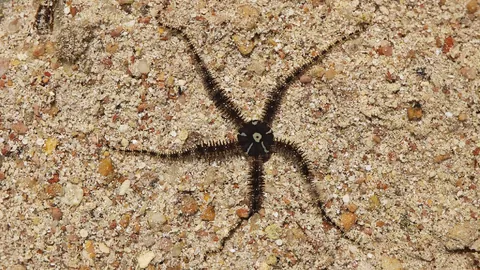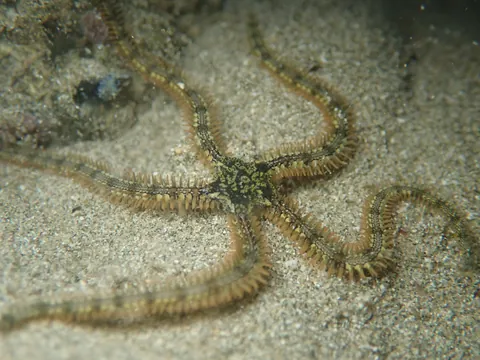
Alexander's Spiny Brittle Star
Ophiocomella alexandri
Ophiothrix fragilis
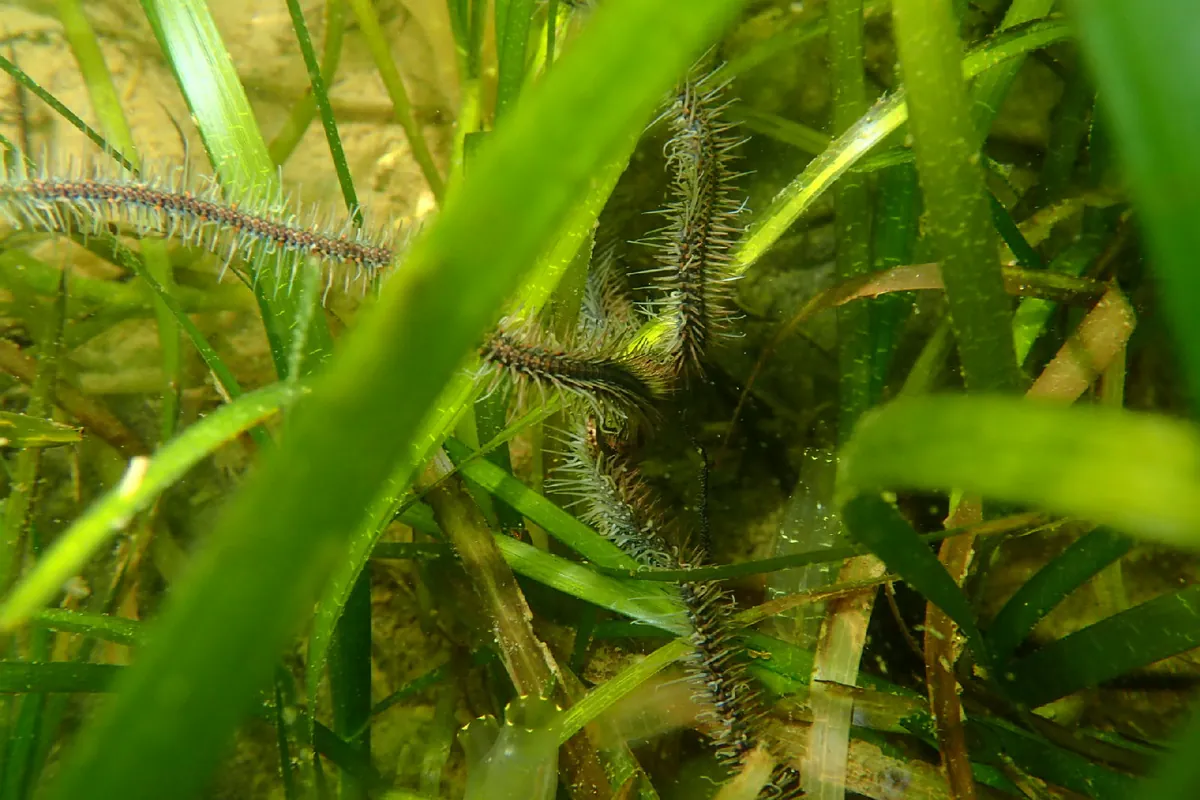
The common brittle star is built for disappearing: it wedges itself under stones and shells, and if a predator grabs an arm, it simply lets the arm break away and crawls off without it.
Several brittle stars share this rocky ground, but the pink banding on the arms is the mark to check - the disc's own colour is too variable to trust.
This brittle star has a small, spiny central disc with five slender, tapering arms spreading out from it, each many times longer than the disc itself. The disc surface is covered in spines set in a pattern of triangular plates that form heart-shaped pairs. The arms are thin, covered in overlapping scales, and lined with rows of glassy, tooth-like spines. Colour is highly variable, from violet, purple, and red to yellowish or pale grey, often spotted with red, while the arms themselves are usually white or grey banded with pink.
This species lives on hard ground, tide-swept rock, and coarse sand or shingle, often tucked into empty shells or under stones. It ranges from shallow water on the shore down to very deep water, with records to over 1,200 m.
It moves by jerking pairs of arms forward and pulling itself along. Individuals higher up the shore tend to live alone, hidden under seaweed or pebbles, while offshore it can gather into dense carpets covering the seabed. It feeds both as a scavenger on dead material and as a suspension feeder, raising an arm and its fine tube feet into the current to catch drifting food particles, then passing them down to the mouth.
harmless
Describe what you saw and we name it, then keep every species you find in your Oceandex.