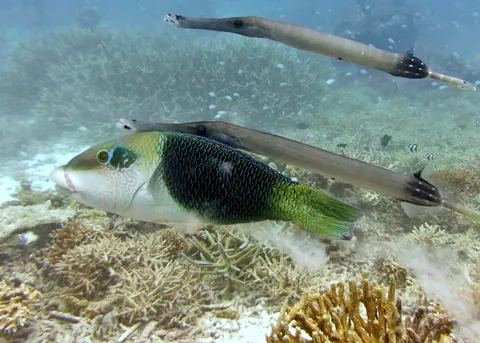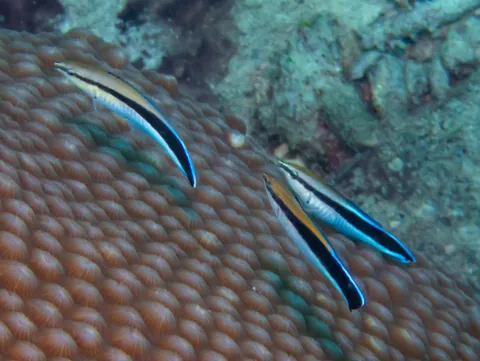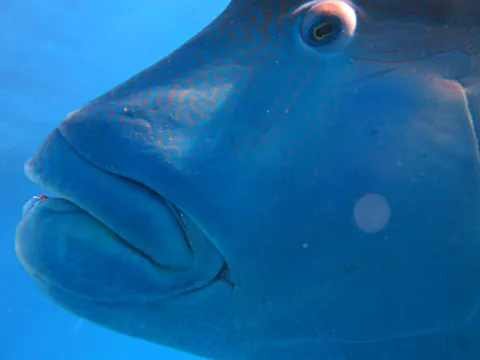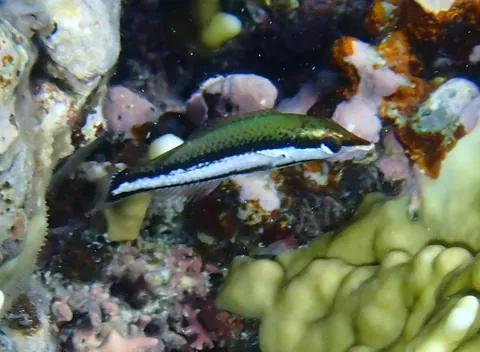
Bird wrasse
Gomphosus varius
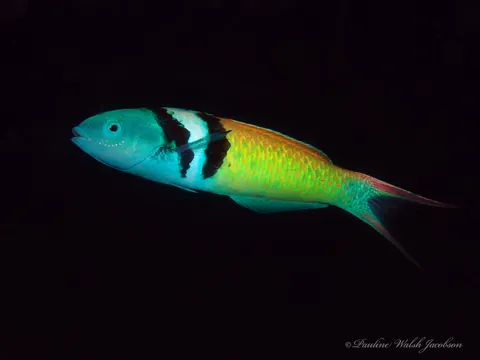
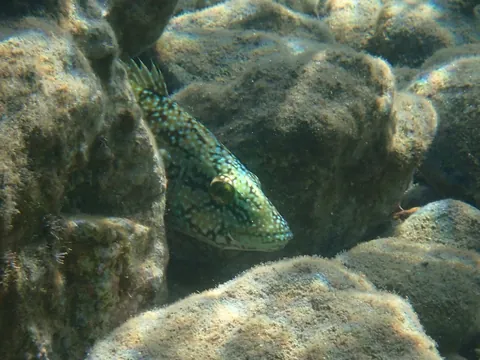
Halichoeres hortulanus
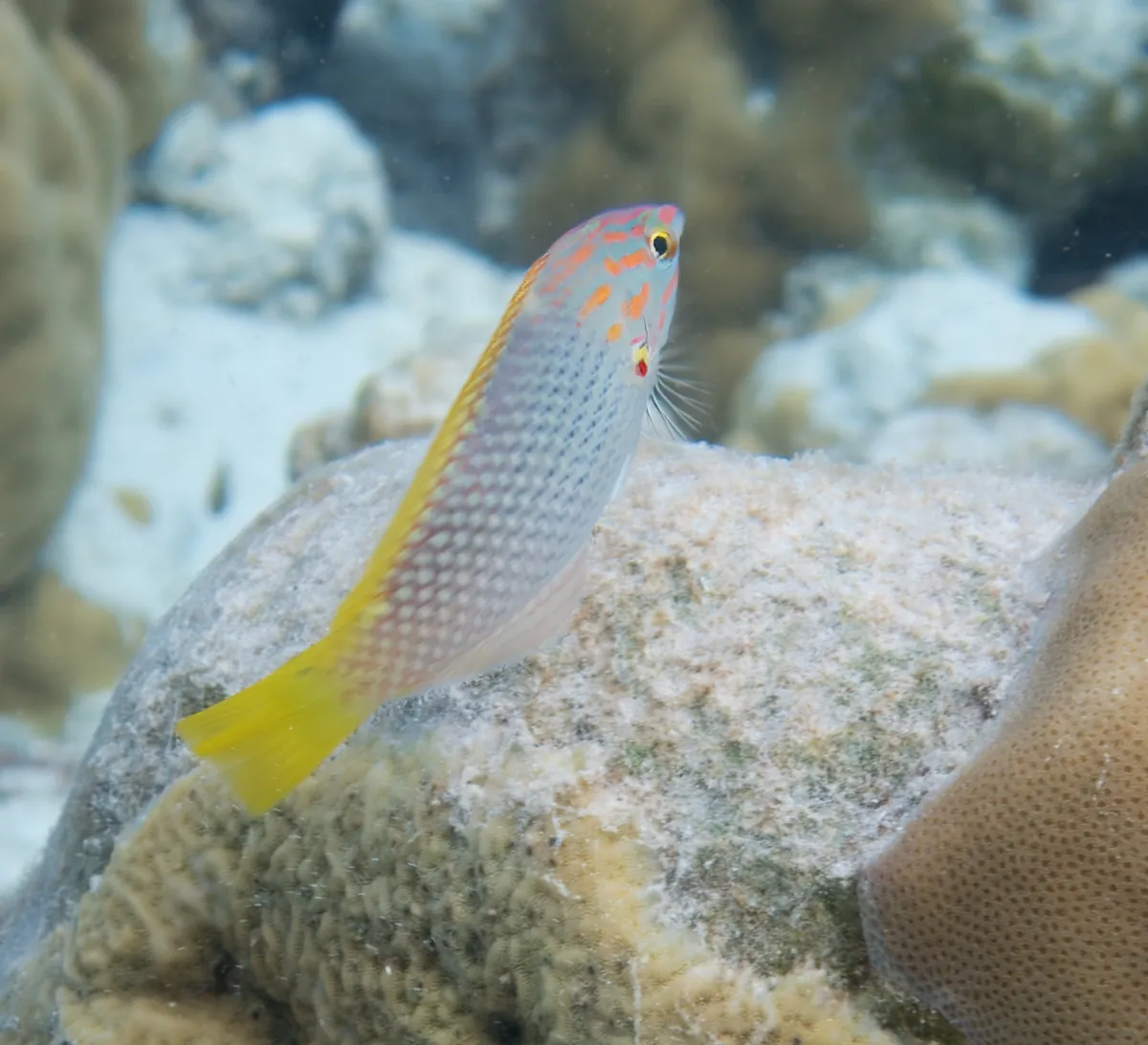
The checkerboard wrasse is a slim, busy reef fish that never stays still for long, darting low over sand patches and reef edges. Adults reach about 27 cm. Young fish and adults look so different that they are often taken for two separate species.
Also known as: four-spot wrasse, rainbowfish, wall wrasse, chequered wrasse, fourspot wrasse, wrasse, goldstripe wrasse, chequerboard wrasse, fourspot wrasse
Because juveniles and adults look almost like different species, check whichever fixed mark matches the life stage in front of you. On juveniles, look for the black spot ringed in yellow near the rear of the dorsal fin. On adults, look for the blue-black edging on every scale, since the yellow spots near the dorsal fin vary between individuals and are not a reliable check.
The body is slim and slightly stretched out, with the mouth at the front tip. Colour changes completely as the fish grows. Adults have a white to greenish body in which each scale is edged in blue to black, so the flank looks like a chequered board. The head is greenish with pink lines that run back from the eye and break into dots. A bright yellow spot sits high on the side where the dorsal fin, the fin along the back, begins, and some fish have a dark spot just behind it or a second yellow spot further back. Juveniles look nothing like this: silvery white with three dark blotches on the back and side, a red line through the eye, two small white spots on the tail base, and a black eyespot ringed in yellow at the rear of the dorsal fin.
This wrasse lives across the warm parts of the Indian and central Pacific Oceans, from the Red Sea and southern Africa east to French Polynesia, reaching southern Japan in the north and the Great Barrier Reef in the south. Look for it in clear lagoons and on seaward reefs, especially over open sand patches between coral, and along slopes and drop-offs. It is a shallow-water fish, found from 1 m to about 30 m, in water between 24 and 28 C. Juveniles keep to the bottom of surge channels and to spots under ledges.
It hunts small animals with hard shells, taking crustaceans, molluscs, worms and sea urchins from the reef surface and from the sand. Like many wrasses, it changes sex during its life: every fish starts as a female, and some later become males, which is when the bold adult colours appear.
Describe what you saw and we name it, then keep every species you find in your Oceandex.