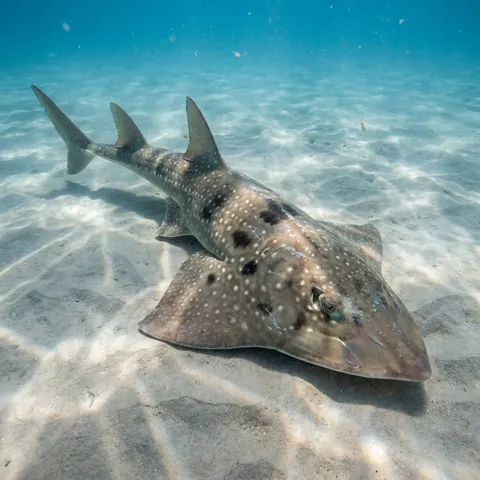
Whitespotted Guitarfish
Rhynchobatus australiae
Rhina ancylostoma
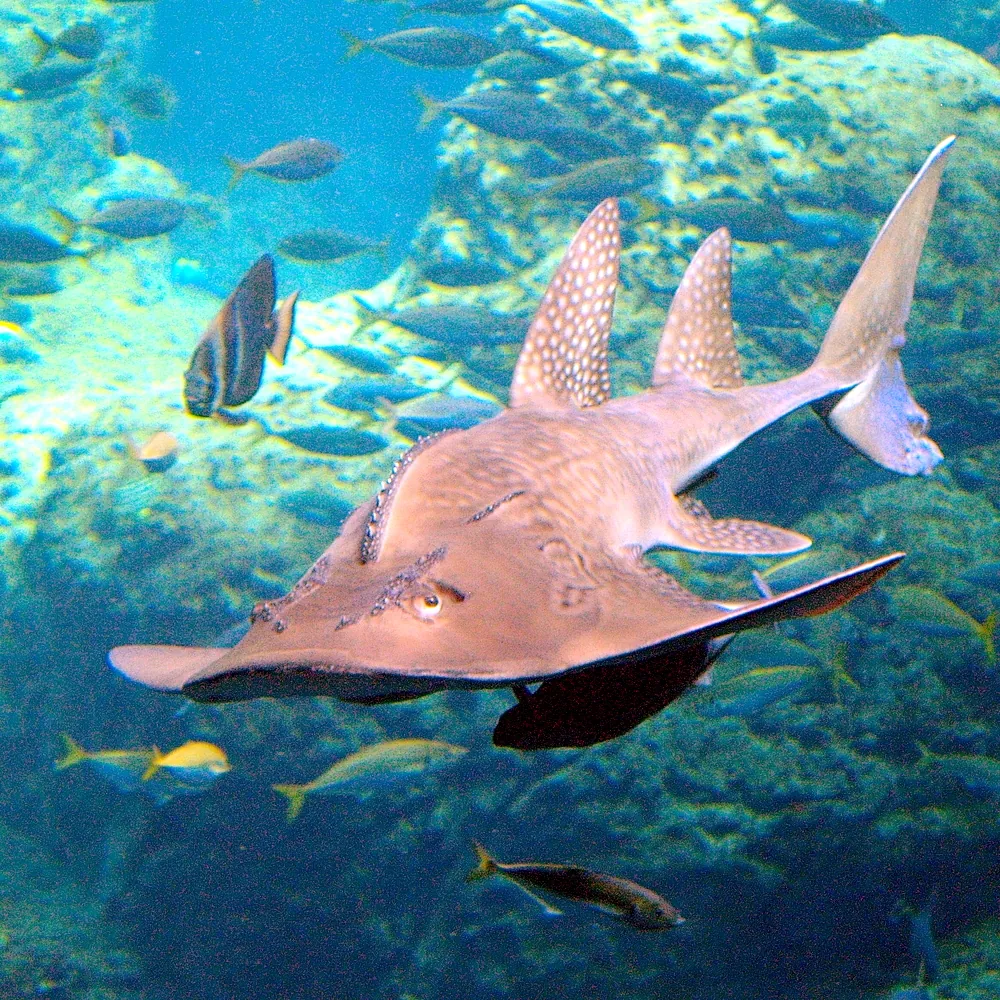
The bowmouth guitarfish is a heavy, armour-plated ray that looks like it borrowed parts from a shark, a ray, and a stegosaurus all at once. It can grow to 3 m long and weigh up to 135 kg, making it one of the biggest rays a diver is likely to meet.
Other flattened rays with shark-like tails can look similar, but check the back: only this species carries that raised midline ridge.
This ray has a short, wide, flattened head with a rounded snout, set off from the body by its eyes and the large breathing holes just behind them. Its lower jaw has three lobes that fit into matching dips in the upper jaw, giving it a curved mouth. The body is thickest just in front of two tall, sickle-shaped fins on its back, and the broad, triangular side fins have a deep notch where they meet the head. A long, shark-like tail ends in a large, crescent-shaped fin. The whole top surface feels grainy, with a raised ridge running down the middle of the back.
It lives on sandy or muddy seabeds across the tropical Indo-Pacific, often near rocky and coral reefs or shipwrecks. Divers usually find it resting on the bottom between 3 and 90 m, though it sometimes swims up into open water.
Females give birth to live young rather than laying eggs, with the pups nourished inside the body by a yolk sac. Litter sizes vary, and males reach maturity at a smaller size than females, which grow larger overall.
other
Its scientific name, ancylostoma, comes from Greek words for "curved mouth" - a nod to the hooked lower jaw that gives this ray its common name, the bowmouth guitarfish.
Describe what you saw and we name it, then keep every species you find in your Oceandex.