Bird wrasse
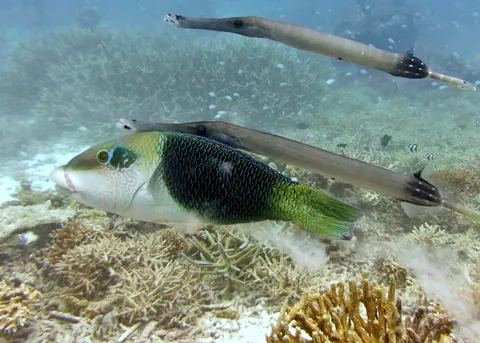
Gomphosus varius
Labroides dimidiatus
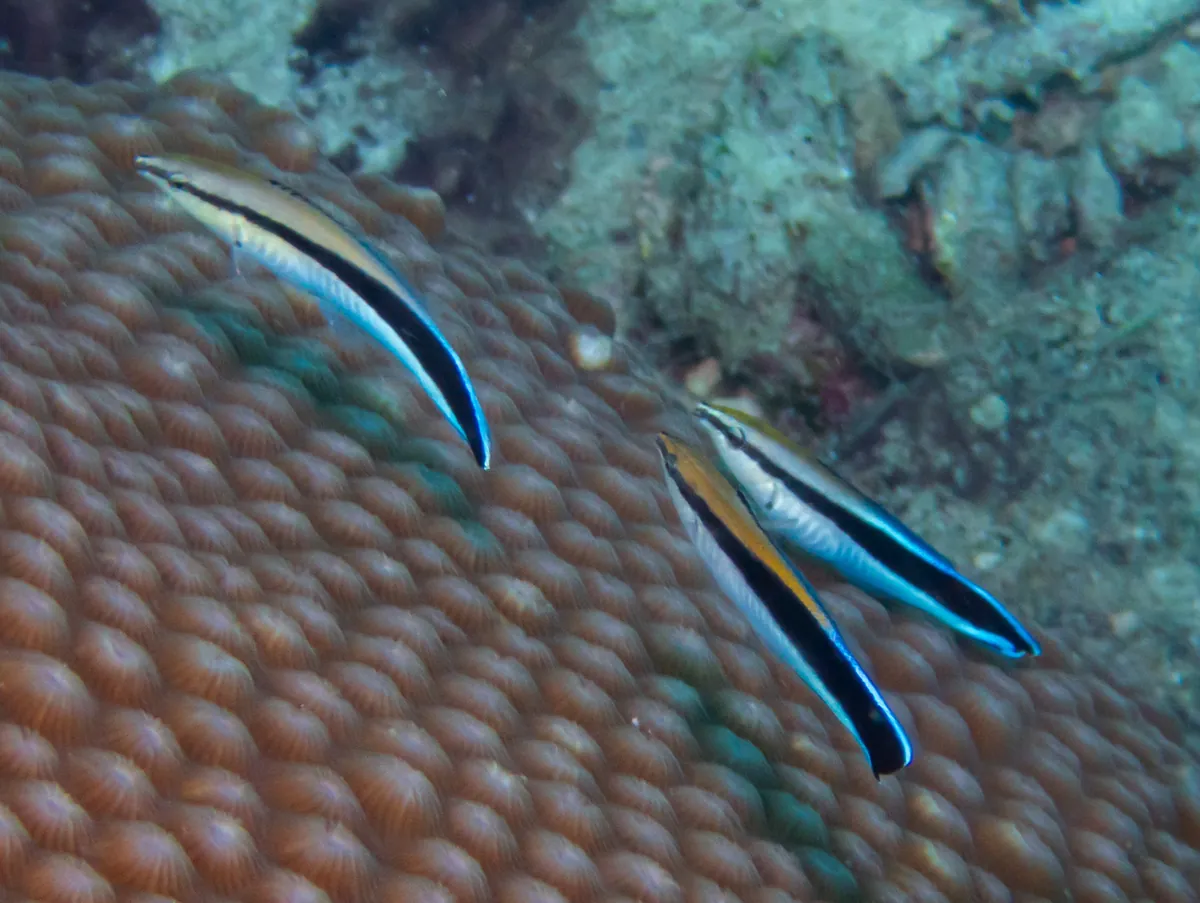
The bluestreak cleaner wrasse is a small, slim reef fish, at most 14 cm long, that makes its living by picking parasites and dead skin off other fish. It works from a fixed spot on the reef called a cleaning station. Visiting fish, known as clients, queue up there, and the wrasse greets them with a dance in which it bobs its rear end up and down. Once a client accepts, it holds a stiff pose and lets the wrasse work over its skin, its gills and sometimes the inside of its mouth. Both sides gain: the wrasse gets a meal of parasites and fish mucus, and the client gets cleaned. Its clients are not only reef fish; whales, sharks and rays, lobsters and turtles have all been cleaned by this species.
Also known as: blue-streak cleaner wrasse, bluestreak cleaner wrasse, cleaner wrasse, bluestreak cleanerfish, bridled beauty, wrasse, bluestreak cleaner wrasse, cleaner fish, cleaner wrasse, bluestreak cleaner wrasse, cleaner wrasse, common cleanerfish, gadfly fish, common cleaner wrasse, cleaner wrasses, cleaner fish, blue streak, cleanerfish, bluestreak cleaner wrasse, blue-streak cleaner wrasse, bridled beauty, cleaner fish, cleaner wrasse, cleaner-fish, common cleaner wrasse, common cleanerfish, gadfly fish, blue streak
Look for the black stripe. It starts at the snout, runs straight through the eye and along the whole side, and gets wider as it reaches the tail, on a pale body that turns blue at the front. The behaviour confirms it: a small fish that stays in one place, dances with its tail end bobbing, and swims fearlessly around the mouth and gills of much larger fish. Bigger fish recognise it by the same stripe and the same movements.
The body is long and slender. A broad black stripe runs the length of the fish, through the eye and back to the tail, and it widens towards the rear. The back and belly are white, sometimes with a yellow tinge, and in deeper water the back is often yellow. Towards the head the pale body turns bright blue. Young fish look different: black, with a single electric-blue line.
It lives on tropical coral reefs from East Africa and the Red Sea across the Indian Ocean to the western and central Pacific. Look for it in coral-rich ground, from the sheltered water of inner lagoons and shallow reef flats out to seaward reefs. It works from a metre or so under the surface down to about 30 m, and has been recorded to 40 m. On a dive you will usually find it in the same small patch of reef each time, because a cleaning station is a fixed address.
Every fish starts as a female and the largest can turn into a male. A dominant male holds a territory, keeps other males out, and controls the females living in it. If he disappears, one of the larger females changes sex, becomes a functioning male, and takes over the territory.
This little fish is reported to have passed the mirror test, a check for self-recognition that few animals manage. It is a striking claim for a fish smaller than your hand.
Describe what you saw and we name it, then keep every species you find in your Oceandex.