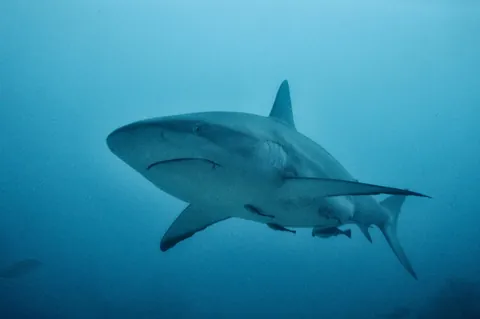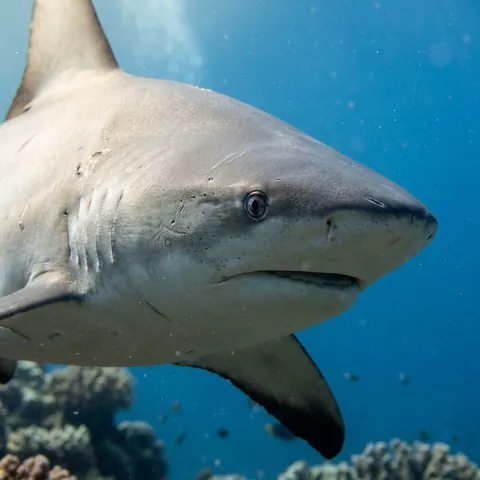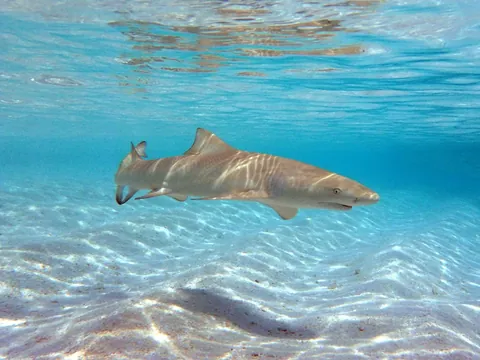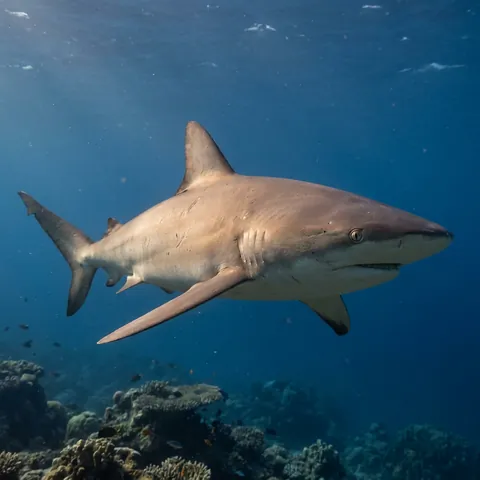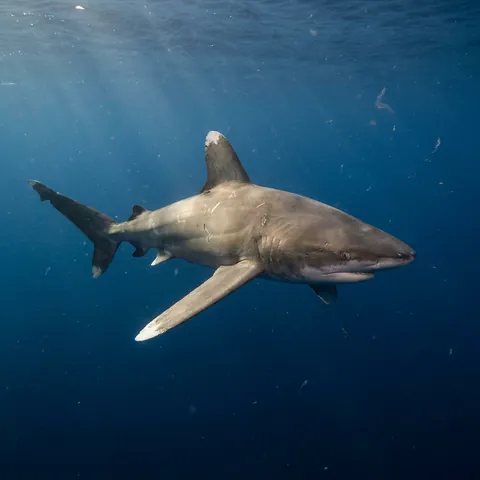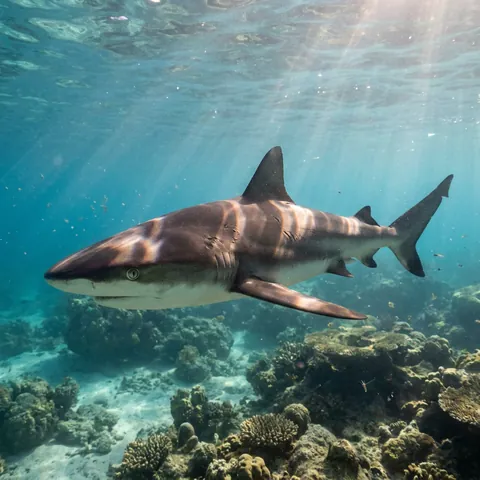
Blacktip reef shark
Carcharhinus melanopterus
Prionace glauca
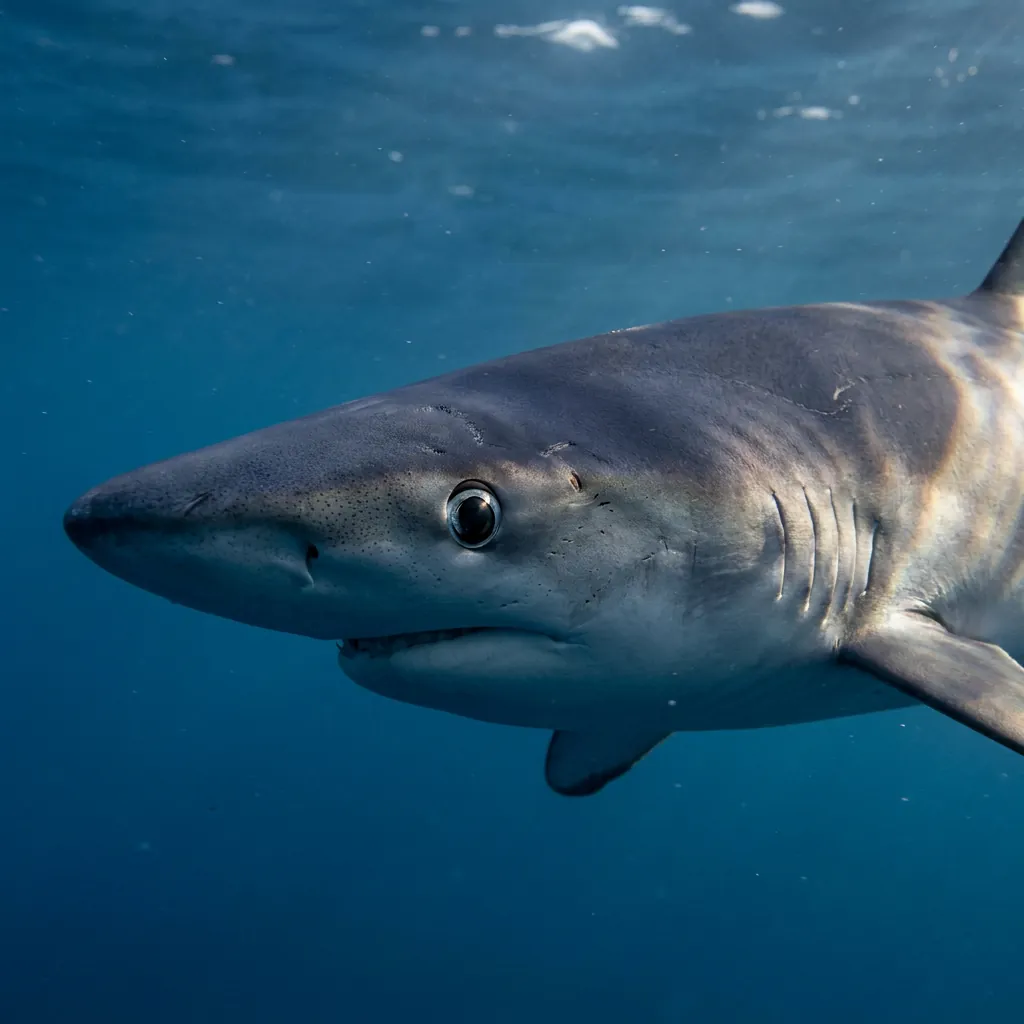
The blue shark is a slim, fast-swimming hunter of the open ocean, easily told apart from reef sharks by its striking colour. It can grow to about 400 cm, though most divers who meet one see something closer to 335 cm.
Also known as: prionace glauca, blue dog, blue poninter, blue whaler, blue whaler shark, great blue, great blue shark, great blue whaler, shark, tribon blou
Other open-ocean sharks share a similar grey-blue colour, but the blue shark's pectoral fins are unusually long and narrow compared to its body, a proportion that holds even when the colour fades.
The body is slender and streamlined, with a long, pointed snout and large eyes. It is deep blue along the back, fading to lighter blue on the sides and white underneath. The pectoral fins are notably long and narrow, and the curved, triangular upper teeth have fine saw-like edges.
The blue shark is an open-ocean species that ranges from the surface down to deep water, most often between 1 and 220 m. It lives in temperate to tropical seas worldwide and can approach shore in cooler waters, where divers sometimes encounter it.
This is a highly migratory shark, covering long distances across open water as it follows prey and the seasons. It swims at different speeds by day and night and moves both across the surface and up and down through the water column.
Squid make up the bulk of its diet, along with a wide range of fish, crabs, and other invertebrates. Blue sharks sometimes hunt together, herding schools of prey into a tight group that is easier to pick off.
Blue sharks give birth to live young after a long pregnancy, with pups nourished through a placenta rather than hatching from eggs. Newborns are left in separate nursery areas away from adults to grow up on their own.
generally not aggressive but a large shark — observe with caution
The blue shark is listed as Near Threatened. It is one of the sharks most commonly caught unintentionally by commercial fishing fleets working the open ocean.
During mating, males grip females with a bite, so female blue sharks have evolved skin about three times thicker than males just to withstand it.
Describe what you saw and we name it, then keep every species you find in your Oceandex.