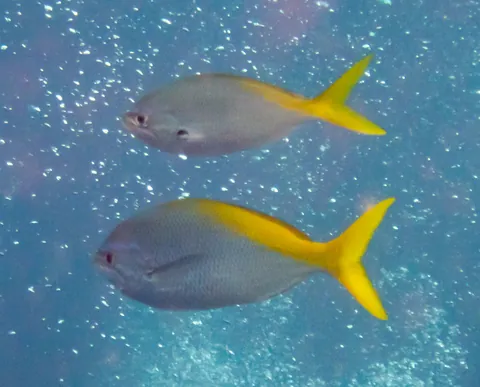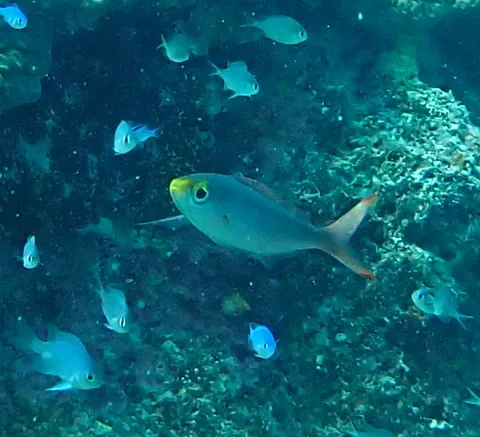
Banana fusilier
Pterocaesio pisang
Caesio caerulaurea
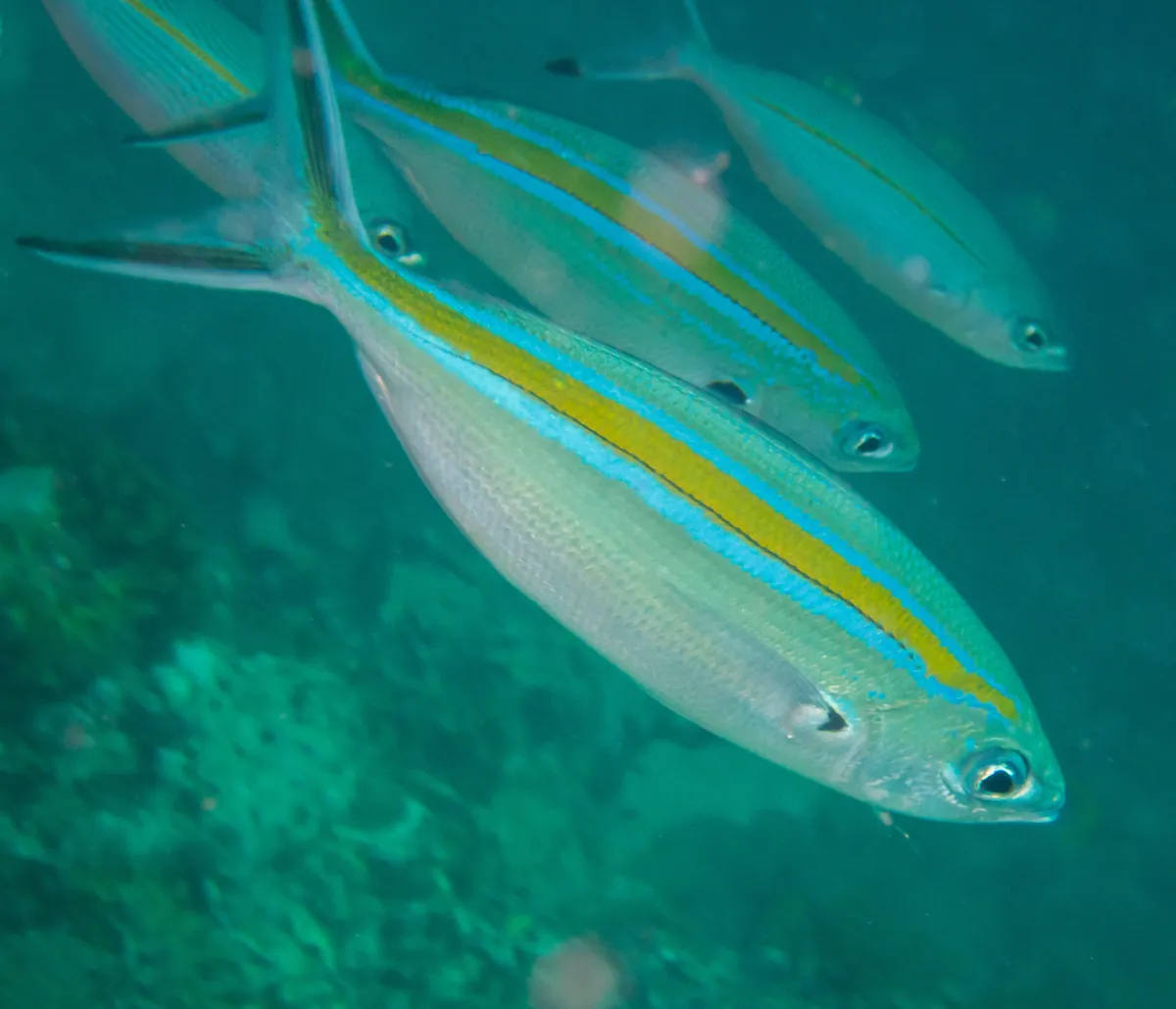
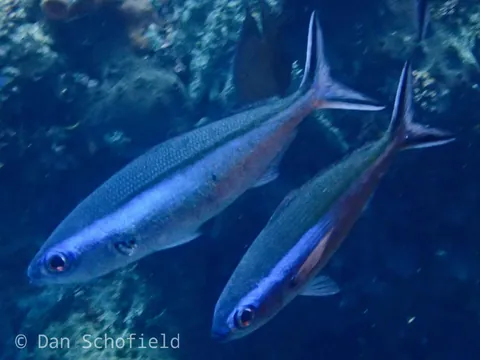
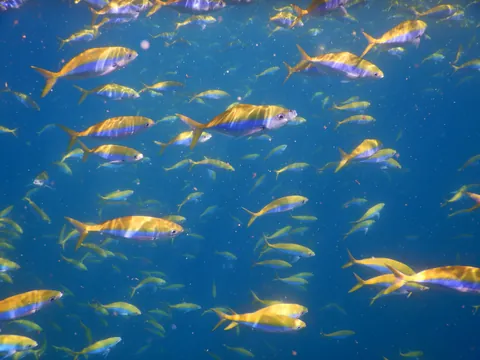
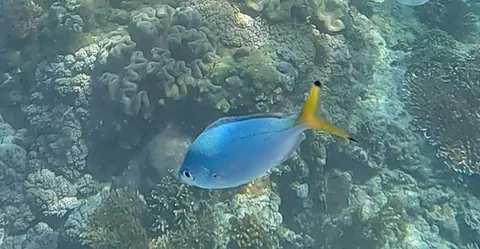
A flash of gold cuts through a blue school on the reef edge, and it belongs to this fusilier. Schooling by the hundred over the reef, it grows to about 35 cm, though most you meet are closer to 25 cm.
Also known as: caesio caerulaurea, blue fusiler, blue fusilier, blue-and-gold fusilier, fusilier, gold-band fusilier, gold-banded fusilier, goldband fusilier, scissor tailed fusilier, scissor-tail fusilier, scissor-tailed fusilier, scissortail fusilier
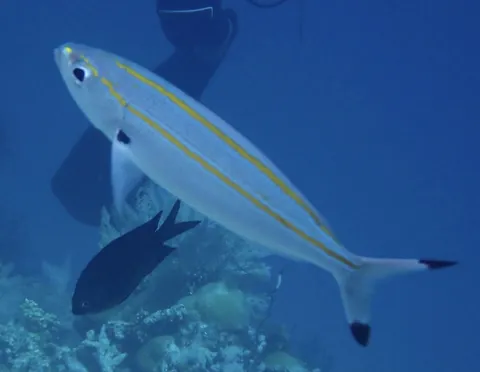
Several fusilier species school together and look alike at a glance. This one gives itself away at the tail: its gold body stripe runs on past the body onto both lobes of the forked tail as dark streaks, forming a scissor-like pattern.
The body is fusiform (torpedo-shaped) and only lightly flattened side to side, blue above and fading to white on the belly. A gold stripe runs the length of the body along the lateral line (the faint sensory line down the flank), edged on both sides by a thin pale blue-white line.
Found over coastal, lagoon and seaward reefs with healthy coral growth, from just below the surface down to about 50 m.
Blue and gold fusiliers gather in large midwater schools, sifting drifting zooplankton from the current. Spawning happens over most of the year, timed to lunar cycles, when the whole school takes part in a mass release of eggs.
harmless
Courtship here is a small drama: as dusk falls, one or two males nip and bump a female's belly for over an hour before spawning. In the final minutes, several males jostle to press against her, and the winning pair spirals up to the surface together to release eggs and sperm - while 'sneaker' males who lost the contest race in to shed their own sperm over the same spot.
Describe what you saw and we name it, then keep every species you find in your Oceandex.