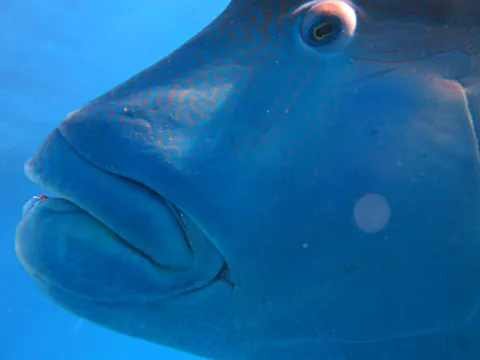
Bird wrasse
Gomphosus varius
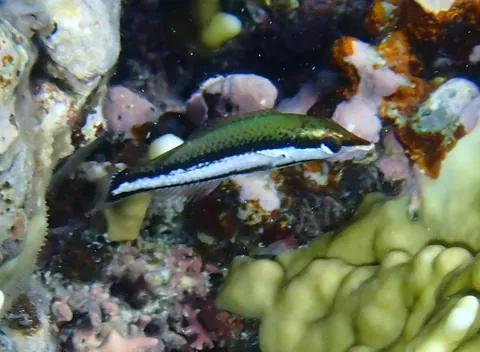
Hemigymnus melapterus
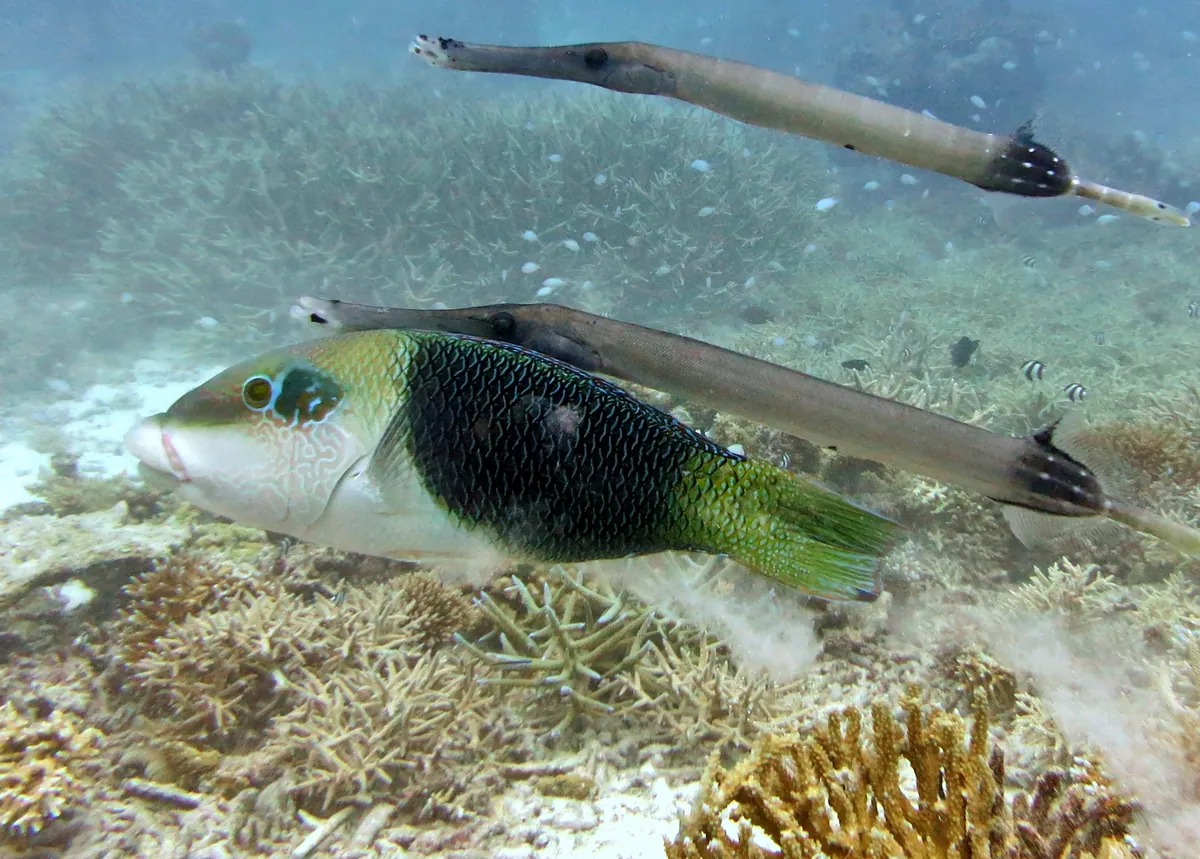
The blackeye thicklip is a wrasse of Indo-Pacific reefs, reaching up to 37 cm long. It has a large head and thick lips, giving it a heavy-jawed look next to the reef's smaller wrasses.
Also known as: blackeye thicklip, blackeye thicklip wrasee, half-and-half thicklip, half-and-half wrasse, half-half thicklip, thick-lipped wrasse, blackeye thicklip, blackeyed thicklip, thicklip wrasse, rainbow fish, half and half wrasse, thicklip wrasse, wrasse, blackeye thicklip wrasse, blackeye thicklip, half-and-half wrasse, half-and-half thicklip wrasse, half & half wrasse, black-eyed thick-lip, black-eyed thicklip, thicklip wrasse, thicklipped wrasse, thick-lipped wrasse
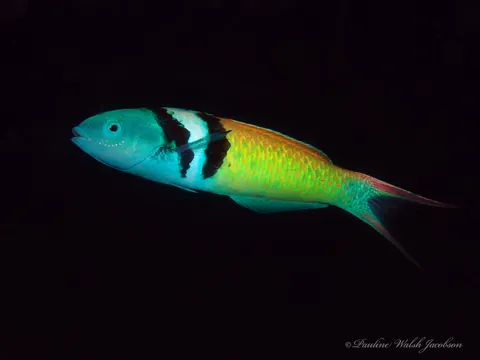
The mark that holds across every life stage is the broad white diagonal band behind the gill cover. Check for that band rather than judging overall body colour, since colour changes completely as the fish grows.
The body is high and somewhat flattened, with a large head and thick, terminal mouth (a mouth that opens straight forward at the tip of the snout). Colour changes with age: juveniles are greenish yellow with yellow vertical lines, a broad white diagonal band behind the gill cover, and an orange tail. Mature fish turn green behind that diagonal band, with dark-rimmed scales and a tangle of pink and turquoise lines across the top of the head.
This fish lives on reef flats and in lagoon and seaward reefs, from 1 to 30 m deep but most commonly between 5 and 30 m. Young fish stay hidden among branching corals close to shore, while adults range over mixed sand, rubble and coral.
This wrasse lives alone or in small groups. It forages along the bottom, taking mouthfuls of sand, sorting out the edible items in its mouth, and blowing the rest out through its gill openings.
It feeds mainly on small invertebrates, especially crustaceans, bristle worms, molluscs and brittle stars, picked off coral branches or out of the sand.
Describe what you saw and we name it, then keep every species you find in your Oceandex.