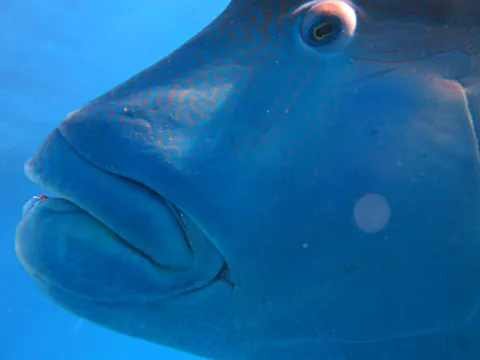
Blackeye thicklip
Hemigymnus melapterus
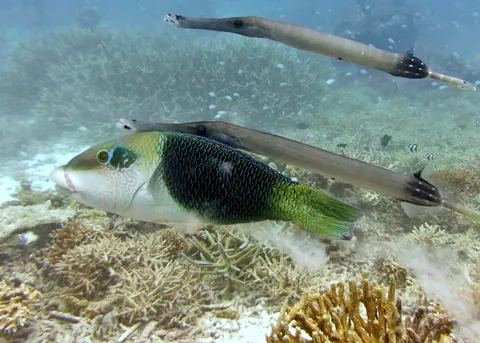
Gomphosus varius
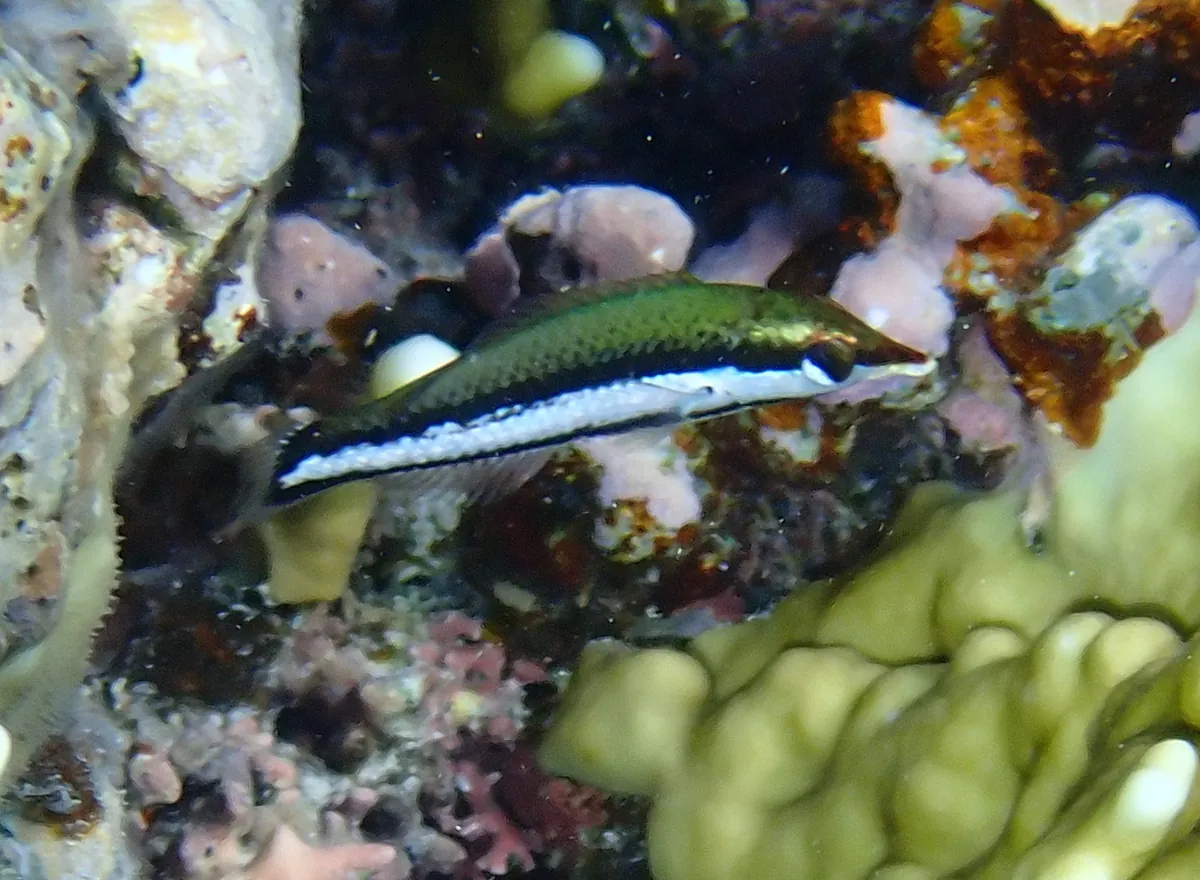
The bird wrasse is a medium-sized wrasse of the Indo-Pacific, named for the long, beak-like snout of the adult. It reaches about 30 cm and lives from just below the surface to 35 m, usually between 2 and 30 m. It is active by day and is listed as Least Concern.
Also known as: bird-nose wrasse, brown bird wrasse, olive club-nosed wrasse, purple club-nosed wrasse, birdfish, clubnosed wrasse, green birdmouth wrasse, pacific bird wrasse, wrasse, birdnose wrasse, birdnose wrasse, clubnosed wrasse, bird-nose wrasse
Two things give it away, and neither depends on colour. First, the long beak-like snout, unlike any other reef wrasse of this size. Second, the swimming style: it flaps its pectoral fins in a jerky, bird-like beat as it moves along the reef. Together they are easy to read at normal viewing distance. Small fish without the long snout are much harder to name.
The body is long and flattened from side to side, ending in a straight-edged tail, and the snout is drawn out into a slender beak. Males and females look different. The female is smaller and duller: the chest and belly are pearly white, the flank scales are grey with a dark rim, the top of the snout is red-orange, and a fine brown line runs through the eye. The male is more evenly coloured, mainly green, with a head that can look dark blue and a lighter yellowish-green patch at the shoulder above the pectoral fin, the paired fin behind the gill cover. Small juveniles have not yet grown the long snout.
This wrasse lives in warm water across the Indo-Pacific, from the eastern Indian Ocean out to the islands of the Pacific. It likes reef ground rich in hard coral, and you will find it on outer reef slopes, on the reef itself and in lagoons, down to at least 30 m.
The bird wrasse is a daytime hunter and is usually alone, though it sometimes forms small groups. It works over the coral picking out small bottom-living crustaceans, and it also takes brittle stars, molluscs and small fish; the long snout reaches into the spaces between coral branches. It changes sex during its life, starting as a female and later becoming male. As it changes, its body shape, colour and pattern all change a great deal.
On the reef it sometimes crosses with wrasses of a completely different genus, Thalassoma, producing wild hybrids.
Describe what you saw and we name it, then keep every species you find in your Oceandex.