Common thresher
Alopias vulpinus
Alopias superciliosus
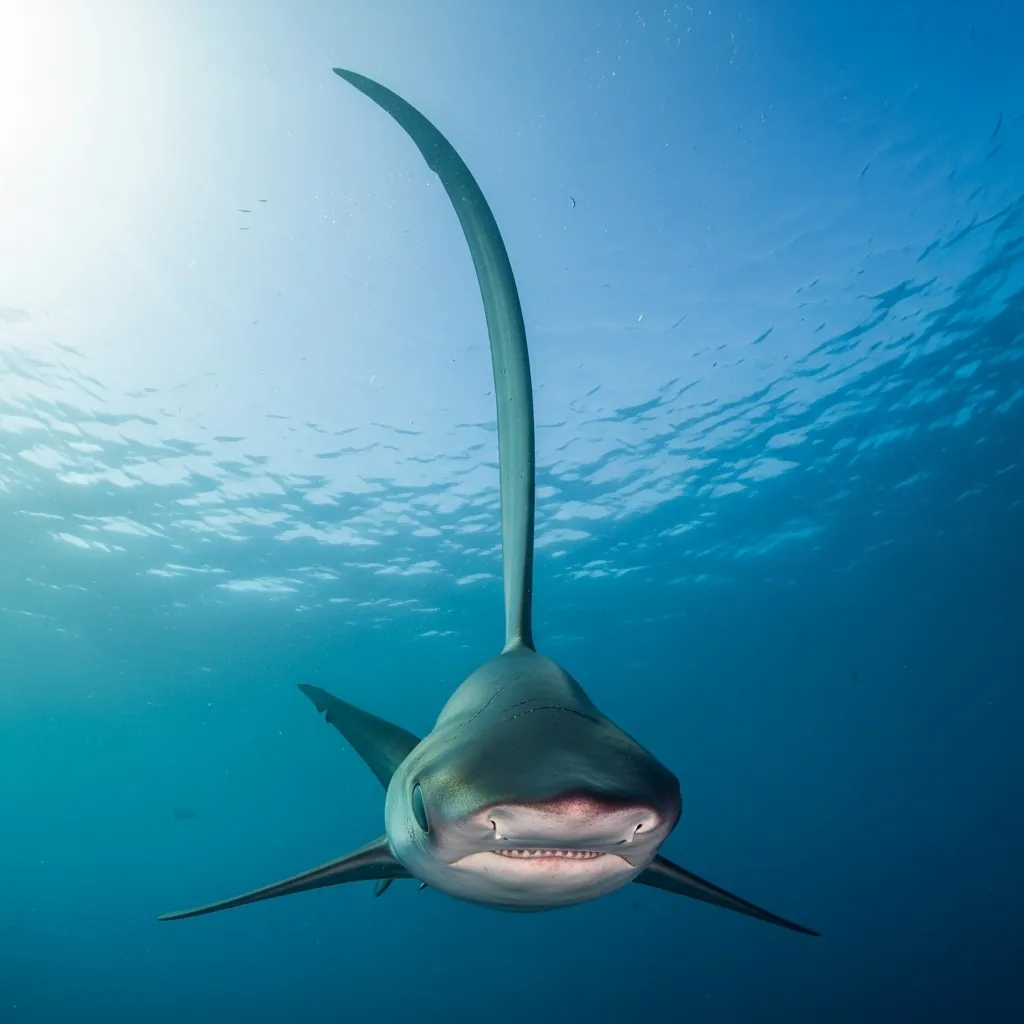
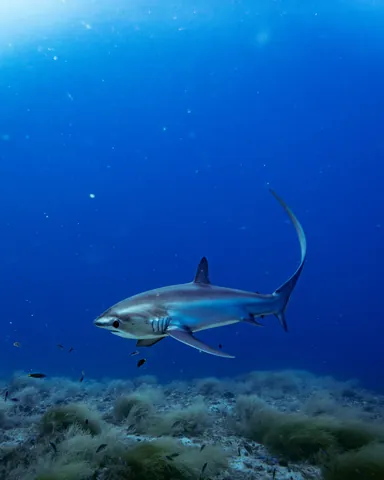
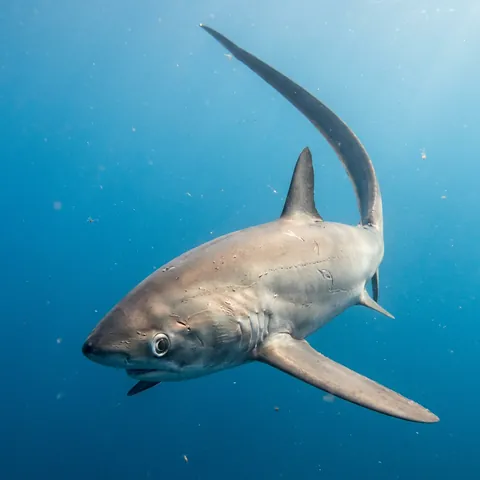
A shark built around its eyes. Each one is huge and taller than it is wide, and the socket runs up onto the top of the head so the shark can look straight up and pick out prey against the faint light above. Add a tail as long as the rest of the fish and you have an animal that is hard to mistake. It reaches close to 4.9 m, tail included, and can weigh over 360 kg.
Also known as: bigeye tresher shark, bigeye thresher, false thresher, bigeye thresher, pelagic thresher, whiptail, thresher, bigeye tresher, big eye thresher shark, thresher shark, big-eyed thresher, bigeye thresher shark, long-tailed shark, bigeye thresher shark
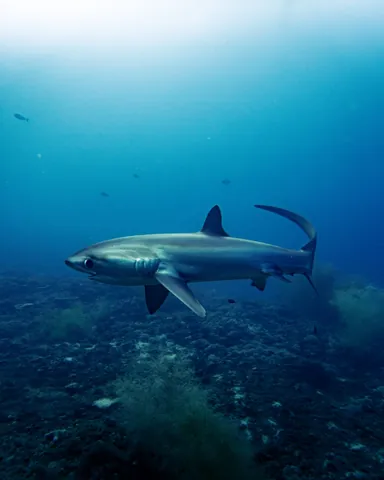
All threshers carry that enormous tail, so the tail alone will not name this one. The mark that settles it is a pair of deep grooves running from above each eye back across the head towards the gill slits, which gives the head a helmet-like look. If you cannot get close enough to see them, check the first back fin: on this shark it sits far enough back that its rear tip reaches over the hip fins.
The upper half of the tail fin is very long, taking up as much as half the whole length of the shark, and it is broader than in its relatives. The eyes are large and bulge at the top, and they point upwards. The snout is fairly long and rounded. The pectoral fins are big, with a curved front edge and broad tips. The first back fin sits well back on the body. The colour is a deep metallic violet to purple-brown above and creamy white below, but it fades fast to dull grey once the shark is out of the water.
This shark lives in warm seas nearly all the way round the world, in the Atlantic including the Mediterranean, the Indian Ocean and across the Pacific. It keeps to water over the continental shelf and out in the open sea, and only now and then comes into shallow coastal water. It has been tracked down to 730 m, though it normally stays in the top 100 m or so. One tagged shark travelled from New York to the Gulf of Mexico.
The bigeye thresher is one of the few sharks known to move up and down with the clock. It spends the day in deep, cold water below the thermocline, the layer where warm surface water meets the cold water beneath, then rises at night into the top 100 m. The reason is most likely food at night and safety by day. Its daytime swimming is steady and even. At night it climbs slowly and drops fast. Divers hardly ever meet it, and it is not dangerous.
It has bigger teeth than the other threshers and takes a wider range of food: schooling fish such as mackerel and herring, bottom fish such as hake and whiting, bigger open-water fish such as lancetfish and small billfish, and squid. It seems to stun prey with that long tail before taking it. The upward-facing eye sockets give it proper depth judgement looking up, which helps it aim the strike. In the Mediterranean it sticks close to schools of frigate mackerel and appears to follow them around.
The name superciliosus is Latin for 'above the eyebrow', and it points to those grooves over the eyes. The shark was first described from a specimen caught off Madeira, but the description was then overlooked for about a century. Only when new specimens turned up off Cuba and Florida in the 1940s was the original name brought back.
Describe what you saw and we name it, then keep every species you find in your Oceandex.