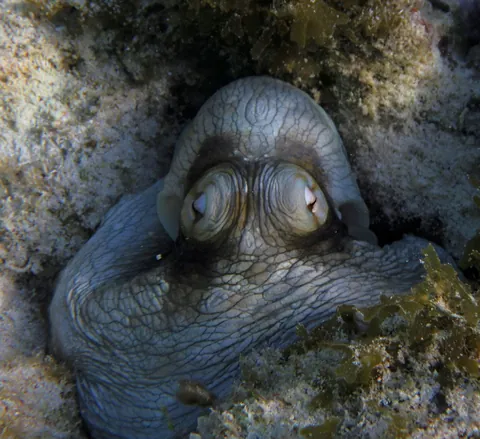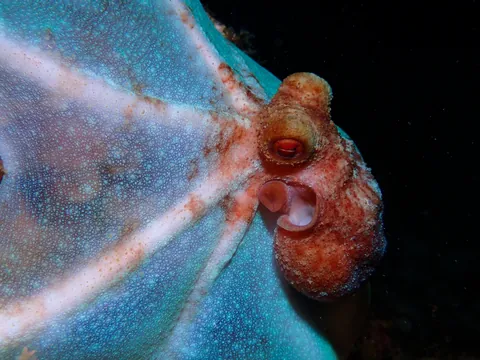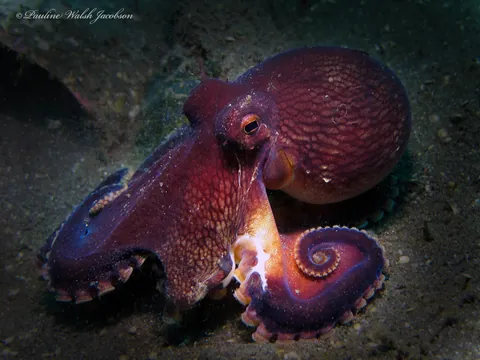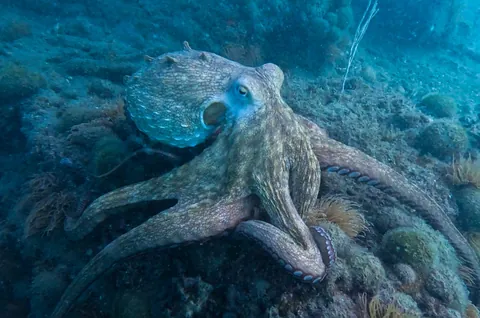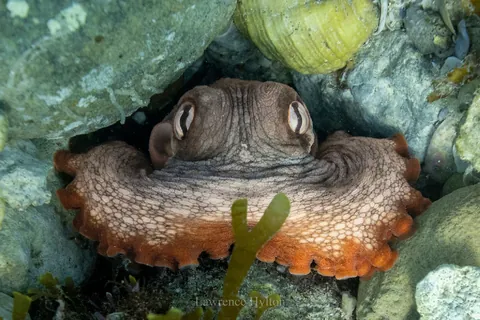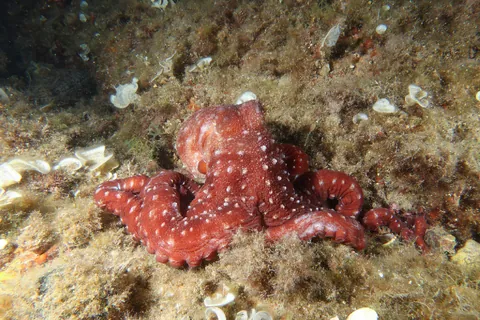
Atlantic White-spotted Octopus
Pinnoctopus macropus
Octopus cyanea
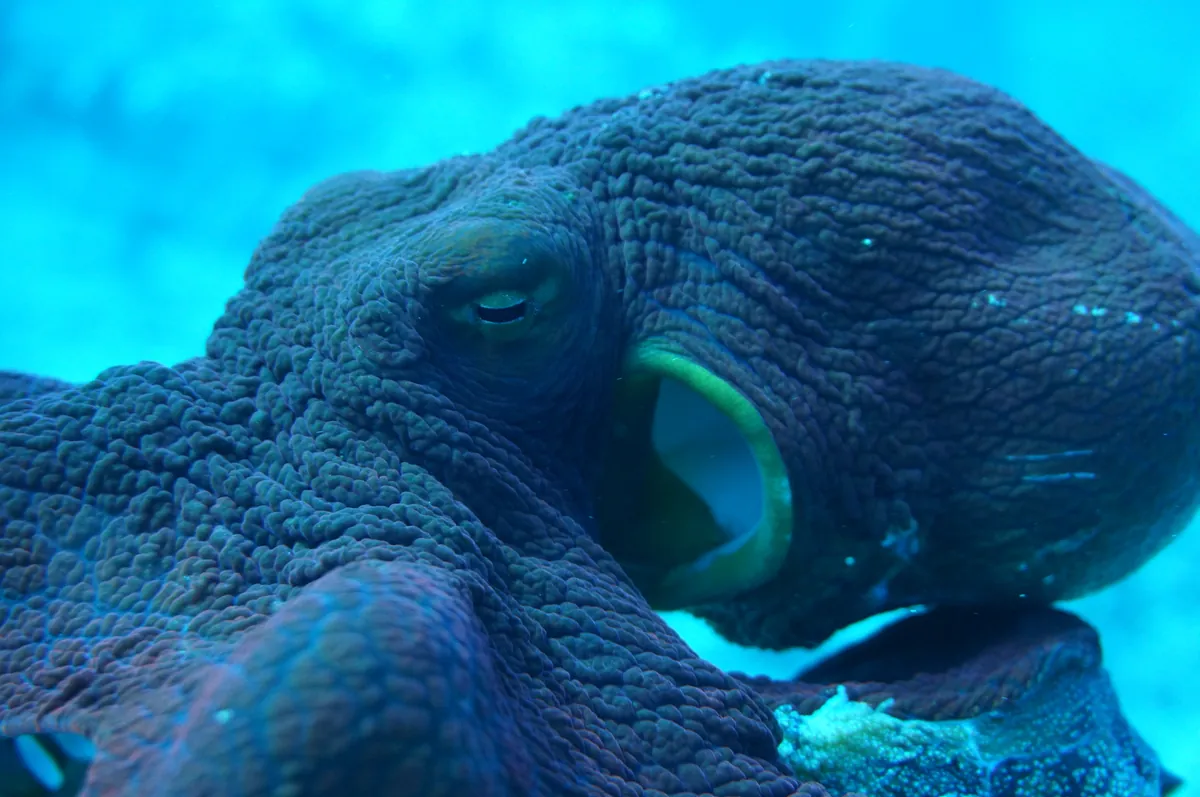
The big blue octopus is also called the day octopus, and that name tells you the important thing: unlike most octopuses, it is out and working in daylight, with its busiest spells around dawn and dusk. It is a reef animal that keeps a den and returns to it after each hunting trip. The recorded maximum is 22 cm in length and 6 kg in weight.
Also known as: big blue octopus, reef octopus, cyane's octopus, common reef octopus
Do not try to use colour or skin texture, because this animal changes both from second to second. Use the situation instead. An octopus out in the open on an Indo-Pacific reef in daylight, especially early or late in the dive, is very likely this species; most others hide until dark. The second clue is the den. Look for a hole with a scatter of empty shells and crab cases piled just outside it, a rubbish heap left by the animal inside.
It has the usual octopus build, a soft rounded body with eight long arms, but almost nothing about its look is fixed. It changes colour, skin pattern and even skin texture constantly, matching the ground it is crossing as it goes. The changes are instant, driven straight from the brain through colour cells in the skin, so the same animal can look like smooth sand one second and lumpy coral rock the next.
This octopus lives on reefs and in shallow water across the Indo-Pacific, from the Red Sea and the East African coast and Madagascar, through southeast Asia and the islands of the Pacific, as far as Hawaii. It is recorded down to 150 m. Each animal holds a den and defends it: a rock crevice, a space under an overhang, a gap between coral heads, or a hole it digs out of rubble or sand. Even young ones set up a home quickly and drive off others of their kind. A male and a female may hold dens side by side.
It hunts by touch, feeling into cracks as it moves over the reef. It also uses a spread-out approach, throwing the web of skin between its arms over a coral head, a rock or a clump of algae and then probing underneath with its arm tips to see what is trapped. Its food is mostly clams, sea snails and reef crabs, along with shrimps and small fish. Small catches are eaten on the spot; bigger ones are carried home. It bites crabs and injects them with toxic saliva, and it drills into shellfish to soften the animal inside before pulling it out. It sometimes hunts alongside reef fish, including groupers and goatfish, with the octopus flushing prey out of holes.
During joint hunts with reef fish, day octopuses have been seen to punch their fish partners with an arm. Researchers think some punches keep pushy fish from crowding in on the catch, but a few land well outside any hunt, which has led to the serious suggestion that the octopus does it out of spite.
Describe what you saw and we name it, then keep every species you find in your Oceandex.