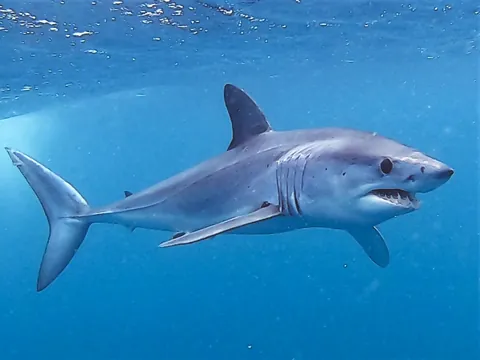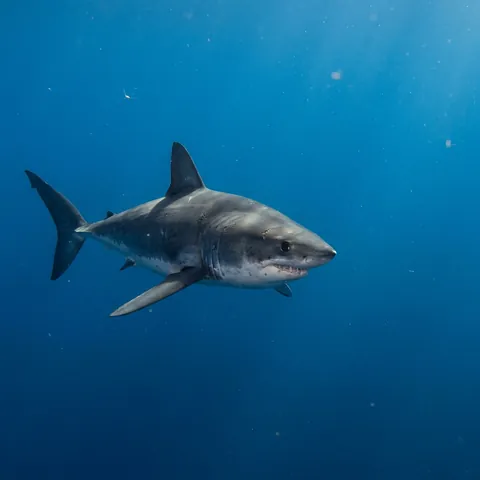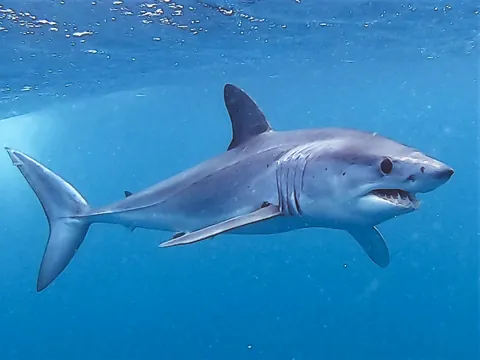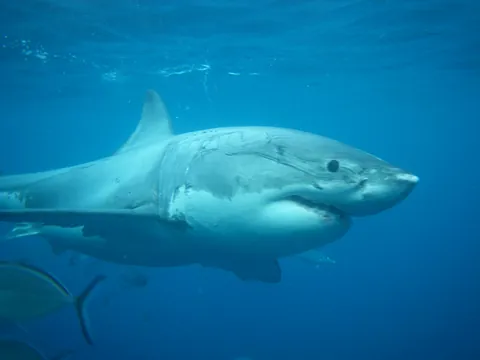
Great White Shark
Carcharodon carcharias
Cetorhinus maximus
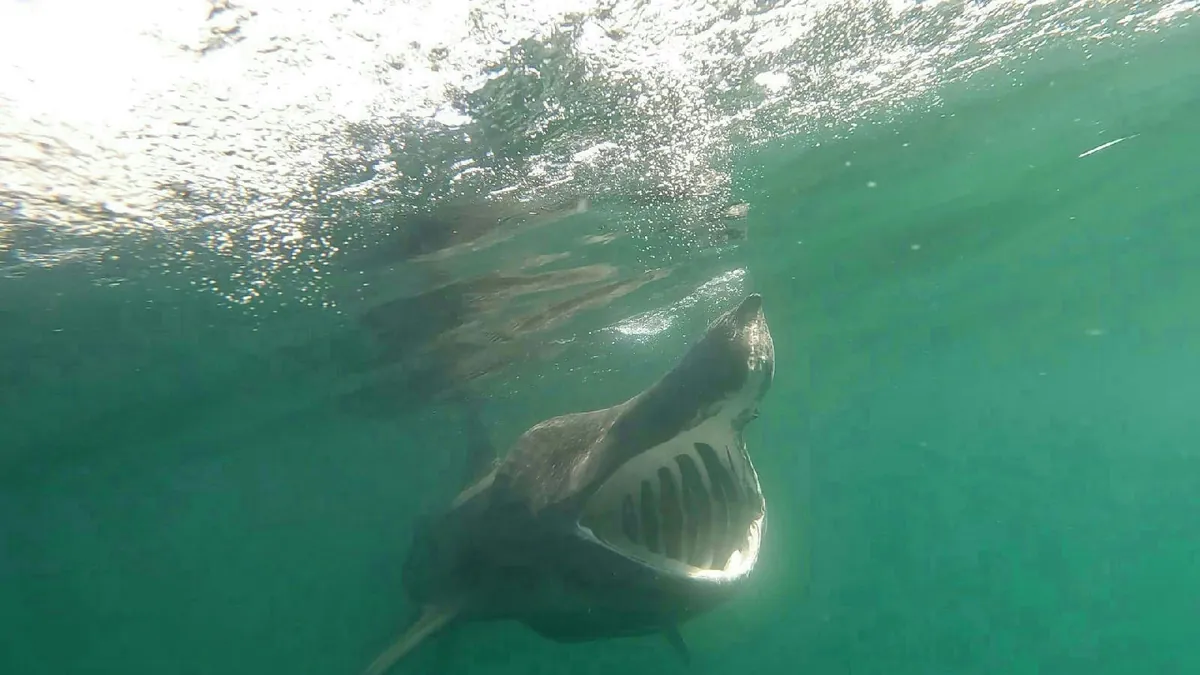
The basking shark is the second-largest fish in the ocean, yet it lives on some of the smallest food in the sea. It commonly reaches about 700 cm long, with the biggest individuals growing past 1500 cm.
Also known as: sunfish, bone shark, great basker, basking tresher, hoe-mother, elephant shark
Its body shape can be confused with a great white shark's. Look at the mouth: a feeding basking shark swims with its huge jaw held wide open, far wider than a great white ever opens its mouth.
The basking shark has the classic shark shape, and swims slowly near the surface with its huge mouth held wide open to feed. At a glance it can be mistaken for a great white shark.
Basking sharks live worldwide in cool to warm coastal waters, usually near the edge of the continental shelf. They are often seen close to shore, sometimes entering bays with narrow mouths, and can be found from the surface down to about 2000 m. In winter, they tend to move into deeper water.
This shark is a slow, unhurried swimmer that does not flee from boats the way a great white would. Despite its size, it can breach, leaping fully out of the water, possibly to shake off parasites. It travels long distances between seasons, following the richest patches of plankton. Basking sharks are usually alone, but they gather in groups during summer, sometimes swimming nose to tail in slow circles.
It feeds by swimming forward with its mouth open, straining zooplankton, tiny fish, and small invertebrates from the water with its gill rakers. It seeks out the densest patches of plankton rather than feeding at random.
Basking sharks give birth to live young that develop from eggs inside the mother, with no placenta. Before birth, the young may feed on the mother's unfertilised eggs. Only one of the female's two ovaries appears to work. Pregnancy is thought to last over a year, possibly two to three years, and litters are small. Mating happens in early summer and birth in late summer, in shallow water.
Basking sharks face pressure mainly from being caught by accident in trawl nets. Some populations have been hit hard: in New Zealand, sightings became rare after heavy bycatch in the 1990s and 2000s, leading the country to list the species as nationally vulnerable in 2018.
Its scientific name, Cetorhinus maximus, is built from Greek and Latin words meaning "greatest sea monster" or "greatest whale-shark" - a fitting name for the world's second-biggest fish.
Describe what you saw and we name it, then keep every species you find in your Oceandex.