Chinook Salmon
Oncorhynchus tshawytscha
Salmo salar
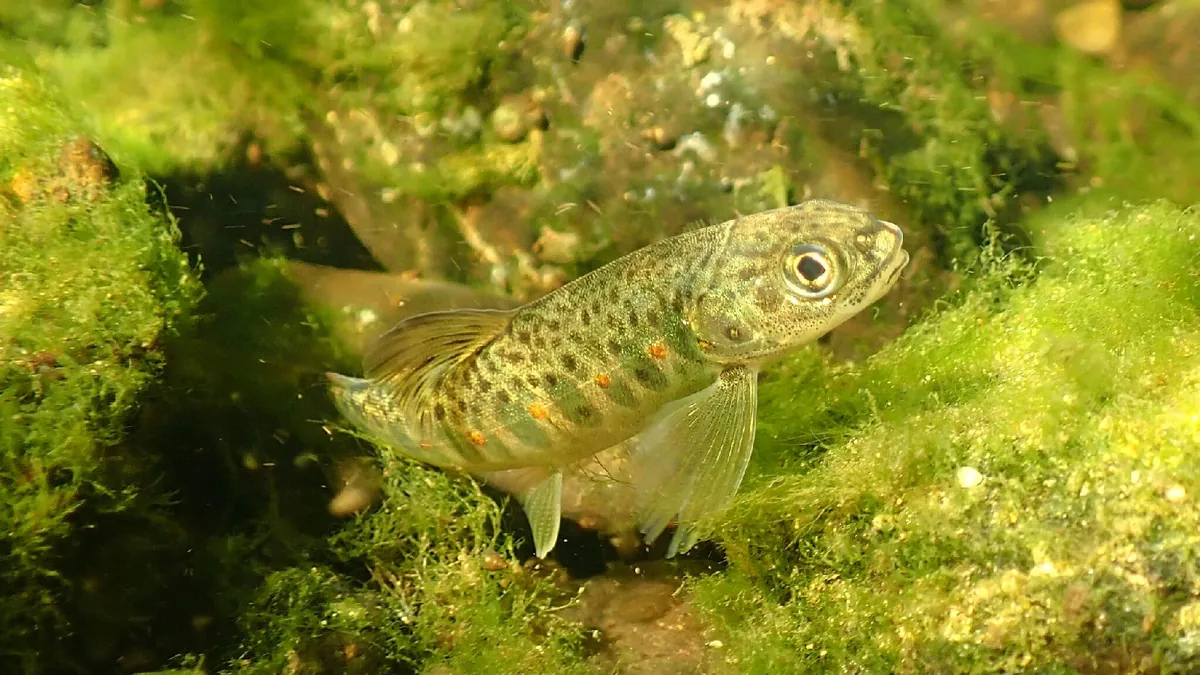
The Atlantic salmon is the fish that gave its name to a whole way of life: born in a river, grown at sea, and driven back upstream to spawn where it began.
Also known as: outside salmon, caplin-scull salmon, grilse, grilt, common atlantic salmon, kelt, ouananiche, ouinanish, salmon peel, sebago salmon, winnish, bay salmon, black salmon, breeder, fiddler, parr, sea salmon, slink, spring fish
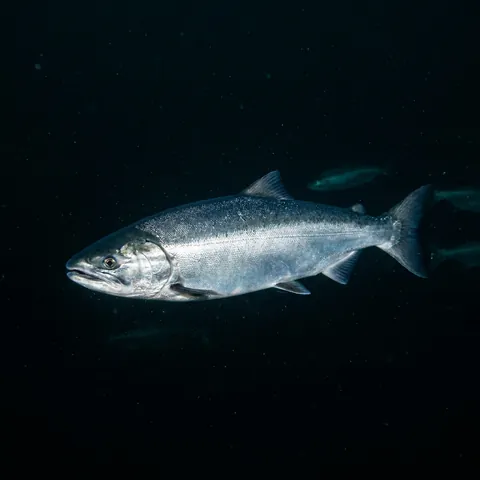
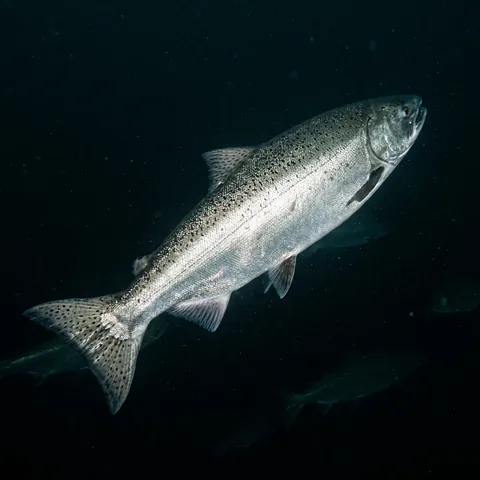
Other members of the salmon and trout family share this silvery look. On the Atlantic salmon, the black spots sit mostly above the lateral line, the faint sensory stripe running along the side, while the tail fin itself stays plain and unspotted.
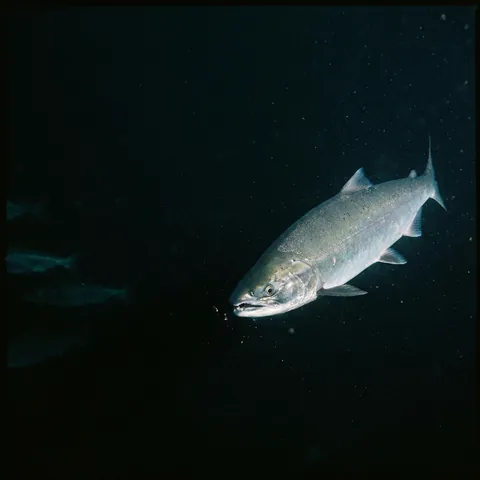
Young salmon living in fresh water are marked with blue and red spots, quite unlike the adults. As they mature, they turn a smooth silver-blue. The body is torpedo-shaped with well-developed teeth, and every fin except the small adipose fin near the tail is edged in black. Around spawning time, males develop a faint green or red tint.
This species is born in rivers of Europe and northeastern North America, where it spends its early life before heading out to the open ocean to feed and grow. It is a cold-water fish, sensitive to changes in water temperature, and returns to fresh water to breed.
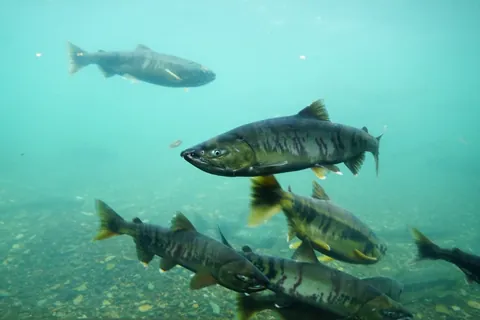
Young fish often gather into schools, especially as they leave the river mouth for the sea. Adult Atlantic salmon are notably more aggressive than other salmon and are more willing to attack other fish.
Juveniles start out hunting tiny invertebrates in the riverbed and current, including insects such as caddisflies, blackflies, mayflies and stoneflies, and will occasionally take small fish or even salmon eggs. Adults feed mainly on capelin, a small silvery fish, along with herring, smelt, sand lance and other small fish.
A female digs a nest, called a redd, into a gravel streambed by fanning water with her tail, then releases her eggs there alongside a male's milt before covering them over with gravel. Unlike Pacific salmon, which die after spawning once, the Atlantic salmon can survive the ordeal and return to the sea to repeat the journey, though most only manage this once or twice in a lifetime.
The Atlantic salmon is classed as Near Threatened. Numbers have fallen across much of its range due to overfishing and the loss or degradation of river habitat, and some regional populations are now considered even more at risk than the species as a whole.
Unlike Pacific salmon, which always die after spawning once, the Atlantic salmon can recover, swim back to sea, and return to spawn again in a later year.
Describe what you saw and we name it, then keep every species you find in your Oceandex.