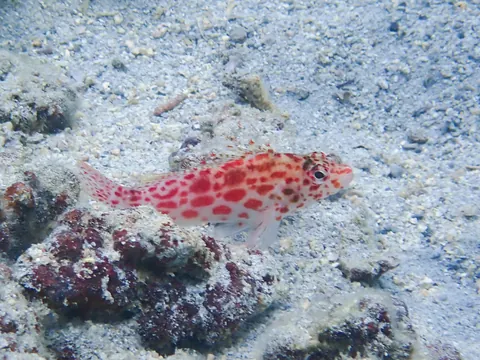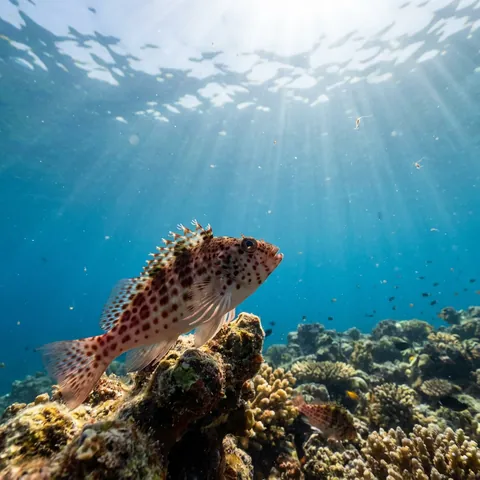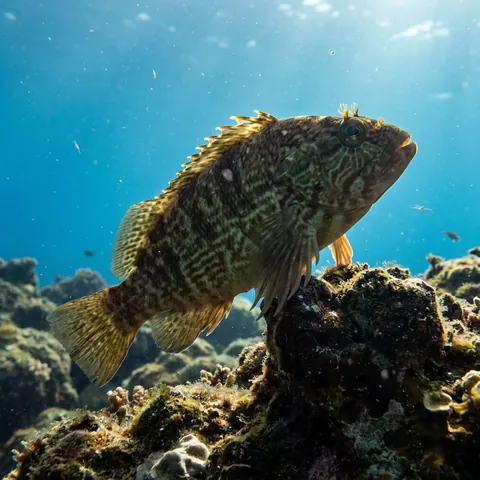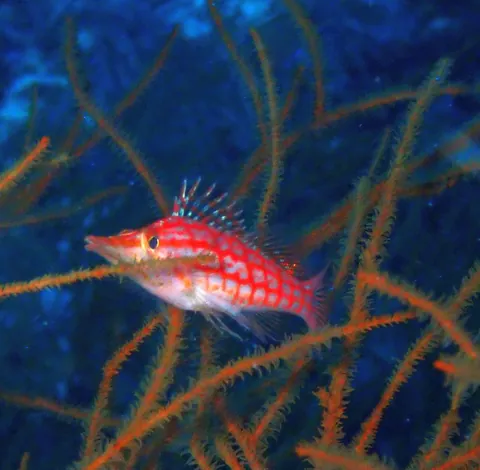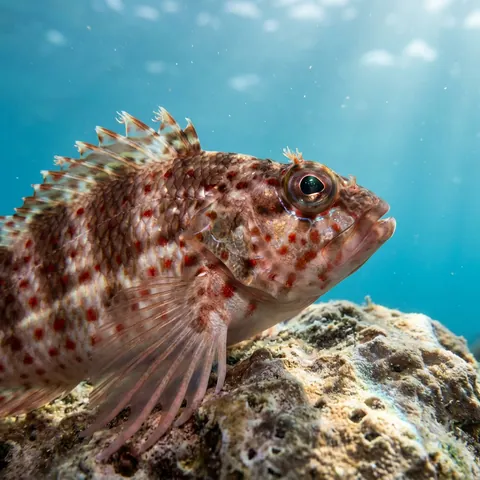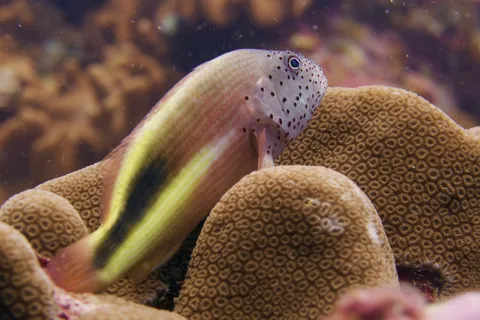
Blackside hawkfish
Paracirrhites forsteri
Paracirrhites arcatus
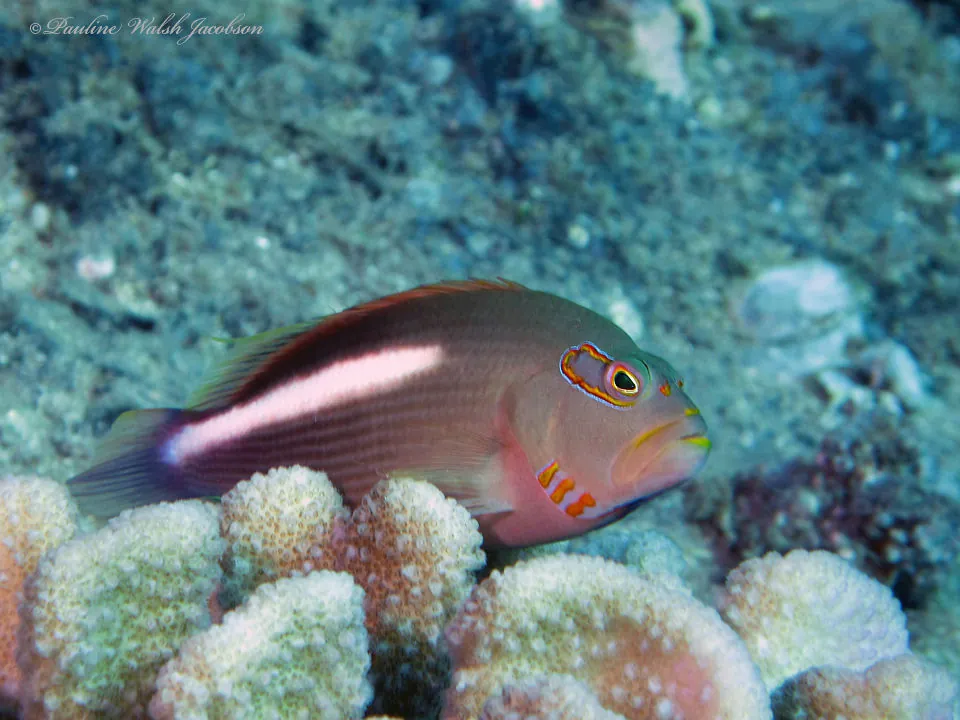
The arc-eye hawkfish is a small, deep-bodied reef fish of the tropical Indo-Pacific. Hawkfishes have no swim bladder and perch instead of swimming, and this one spends much of its time sitting on a coral head watching the water around it. It reaches about 20 cm and lives from 1 m down to 91 m, though divers usually meet it above 33 m. It is listed as Least Concern.
Also known as: horseshoe hawkfish, ring-eye hawkfish, whiteline hawkfish, arc-eye hawkfish, whitelined hawkfish, ring-eyed hawkfish, ring-eye hawkfish, horseshoe hawkfish, ringeyed hawkfish, arc-eyed hawkfish, arc eyed hawkfish, whiteline hawkfish, arc-eye hawkfish, arc eye, striped hand-fish, ringeye hawkfish, arc-eye hawkfish, ringeyed hawkfish, ringeye hawkfish, ring-eyed hawkfish, arc-eyed hawkfish
Ignore the body colour, which changes from fish to fish. Look at the eye: a horseshoe or arc of thin orange and black lines curves around and behind it, and this mark is always there. Below it, three short orange dashes lie along the lower edge of the gill cover in a light blue patch. A small fish perched still on a branching coral head, propped on its lower fins, is the giveaway posture.
The body is fairly deep and the tail is nearly straight-edged. The background colour varies a lot, but pale pinkish brown or brown is usual. Behind the eye is a horseshoe-shaped mark made of three fine lines in orange and black. The gill cover carries three short orange dashes set in a pale blue patch. A broad white to pink stripe often runs along the upper side of the body, from about halfway back to the tail. Each spine of the dorsal fin ends in a small branched tuft of skin, called a cirrus.
This hawkfish is found across the tropical Indo-Pacific, from the East African coast to the far islands of the central Pacific, north to Japan and south to Australia. It lives on lagoon and seaward reefs, from the shallows down to at least 33 m. It sits on the heads of small branching corals such as Pocillopora, Stylophora and Acropora.
Look for a fish doing nothing. It perches motionless among the coral branches, alone, and waits. From there it takes shrimps, crabs, other crustaceans and small fish. Colour depends on where it lives: dark fish sit on dark basalt ground and pale fish sit on coral, and the two kinds often live only a few metres apart. To spawn, a pair rises together off the reef and releases eggs and sperm into open water.
The same reef holds two colour forms of this fish at once, dark ones on black basalt rock and pale ones on coral, sometimes only a few metres apart.
Describe what you saw and we name it, then keep every species you find in your Oceandex.