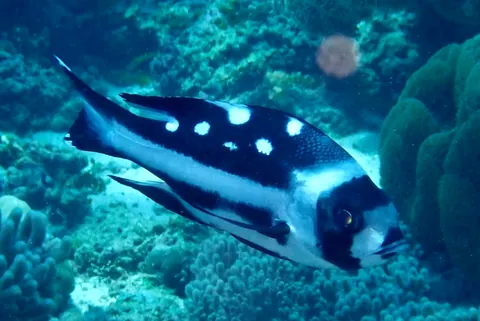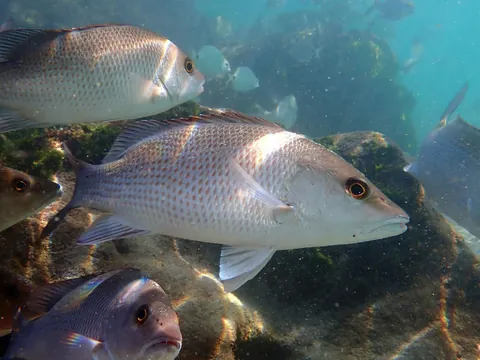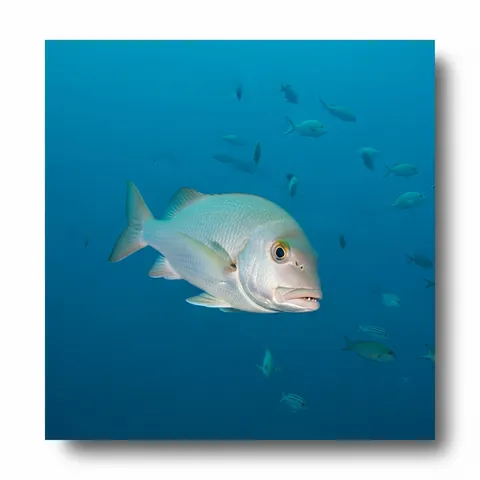
African forktail snapper
Apsilus fuscus
Ocyurus chrysurus
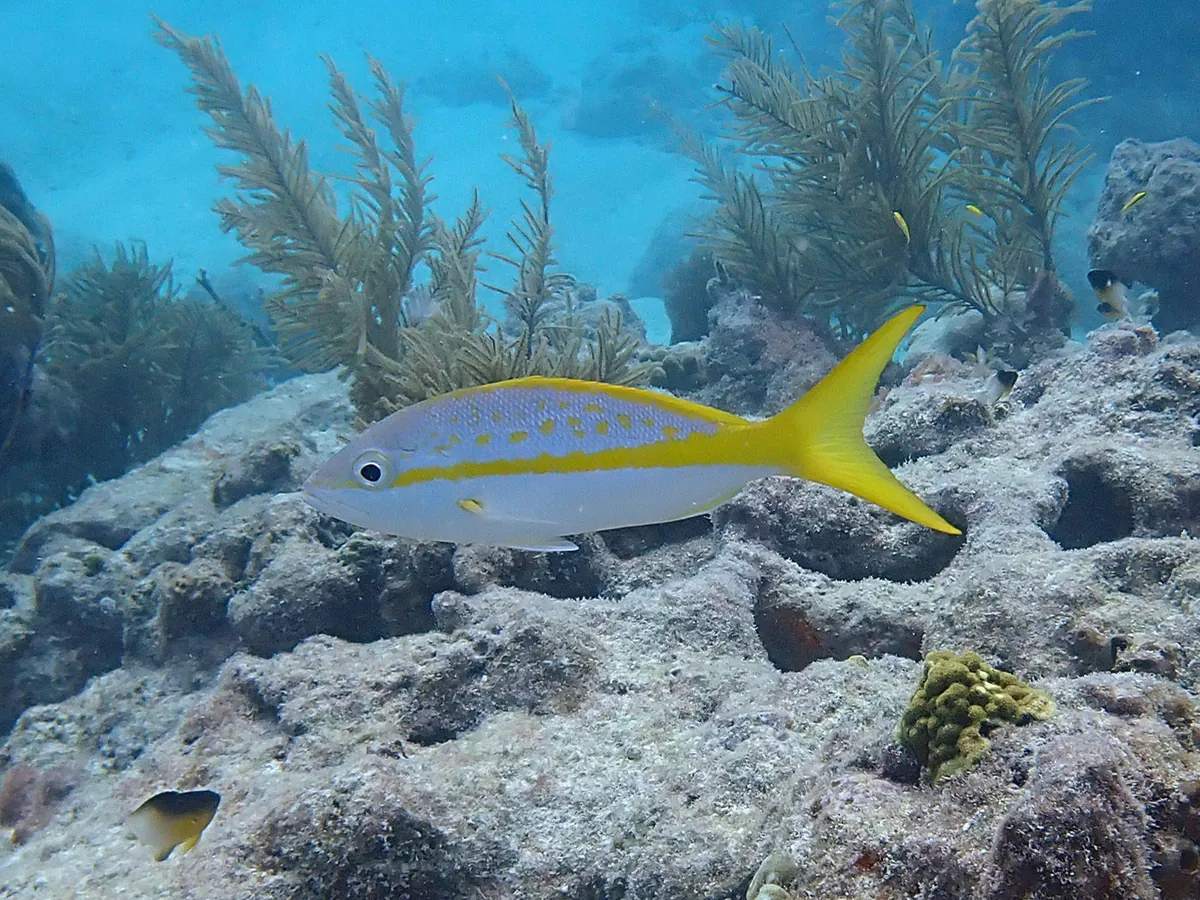
The yellowtail snapper is a slim, fast-swimming reef fish of the western Atlantic, usually around 40 cm long but reaching up to 86 cm and over 4 kg. It is easy to spot by the bright yellow stripe running the length of its body.
Also known as: cola, yellowtail
Many Caribbean snappers have a dark spot on the side below the dorsal fin; this species has none, so its solid yellow stripe and tail stand out with no dark mark to confuse it with.
A yellow stripe starts at the snout and widens along the side until it reaches a completely yellow, forked tail. The rest of the body is olive to bluish-black, scattered with yellow spots above the stripe. The dorsal fin is yellow, while the anal and pelvic fins are whitish. The head and mouth are small for a snapper, and the lower jaw juts out slightly past the upper one.
This species ranges from Massachusetts to southeastern Brazil but is most common in the Bahamas, south Florida, and across the Caribbean. Adults live in coastal waters around coral reefs and are usually seen well above the bottom, often in groups, while young fish tend to gather over beds of weed.
The yellowtail snapper is listed as Data Deficient. Its stock is not overfished in the United States, but populations in Cuba and Brazil are overfished, and the species is considered highly vulnerable to overfishing in Mexico, where management of the fishery is very limited.
This snapper has teeth on the roof of its mouth, on a bone called the ectopterygoid, an unusual feature not typical of other snapper species.
Describe what you saw and we name it, then keep every species you find in your Oceandex.