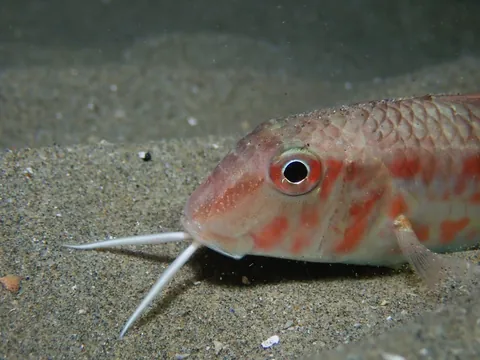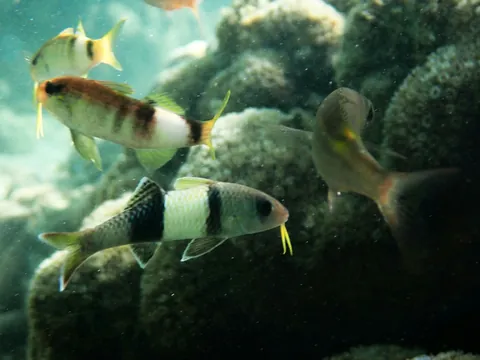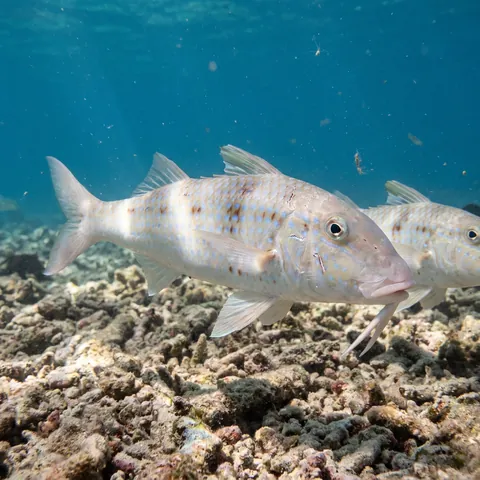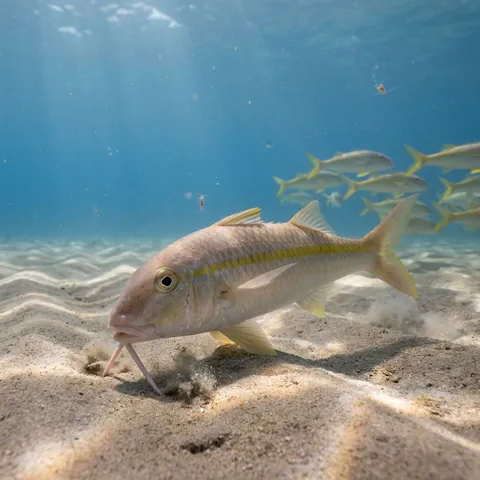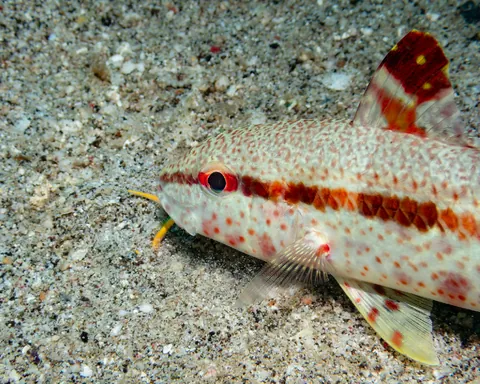
Freckled goatfish
Upeneus tragula
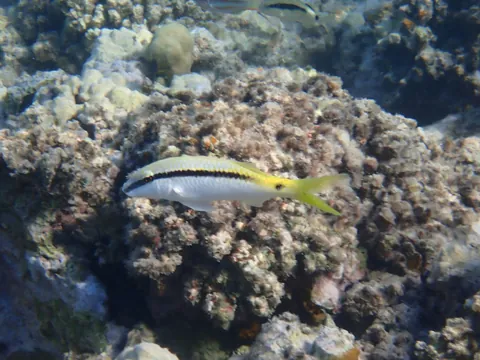
Mulloidichthys flavolineatus
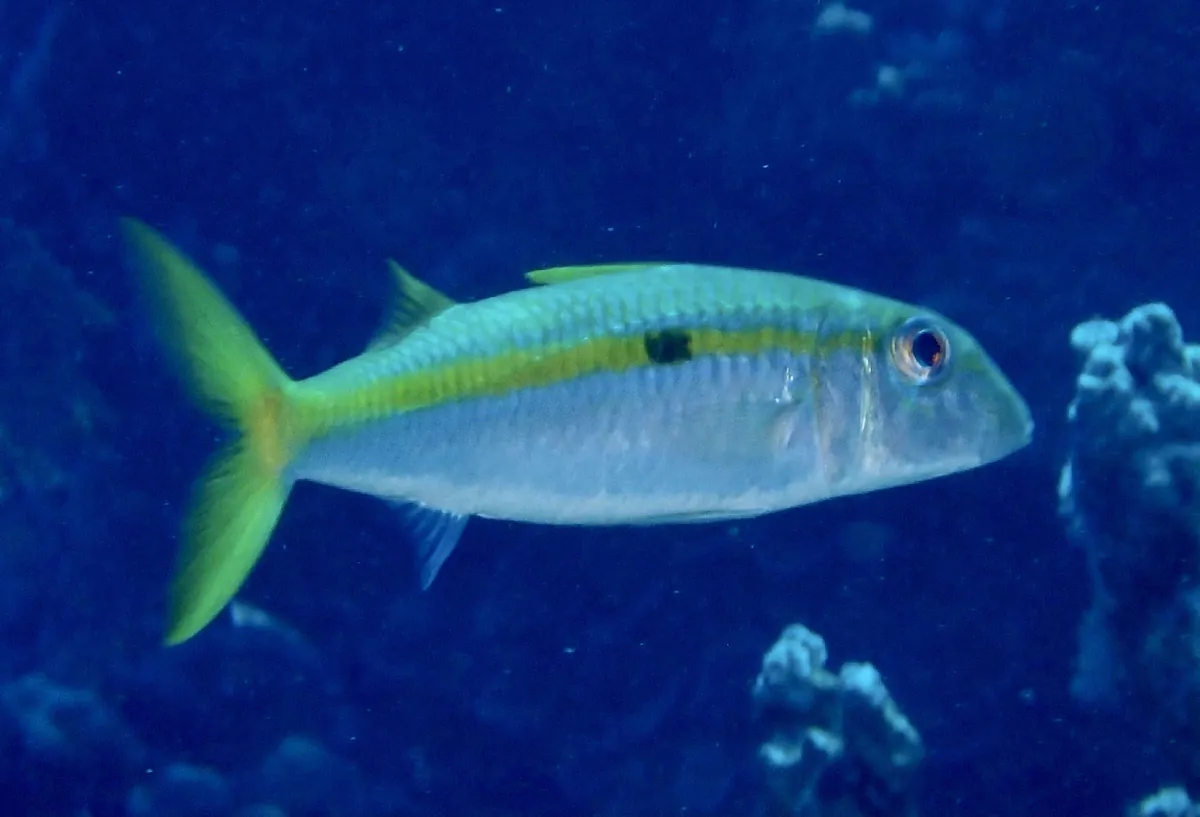
The yellowstripe goatfish is a pale, slim fish of sandy ground. Like all goatfish it has a pair of barbels, fleshy feelers under the chin, and it uses them to probe the sand for food. It eats crustaceans, shellfish, worms, heart urchins and foraminiferans, single-celled animals that live in the sand. Divers usually meet it in schools, often large ones, resting or feeding over open sand. Big adults are more often alone on a sand slope, and other fish tag along behind them to snap up the small animals the goatfish stirs up. It grows to 43 cm, with about 25 cm more usual. In Hawaii it is called weke ʻaʻā, and it spawns there all year with a busier spell from February to June. The IUCN lists it as Least Concern.
Also known as: squarespot goatfish, square-spot goatfish, yellow-lined goatfish, pallid goatfish
Look for a whitish fish over sand with one yellow stripe running from the eye to the tail, and then check for a dark smudge on the side of the body under the front dorsal fin. That blotch sits on the yellow stripe area and is easy to see at viewing distance; it is the mark that separates this fish from other pale, yellow-striped goatfish. Two whisker-like barbels under the chin, either folded back or sweeping the sand, confirm it is a goatfish.
The back is grey to olive and the sides and belly are whitish. One or two yellow bands run the length of the body; the main one goes from the eye straight back to the tail, and there is more yellow striping on the cheek and along the belly. The fins range from red-orange to pure yellow. On the side, below the first dorsal fin, sits a dark blotch. At night the fish can change colour to match its surroundings, which hides it from hunters.
This goatfish lives in the Indian and Pacific Oceans. It is a fish of soft ground rather than hard coral: shallow sandy areas in lagoons, sand near seaward reefs, and sandy bottoms and shore reefs close to land. It is recorded from 1 to 76 m, but most sightings are in the shallow part of that band.
By day it is a plain, obvious school fish, but at night it can change colour to blend into the bottom around it, which makes it much harder for hunters, and for divers, to pick out.
Describe what you saw and we name it, then keep every species you find in your Oceandex.